The same answer reads differently to different people
Two people can get the same AI answer. One finds where to use it right away; the other copies it as is without noticing what is wrong. This gap is usually explained as prompting skill. A prompt is the question or instruction you give to AI.
But AI now helps quite a lot with polishing questions. What it cannot do for you is read the answer that comes back: whether it fits your situation, whether a wrong fact is hiding between plausible sentences, whether something is missing. I call this literacy in the AI era. Literacy is the ability to read text and understand its meaning correctly.
In the previous post on locus of control, I read the gap in outcomes among people given the same AI as a question of who decides. This post looks one step earlier: what you know. To decide, you first have to be able to read.
The 1988 baseball study — knowledge beat reading skill
American education researchers Donna Recht and Lauren Leslie published an experiment on reading comprehension and prior knowledge in the Journal of Educational Psychology in 1988. It is often called the baseball study.
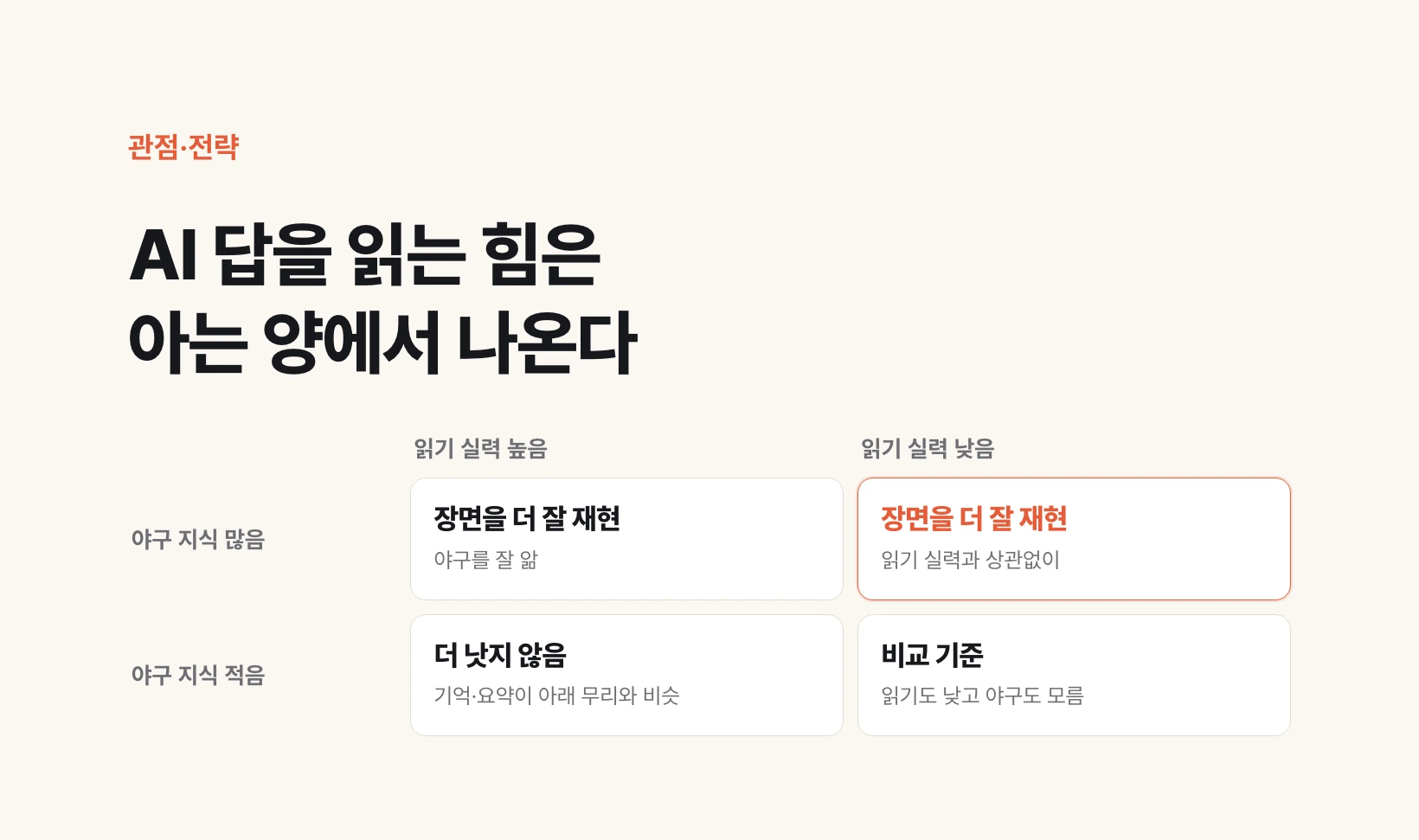
The participants were 64 students in the equivalent of seventh and eighth grade. The researchers divided them into four groups by reading ability (high or low) and baseball knowledge (high or low), and had them read a half-page passage describing one inning of a baseball game. The students then reenacted the described action on a model baseball field, and their recall and summaries were checked.
The results leaned toward baseball knowledge rather than reading ability. Students who knew baseball well reenacted the scene better regardless of reading ability. The researchers wrote that students with high reading ability but low baseball knowledge were no more capable of recall or summarization than students low in both.
One study cannot settle everything. It was a small experiment with 16 students per group, and reading researchers such as Timothy Shanahan point out that it does not prove as much as it is often cited for. Still, the direction is clear: the same text reads easily to someone who knows the field and hard to someone who does not.
From Hakryeokgosa to Suneung — why Korea changed
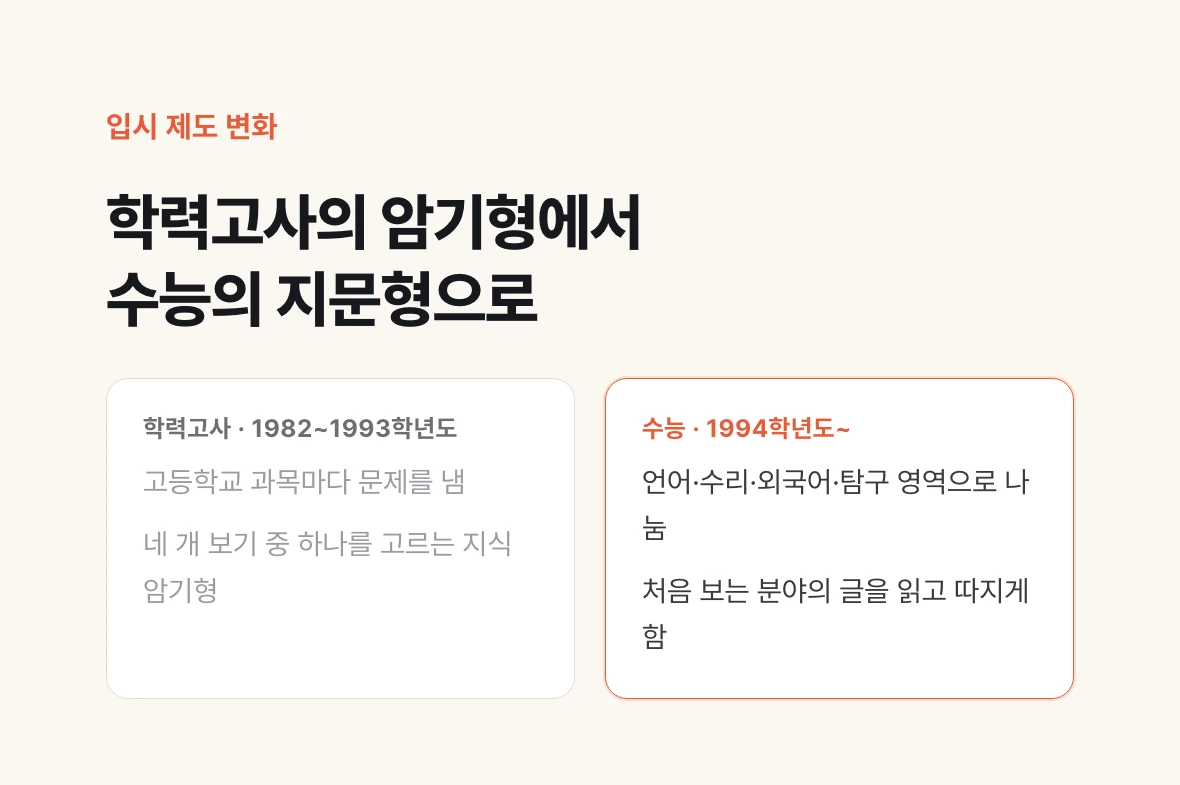
From the 1982 to the 1993 school year, Korean college admissions used the Hakryeokgosa, a national academic achievement test. It set questions for each high school subject and was criticized for having too many four-option multiple-choice questions that tested memorized facts. Students suffered from the pressure to excel in every subject and the side effect of memorizing whole textbooks.
So from the 1994 school year it was replaced by the College Scholastic Ability Test, the Suneung. The aim was to measure integrated thinking across subjects through areas such as language, mathematics, foreign language, and inquiry, rather than subject-by-subject knowledge. The long reading passages in Suneung Korean show this aim well: they give students texts from unfamiliar fields such as science, economics, or law, and ask them to read and reason about the information inside.
At the time, it was the right direction. The ability to think through unfamiliar problems was seen as more necessary for university study than the ability to retrieve memorized facts.
Seen again in the AI era — judging comes from knowledge
From here on, this is my view. Now that AI writes answers for us, AI does much of the "thinking within a given passage." It summarizes long documents and explains texts from unfamiliar fields faster than people do.
What is left for people is judging whether that answer is right, and that cannot be solved inside the passage. The AI answer is the passage, and whether it is wrong can only be known from knowledge outside it. Just as students who did not know baseball struggled to read a baseball passage, people who do not know their own field cannot properly read an AI answer about it.
So I wonder whether Hakryeokgosa-style study, which made students know a lot, actually fits the AI era better than the Suneung, which trained the ability to solve unfamiliar passages. At least from the view that you need to know a lot to use AI well, what the Hakryeokgosa built regains its value.
Memorization alone is not enough — knowledge must be connected
That does not mean we should go back to the Hakryeokgosa era. The criticism it received, that it was study for memorizing isolated facts and picking from options, still holds. A list of unconnected facts does little to help you read an AI answer.
What helped the students in the baseball study was not isolated facts either. It was knowing what happens next with runners on certain bases and a certain number of outs, how a game flows. Because the facts were connected into one picture, they could place a new passage on that picture and understand it.
So the Hakryeokgosa-style study I mean is closer to "know a lot, and know it connected." But I think the order is clear. You need material before you can connect it. If you skip building knowledge in the name of training thinking, you have no grounds for judgment in front of a plausible AI answer.
One thing to try today — ask about three unknown words first
The closest place to grow what you know is the AI answers you get every day. When you get one, before using it, pick three words in it whose meaning you do not know precisely. Then ask about those words first.
Asking for an explanation in terms of your own work, rather than a dictionary definition, makes it stick longer. You can ask like this.
After getting the explanation, rewrite each word in one sentence of your own. As the unknown words shrink, the same answer reads differently, and you start to see what looks off. If your team uses AI together, collect these words into a team glossary. That becomes a Hakryeokgosa textbook tailored to your work.
I don't precisely understand these three words from your last answer.
Please explain each in one sentence, using our team's work (e.g., managing supplier orders) as the example.

1. ____
2. ____
3. ____