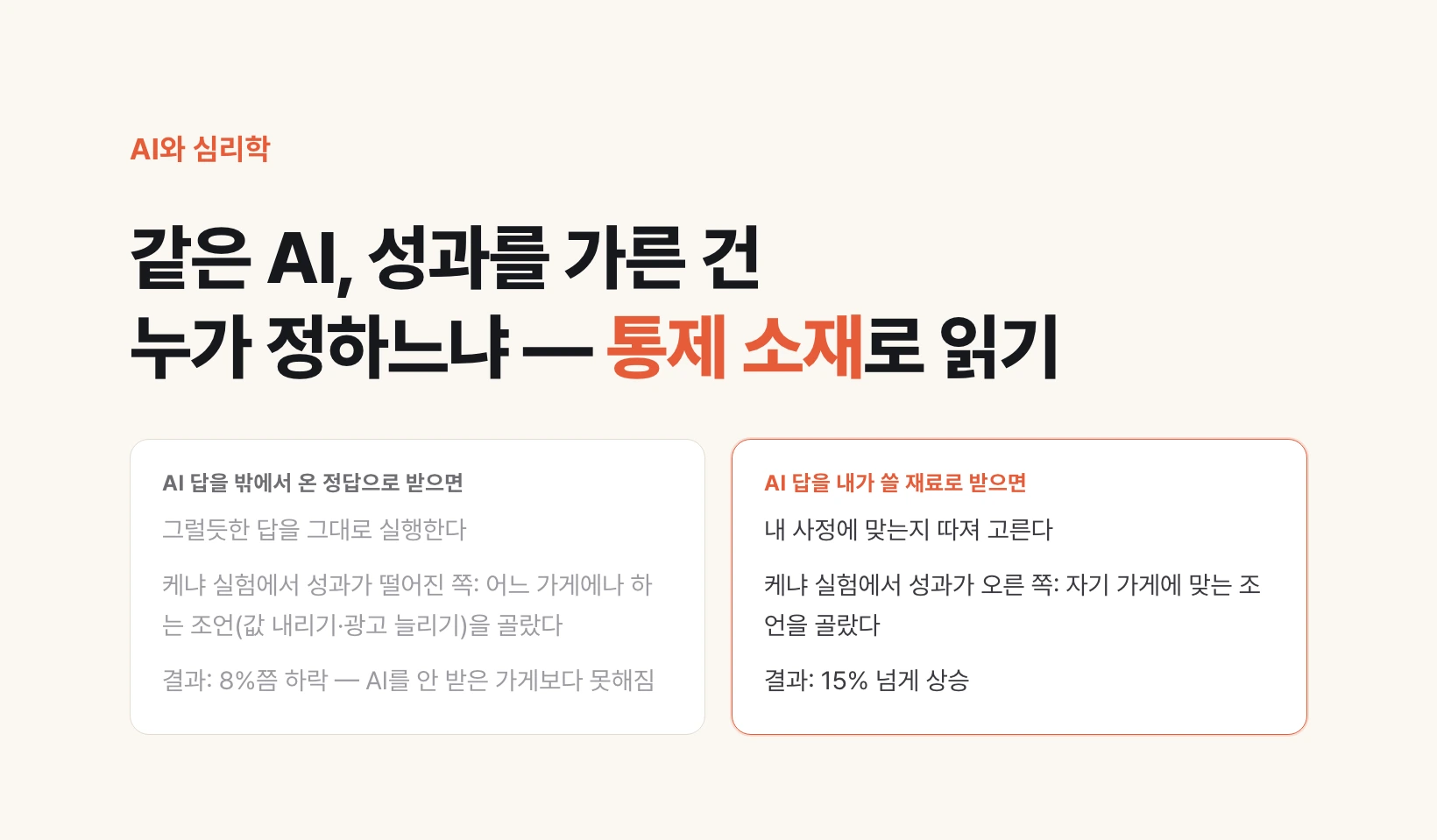
Same AI, split results
A video from the Korean YouTube channel Baekmansumugang gathers what AI builders have said to answer one question. After coding came using AI, then delegating work to several AIs at once. What is left for people above that? The video's answer: deciding what to do and why.
A 2023 experiment in Kenya puts that answer in numbers. Researchers gave half of 640 owners of small businesses such as restaurants, clothing shops, and poultry farms a GPT-4 business advisor they could message anytime on their phones. On average, revenue and profit did not change.
Split by prior performance, the picture changed. Owners who had been doing well gained just over 15%; those who had been struggling did about 8% worse, falling behind businesses that never got the AI. The researchers concluded the gap came not from the questions asked or the advice received, but from which advice owners chose to act on.
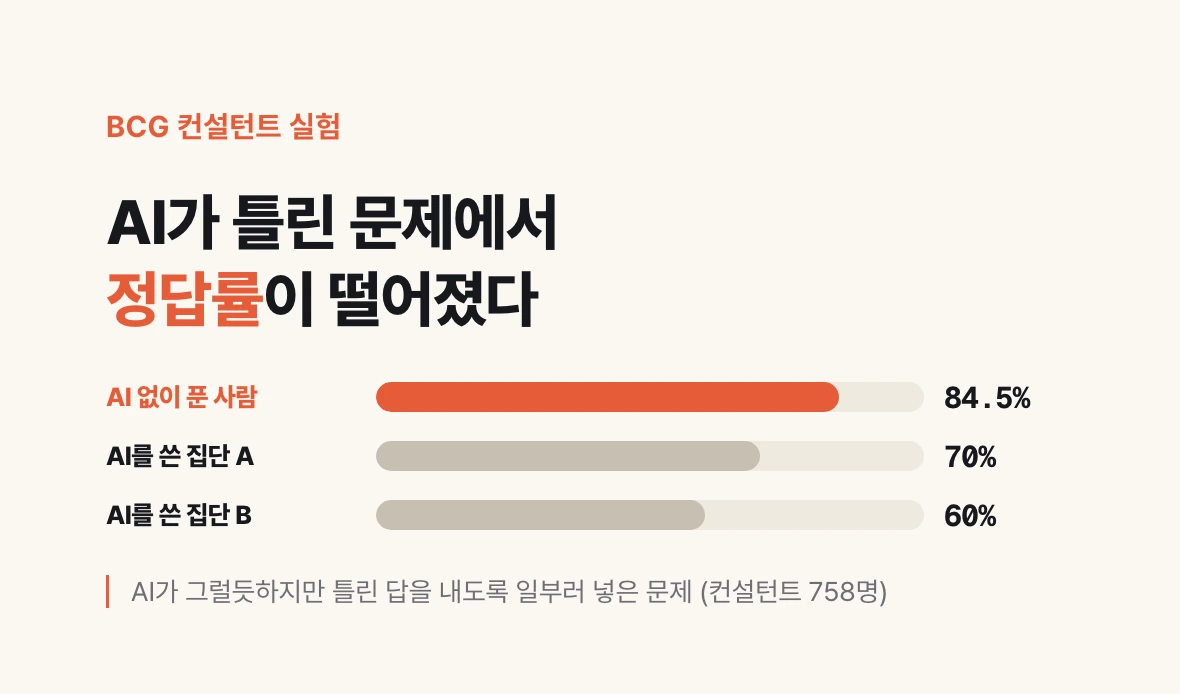
In the same year, 758 Boston Consulting Group (BCG) consultants took part in another experiment. The researchers deliberately included a task where AI gives a plausible but wrong answer. 84.5% of those without AI got it right; the two AI groups scored 60% and 70%. On tasks AI handles well, by contrast, the AI users' work was more than 40% higher in quality. The same company and the same AI lifted people on some problems and dragged them down on others.
Who turned saved time into results
In June this year the Bank of Korea analyzed workers who use generative AI and reported zero correlation between hours saved with AI and growth in work output. Zero correlation means people who saved more time showed no tendency to get more done.
The exceptions were the self-employed, professionals, and heavy AI users. The Bank of Korea described them as groups with strong performance incentives and high job autonomy: people who can decide for themselves what to do with the two hours they saved.
Put the three results side by side and a common thread appears. Everyone had the same AI. What differed was who decided what to keep and what to discard from the AI's output, and what to do with the time left over.
The name Rotter gave it in 1966: locus of control
I read this thread through an old concept from psychology: locus of control.
In 1966 the American psychologist Julian Rotter published 'Generalized expectancies for internal versus external control of reinforcement' in Psychological Monographs. Reinforcement here means the reward or outcome that follows a behavior. Rotter asked where people expect those outcomes to come from.
Expecting outcomes to depend on your own behavior and ability is called internal control; expecting them to depend on luck, other people, or circumstances is external control. Rotter measured this expectation with a questionnaire that asks people to pick whichever of two statements is closer to what they believe.
Locus of control is less a fixed type than a position along a range. Everyone leans internal on some things and external on others.
Helplessness turned out to be the default, not something learned
In 1967, the year after Rotter's paper, Martin Seligman and Steven Maier reported that animals exposed to inescapable shocks later failed to escape even when they could. They called it learned helplessness. The explanation at the time was that the animals had learned nothing they did would change the outcome.
Fifty years later, in a 2016 paper in Psychological Review, the two concluded that the explanation had it backward. Passivity in the face of prolonged bad events is not learned; it is the default. What is learned is the detection that control is possible. They traced the brain pathway through neuroscience research.
A conclusion from animal experiments cannot be carried straight into the workplace. Still, the direction is clear: a sense of control does not appear on its own. It is learned through experiences where control actually worked.
AI's smooth answers pull decisions outward
From here on this is my interpretation. The three studies did not measure locus of control. But their results hint at which way people lean in front of AI.
AI answers always arrive smooth and confident. Some people take them as material to use; others take them as the correct answer handed down from outside. The first group checks whether an answer fits their situation and chooses; the second carries out the plausible answer as is. In Kenya, the owners whose results fell picked generic advice any shop could get, such as cutting prices or spending more on ads. In the BCG study, those who got it wrong trusted the AI on a problem they would have solved alone.
Automation bias, covered in my earlier piece on the ironies of automation, sits in the same place. With a plausible answer nearby, people lower their own checking. In the language of locus of control, they hand the seat that decides outcomes to the machine.
Mindset alone is not enough: authority to decide has to come with it
That is why I think the core of education in the AI era is not tool skills but the mindset that 'I decide what to do, which of several answers to use, and what not to trust.' These are exactly the three decisions the video names as what remains for people.
But the Bank of Korea result also warns from the other side. If AI turns a three-hour report into one hour, yet approval still comes tomorrow and the next task must be assigned from above, the two saved hours become waiting time. That is not a mindset problem; it is a structure in which people have no real authority to decide.
This connects to the 2016 conclusion that a sense of control is learned from control that actually worked. Demanding 'ownership' without granting authority is not education; it is shifting blame. Team leads and executives driving AI transformation have two jobs: let people practice deciding, and give them a place where their decisions actually take effect.
How far education can shift locus of control is still an open question. But the Kenya experiment has already shown that as AI takes over the lower rungs of work, the same AI can erode results for people who lack the sense of pulling outcomes toward themselves.
A prompt habit to change tomorrow

Before asking AI anything, write one line first: 'What am I trying to decide with this answer?' If there is nothing to decide, the AI's answer becomes your decision by default.
Ask for several answers, not one. 'Give me three options and the situations where each would not fit' leaves the choosing with you.
Put your own circumstances in as conditions. In Kenya, the owners who gained chose advice that fit their own shop rather than advice for any shop. Writing your industry, budget, and constraints into the prompt cuts generic answers and gives you a yardstick for judging fit.
Mark in advance where you will not trust the answer. Decide that numbers, dates, quotations, and legal clauses, where errors are costly, are things you will check yourself, and then read.
In short: the ways of using AI keep changing, but who holds the seat that decides outcomes does not.