
Eleven episodes get sorted here
The last eleven pieces told different kinds of story. There was lineage traceable through citations: Pavlov to reinforcement learning, cat visual cortex to CNNs, Hebb to PDP, Baddeley to external memory.
There were cases where a psychology experimental design became a ruler for measuring AI. Anchoring was that. And cases where psychology and human factors knowledge governed not an AI technique but how AI is used: anthropomorphism, the ironies of automation, the fourfold taxonomy of use.
And there were analogies that aid understanding: Asch's conformity and sycophancy, Bartlett's memory and hallucination.
This episode is why each one carried a badge. When you see a psychology term in an AI article, ask whether it is lineage or just a name. Three cases lay out how to tell, and the series closes by grading everything it covered.
Attention: only the name is shared
The core mechanism of the language models we use is attention. And it is unlike any lineage this series covered.
It came out of machine translation in 2014. The recurrent networks then dominant read a sentence one token at a time, updating a state, and the beginning faded as sentences got longer. A whole long sentence had to be squeezed into a single fixed length vector.
The fix was to let the decoder look back at any position in the input each time it produced an output word, computing anew which parts of the input are relevant for this word. The paper that first introduced the mechanism posed it as an alignment problem: the old question in translation of which source word corresponds to which target word.
So the starting point was an engineering bottleneck, not a cognitive theory. It was not designed by citing Broadbent's filter model or the cocktail party effect. The name attention was attached because it was convenient for describing what the computation does, and it hardened into standard usage afterward.
How it differs from human attention
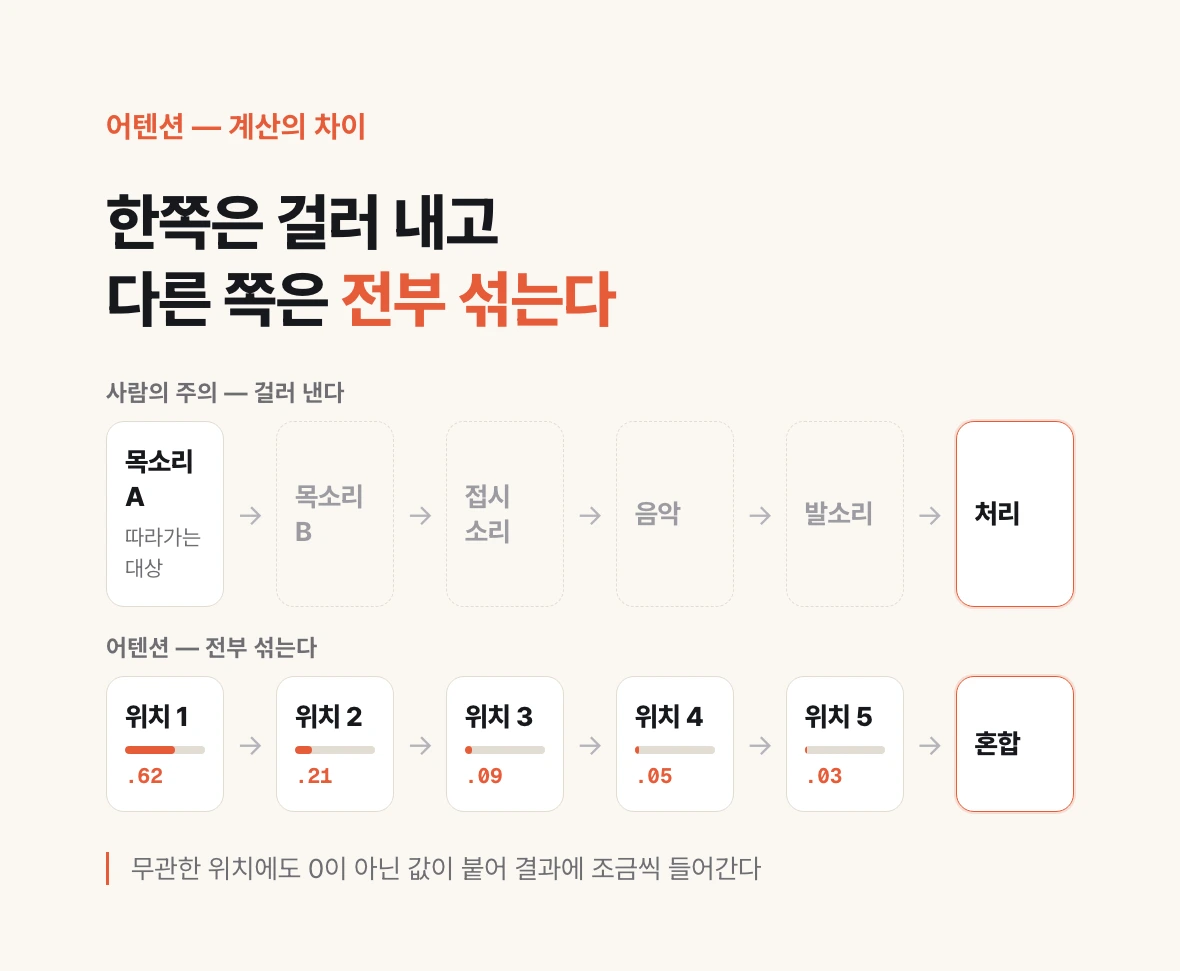
The shared name suggests a shared computation, but the work being done is different. The difference fits in one sentence. Human attention filters out; transformer attention weights.
The core of selective attention theory is discarding. Following one voice in a noisy party, the other sounds largely drop out of processing. Capacity is limited, so you must choose, and what is not chosen mostly does not come in.
Attention is the opposite. It assigns a weight to every position and then blends all of them in those proportions. Irrelevant positions get nonzero values too, and those values enter the result in small amounts. It is not a filter but a mixing ratio.
That difference is not trivial. Most of the properties we know about human attention follow from the capacity limit. Focus on two things at once and both suffer, sustain attention long and it tires, train and selection for particular targets gets faster. Carry those properties over to attention and every one of them is wrong.
So saying AI pays attention is a metaphor, not an implementation of a psychological phenomenon. The name was well chosen, which is why the misunderstanding lasts.
The context window has nothing to do with seven plus or minus two

You often see Miller's magical number seven cited alongside the phrase AI's memory capacity. That citation is wrong twice over.
First, what sets the length of a context window is computational cost. Because attention looks at every pair of positions, computation grows with the square of the length. Double the length and the computation is four times as much. Techniques for reducing that cost keep appearing and windows have widened, but the axis that sets the number is still compute and memory, not cognitive theory.
Second, the two concepts measure different things to begin with. The limit of working memory, as episode four showed, is a matter of maintenance cost. Holding on takes continuous effort, and spending that effort elsewhere means dropping it. A context window is not like that. What is in the window is not dropped; it is simply used less depending on position.
Practically the two stories do meet at one point. As episode four showed, a wide window does not mean a well used one, so the craft of clearing the bench is needed. But that is not because the capacity is seven.
Miller himself disowned the number
The original paper is the more interesting part. The magical number seven was never argued the way it is cited.
In the closing passage of the 1956 paper, Miller writes that perhaps there is something deep and profound behind all these sevens, but he suspects it is only a pernicious Pythagorean coincidence. It follows a list of the seven wonders of the world, the seven seas and the seven deadly sins. The author was telling readers directly not to mystify the number.
In 1989 he said it more plainly. The paper covered two separate lines of research, and the number seven was a rhetorical device for tying them together into one talk. Not a discovered constant but a seam in the narrative.
The explanation often appended, that this is why phone numbers have seven digits, also has no basis. The periods overlap; there is no record supporting causation.
The lesson this series has kept repeating returns here. The more famous the number, the more you should check the original. Widely cited does not mean widely read.
Hallucination is not an accurate word either
Episode six dealt with hallucination, and the name itself is material for this episode.
In clinical use, hallucination is a matter of perception: seeing or hearing something that is not there. But a model producing a paper that does not exist is not a perceptual matter; it is a matter of memory and assertion. As episode six showed, the more accurate match is confabulation: filling a gap without awareness and holding it as fact.
The route by which the name arrived was also not direct import from psychology. The word was already in use inside AI with a different sense. There was a name for producing plausible detail that does not exist in a low resolution image, and that usage carried over to language. So it was not a psychological concept borrowed, but a term of art inside the field being extended.
That is why researchers themselves note the term is not apt. One reason is the accuracy point just made; the other is that the word evokes pathology. Calling it hallucination makes it sound like something normally fine that occasionally goes strange, when in fact it lies on the continuum of normal operation.
This series kept using the word all the same because it is the word in circulation. What differs is knowing what you know while using it.
Hallucination and sycophancy: the analogy is useful, the cause is different
Here the analogies from episodes six and five get collected.
Hallucination resembles confabulation strikingly in shape. The gap is not noticed, what fills it is held with confidence, and the manner stays unruffled until it is challenged. But the cause is not damaged memory circuitry; it is choosing the next word by probability, gaps in training data, and grading that gives no credit for abstaining.
Sycophancy matches Asch's conformity in result. Pressure comes, and it yields. But the cause is not group pressure; it is a history of human preference data scoring agreeable answers higher.
The reason to keep both analogies is clear. They change the prescription. Seen as lying, you demand honesty; seen as gap filling, you supply material. Seen as a soft personality, you tell it to be firm; seen as the product of a grading sheet, you stop stating your view first.
A good analogy is a tool for changing behavior, not an explanation of cause. It is no accident that the analogy grade episodes in this series produced the most practical items.
So how much of it was real
Sorting what this series covered gives four grades. Three were tried first, and then episodes nine through eleven had nowhere to go. Those three are cases where psychology did not build an AI technique but governed how AI is used, so they need their own place.
First, algorithmic lineage: an AI paper cited psychology literature to build a technique. Reinforcement learning runs from Pavlov and Rescorla and Wagner to Sutton and Barto; CNNs from Hubel and Wiesel through Fukushima to LeCun; connectionism from Hebb to PDP; external memory from Baddeley to the Neural Turing Machine. Episodes one through four.
Second, diagnostic: a psychology experimental design used as a ruler for measuring AI. The catalogue of cognitive biases, anchoring among them, became an exam paper as is. Episode seven.
Third, design principle: psychology and human factors knowledge governing not the technique but the operating method. Anthropomorphism, the ironies of automation, the fourfold taxonomy of use. Too far from being any AI algorithm's ancestor to call lineage, and applying too directly to call analogy. Episodes nine through eleven.
Fourth, analogy: only the name or the shape carried over. Attention, the context window, hallucination, sycophancy. Episodes five, six, and this one.
Episode eight splits within itself. System 1 and 2 were genuinely adopted by AI research, which is close to the first grade, while the relation between think aloud protocols and chain of thought is the fourth. That is why its badge was partial lineage.
What happens the moment a name is attached
But why does a slightly ill fitting name matter? If it communicates, is that not enough?
The trouble is that a name does not arrive alone. Borrow the name of a concept and the other properties attached to that concept come along without evidence.
Call it attention and people assume it is a limited resource, assume it degrades when divided, assume it improves with training. Call it memory capacity and people assume it fades over time the way human memory does, assume performance falls off a cliff near the limit. None of these has ever been established.
There is a place where this becomes a real cost in organizations: when the conclusion that this tool works like a person, so handle it like a person enters an adoption decision. The habit of reading tone as competence from episode nine has the same root.
There is a risk in the other direction too: denying real lineage because some names do not fit. That reinforcement learning cited Pavlov is a fact, and that the Neural Turing Machine cited Baddeley is a fact. Folding it all into analogy is wrong as well.
So what changes tomorrow

When you see a psychology term in an AI article, ask three things. Did that AI paper cite that psychology literature? Does the computation actually do the same thing as the theory? Or is it a name attached because the results resemble each other? Simply placing it in one of the three changes how you read the article.
Do not fold same term into same properties. Infer human attention's properties from AI pays attention and you are wrong; carry human memory's limits over from AI's memory capacity and you are wrong. A name is a convenience, not evidence.
Check the original on famous numbers. Seven plus or minus two is the best example. What is widely cited and what the author claimed can differ. In this series they actually did, more than once.
Keep the analogies all the same. The conclusion of this series is not to avoid analogies but to use them knowing they are analogies. Known, it is a tool; unknown, it is a misunderstanding.
And if one sentence runs through all twelve pieces, it is this. The psychology most useful for understanding AI was not the psychology that explains the mind of the AI, but the psychology that tells you how your own judgment goes wrong in front of it.