What happened in the first week of September 2026
Four frontier models shipped in one week: Anthropic's Claude Fable 5.1, Google's Gemini 3.8 Flash, Meta's Muse Spark 1.3, and OpenAI's GPT-6 Astra. All four claimed a number-one result on something.
Other things moved too. On September 1 two models that generate screens and space appeared: Runway's Solaris and World Labs' Atlas. On September 3 Microsoft shipped the speech recognition model MAI-Transcribe-2, and the same day NVIDIA announced it had agreed to acquire Hugging Face.
This is not a list of the week's releases. The spectacle of announcements each claiming first place on a different table is itself the fact worth noting, and for anyone choosing a model, learning to read that spectacle outlasts any individual score.
First: number one depends on the table

The cleanest demonstration sits inside Microsoft's own announcement. The headline of the MAI-Transcribe-2 post calls it the fastest, most accurate and cheapest speech recognition model in the world. The body says it ranks first on the FLEURS benchmark across 60 languages, with an average word error rate of 5.2 percent.
A few lines later the same paragraph says it ranks second on the Artificial Analysis word error rate leaderboard. Both sentences are true. They measure on different tables. Neither is a lie and neither is the whole model.
The habit to take from this is simple. When an announcement says number one, look for the name of the table next to it. A number one without a table name is not information.
Second: a composite ranking is a function of its weights
Composite indices such as Artificial Analysis gather many benchmarks, apply a weight to each, and fold them into one score. That is convenient. One table lines up every model.
But change the weights and the order changes. So a composite rank does not answer which model is smarter. It answers which model leads under this particular weighting. Raise the weight on coding and coding models climb; raise it on reasoning and reasoning models climb.
It is therefore not strange that a composite rank disagrees with what you feel using the model. That index simply weights things differently than your work does. The leaderboard is not wrong; it is answering a different question than yours.
Third: price sits outside the leaderboard
Performance leaderboards usually do not line models up by price. Yet among the models that shipped this week, the spread in price is far wider than the spread in performance.
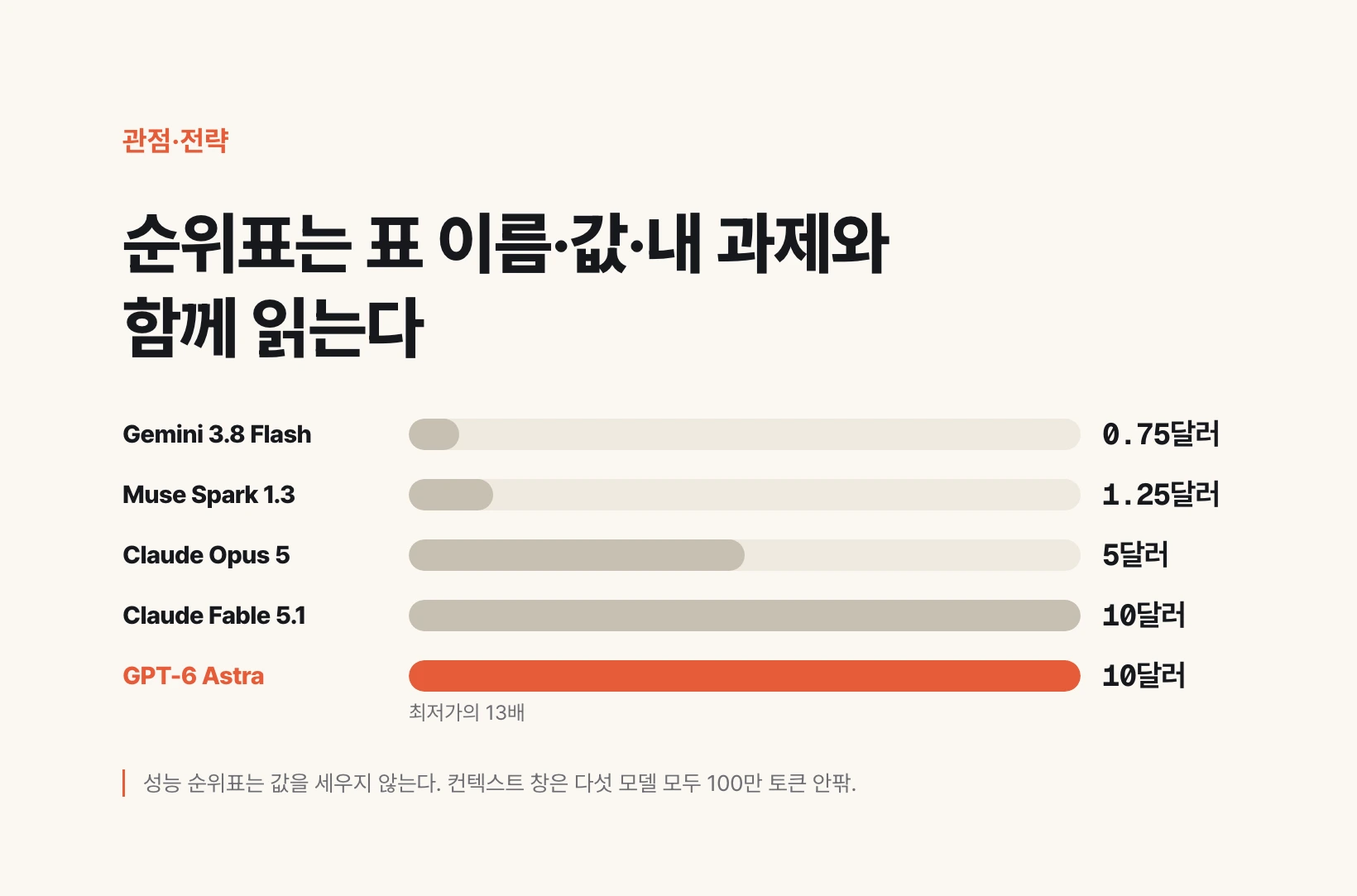
Using OpenRouter's published prices as of September 7, 2026, the cost per million input tokens lines up like this: Gemini 3.8 Flash at 0.75 dollars, Muse Spark 1.3 at 1.25 dollars, Claude Opus 5 at 5 dollars, Claude Fable 5.1 at 10 dollars, and GPT-6 Astra at 10 dollars. The cheapest and the most expensive are more than 13 times apart.
Output prices spread further: 3.75, 4.25, 25, 50 and 50 dollars in the same order. Context windows are all around one million tokens, so that axis barely separates them.
Whether being one row higher on a leaderboard is worth paying 13 times more is a question the leaderboard does not answer. The answer differs by task. For contract review, where one mistake is expensive, the expensive model is right. For summarizing hundreds of meeting transcripts a day, price is the whole feasibility question.
So what should you look at? An eval set built from your own tasks
Building your own table is faster than learning to read everyone else's. You do not need tooling. One document will do.
Four steps. One, pull three to five tasks from real work and write them down as full prompts. They have to be things you actually did yesterday; invented examples do not separate models. Two, write pass conditions rather than answers: what must be present to pass, what disqualifies. Three, when a new model ships, paste the same prompts and put the outputs side by side. Four, record price and elapsed time next to each result.
Once this document accumulates you can judge independently of anyone's number-one claim. And the judgment survives in a form you can show other people. What you need to propose a model switch inside an organization is not a screenshot of a benchmark but a table showing how five of our own tasks came out.
# Our task eval set (2026-09)

## Task 1 - Summarize a client call transcript
Prompt: Split the transcript below into client requirements / our commitments / open items. <transcript>
Pass: no open item is dropped. No commitment is invented.
Fail: fabricates a date or an amount.

| Model | Result | Price | Time |
|---|---|---|---|
| (record) | | | |

## Task 2 - Flag risky clauses in a contract
Prompt: ...
Pass: ...
Fail: ...
The real news this week was the terrain, not the leaderboard
On September 3, in a post under his own name, Jensen Huang announced that NVIDIA had agreed to acquire Hugging Face. The figure is 12,930,300,000 dollars.
The announcement's own numbers describe what Hugging Face is: more than 18 million developers, researchers and creators sharing more than 3 million models, 500,000 datasets and 1 million applications, with more than 200,000 companies using the platform to discover, evaluate, customize and deploy AI. It is fair to call it the GitHub of open models.
Two sentences are nailed down twice in that post: NVIDIA compute will not be required to build on or deploy through Hugging Face, and multi-cloud, multi-accelerator development and deployment will continue to be supported. Repeating those lines in an acquisition announcement tells you what the concern was.
Why a chip company buys an open model repository is worth reading. Meta, OpenAI and Google are all moving toward their own silicon. Even if frontier labs buy less NVIDIA compute, the companies and institutions that want to run open-weight models on their own servers still need GPUs. NVIDIA states it is the largest contributor of open models and data to Hugging Face, with more than 500 models and 250 open datasets released there. This acquisition is a larger bet in the same direction.
Generation moved from text to screens and space
Solaris, released by Runway on September 1, is an interface world model. Until now a screen was implemented through code as an intermediate representation, which meant its appearance and behavior had to be specified in advance. Solaris skips that step and synthesizes the screen frame by frame in response to what the user does.
It splits into two parts. A language model interprets user intent and specifies how an interaction should affect the generated environment; the visual model only renders the result. High-level reasoning is separated from rendering. The paper frames this as a step toward a new paradigm for software, in which interfaces are generated and continuously adapted around user intent rather than implemented as fixed collections of predefined states.
Atlas, released by World Labs the same day, takes the spatial side. It is an omni model pretrained from scratch on text, images, video and 3D, folding all inputs into one shared spatial context. Give it one to dozens of photos and it generates new viewpoints at a camera position and angle you specify, taking camera geometry as a native input rather than a text instruction. Not a little to the left, but coordinates. Output runs up to one minute at 1440p, and the model imagines the parts the photos never captured.
Atlas also reconstructs real scenes in 3D from several images and, given video, models space and time for real-to-sim robotics workflows. World Labs claims it outperforms state-of-the-art models specialized for 3D reconstruction.
Three lines for reading a leaderboard
One: look for the table name behind the words number one. A number one without a table name is not information.
Two: a composite index is a function of its weights. Ask whether those weights match your work.
Three: fix three to five of your own tasks and measure each new model on them yourself, recording price and elapsed time beside the result. That table does not wobble when everyone else's does.