
The two currents running through this week
AI news arrives every week, but most of it is a list of unrelated announcements. The five days from August 11 to 15, 2026 are a rare exception: they read as a single thread. The open-weight camp crossed a performance threshold, and in the same week closed providers switched on features that record user activity.
These look like opposite directions, but they point at the same place. Until now the reason not to run a local model was that performance fell short. That reason largely disappeared this week. And in the same week it became concrete what remains behind when you keep using someone else's server.
Start with the term open weights. It means the company that built the model publishes the finished weight file, so anyone can download it and run it on their own computer or server. This differs from calling an API. An API runs on the company's servers and bills you per call; open weights cost nothing but electricity after the download, and what you type never leaves your machine.
Below is an item-by-item account of what actually happened over those five days. Every figure and date is taken from official company announcements or the papers themselves.
Qwen3.8-27B - a 27B that fits on a laptop GPU beat Opus 4.6
Alibaba's Qwen team released Qwen3.8-27B on August 14. It has 27.8B parameters under an Apache 2.0 license, an open license that broadly permits commercial use, modification, and redistribution. It is a vision-language model that takes images and video alongside text, with a context window of 262,144 tokens.
What matters more than the numbers is the comparison. Across 19 tests that overlap with Claude Opus 4.6, Qwen3.8-27B came out ahead on 15. The wins are on SWE-bench Pro, LiveCodeBench v6, OSWorld, and AndroidWorld - tasks that involve actually editing code and driving a screen to finish a job. It falls behind on pure knowledge tests like GPQA and language comprehension tests like HLE.
Read that contrast literally. The model does not know more. It got better at carrying a given task through to the end. For coding agents and automation pipelines, that is the more useful capability.
Running it takes one high-end consumer GPU. Four-bit quantization compresses the weights and cuts memory use enough to fit on a single card. Quantization lowers precision to shrink the file, so quality drops slightly, but the difference is hard to feel in most practical work.
The easiest way to start is to install Ollama or LM Studio and search for the model by name. Both open a chat window a few clicks after installation, and both expose an OpenAI-compatible API server at the same time, so you can point existing code at a new address and leave the rest alone.
DeepSeek opened the harness, not just the model
On August 13, DeepSeek shipped an updated V4-Pro and released DeepSeek Harness as an MIT-licensed developer preview. Of this week's open-source news, this is the announcement that differs most in kind.
The word harness may be unfamiliar. A model on its own is just a machine that continues text. To make it do real work you need a layer that attaches tools, reads files, executes commands, and manages conversation context. That layer is the harness. Claude Code is the harness around Claude; Codex is the harness around GPT. With the same model, a better harness changes results substantially.
Until now the Chinese labs opened weights but left the harness to you. This time that layer opened too, and the design premise is unusual: practically every piece of the agent runtime is a swappable plugin. Tools, session logs, the agent loop, subagents, the sandbox, the filesystem, and orchestration are all replaceable parts. An agent can even create and modify plugins for the harness itself.
V4-Pro is a 1.6-trillion-parameter mixture-of-experts model with 49B active parameters and a one-million-token context. Mixture of experts means the model does not use every parameter on every pass; it wakes only the subset suited to the input. So the total is large while the actual compute tracks the active count. The weights are MIT.
That said, this model is not sized for a personal PC. 1.6 trillion parameters demands datacenter hardware. What an individual actually gains from this announcement is the harness, not the model. The code is on GitHub under MIT, so there is nothing stopping you from taking it apart and rebuilding it.
MiniMax Music 3.0 - music generation came off the subscription
MiniMax released Music 3.0 as open weights on August 13. Give it a concept and lyrics and it returns a finished song of up to five minutes. Lyrics are optional.
This space has been held by subscription services, Suno chief among them. The model sat on company servers and users paid monthly for a set number of generations. Publishing the weights removes that structure. No subscription, no generation cap, no download limit.
It runs directly in ComfyUI, a free program that executes image, video, and audio models by wiring nodes together. The official documentation carries a Music 3 tutorial, and Hugging Face already hosts community fine-tunes and GGUF quantizations.
The license is the part worth reading closely. It ships under the MiniMax-Music3 community license, and you may use and monetize the music you generate commercially. The condition is attributing MiniMax Music 3 as the source of generation. Only companies earning more than twenty million dollars a year from content built on the model need a separate agreement. The Korea carve-out attached to the same company's video model is absent here.
Copyright is a separate question from licensing. If you use it to reproduce a specific singer's voice or an existing song, that responsibility is yours. A license permitting something is not the same as it being legally safe.
The frontier moved too - Grok 4.6 and Gemini 3.7 Flash
xAI shipped Grok 4.6 on August 12. It is not a new base model but a post-training upgrade layered on the same roughly 1.5-trillion-parameter foundation as 4.5, with a supplemental training run, regenerated supervised fine-tuning trajectories, and reinforcement learning in agentic environments. Much of that data came through xAI's acquisition of Cursor.
The scores split. On the Artificial Analysis Intelligence Index it posted 61, tying GPT-5.6 Sol Max and landing one point behind Fable 5 Max's 62, for third place. On GDPval-AA v2, which measures realistic work tasks, it leads at 1753 Elo, and it also leads AA-Briefcase and Harvey LAB. On the coding benchmark DeepSWE v1.1 it scored 65.9%, behind GPT-5.6 Sol Max at 73% and Fable 5 Max at 70%. In one line: not the top composite, but strong on work-shaped tasks.
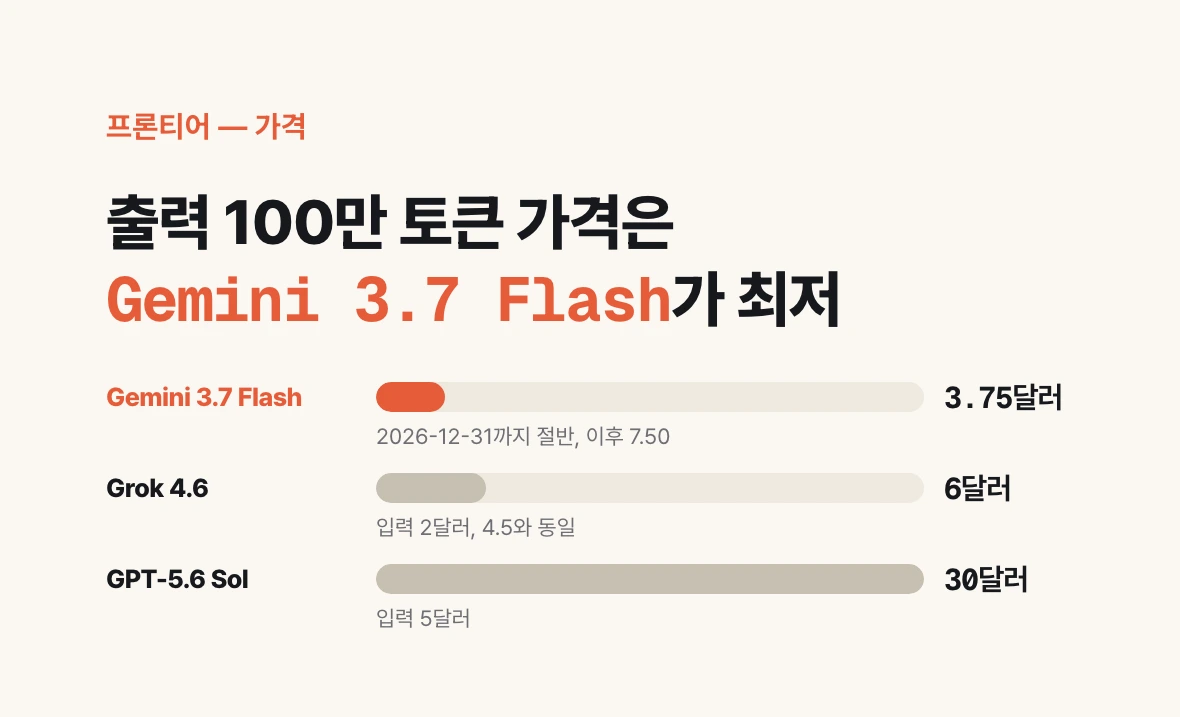
Pricing held at two dollars per million input tokens and six per million output. Against GPT-5.6 Sol's five and thirty, the output side is especially low.
Google shipped Gemini 3.7 Flash in August, three weeks after 3.6 Flash. It targets three things: writing and fixing code, agentic workflows, and precision-sensitive domains like law, medicine, and finance.
The part that makes you reach for a calculator is the price. Through December 31, 2026, it is $0.75 per million input tokens and $3.75 per million output. On January 1, 2027 those rise to $1.50 and $7.50. In other words, it is half price for the next four and a half months only. Agents burn hundreds of thousands of tokens per task, so that gap lands directly on the monthly invoice.
Providers turned on the record - Computer History and text watermarking
OpenAI opened Computer History on August 13. It is a macOS desktop app feature for Pro, Business, and Enterprise users. The European Economic Area, Switzerland, and the UK follow in the coming weeks.
The facts need stating precisely here. It is not screen recording. Through the macOS accessibility APIs it captures interactions such as clicks, typing, keyboard shortcuts, and app switching, periodically converts them into text summaries, and organizes them on a timeline by day and time. It takes no screenshots and uses neither the microphone nor audio. This approach replaced Chronicle, an earlier experimental feature that continuously recorded the screen and read it with OCR.
It is off by default. Pro users turn it on themselves; in business workspaces an administrator must grant access first, and then each member opts in individually. You can choose which apps and websites are included, pause tracking, delete individual entries, or disable the feature entirely.
The upside is clear. If the model knows what you did yesterday, a work log accumulates on its own, and the model can notice repeated tasks and propose automating them. The other side is equally clear: the same record becomes surveillance material inside an organization. The design - off by default, individual opt-in - is written with that concern in view.
Anthropic formalized text watermarking on August 14. It is a response to the EU AI Act, following the EU Code of Practice on Transparency of AI-Generated Content that it signed in July alongside roughly 190 other signatories.
The mechanism is unintuitive, which has produced a lot of misreading. It does not hide special characters in the text. When a model writes, it picks the next word by probability, and a piece of writing contains countless low-stakes choices where either option carries the same meaning. The pattern of those choices is nudged slightly to one side. A reader cannot detect it; only someone holding the key can. The mark travels with the text when it is copied and pasted elsewhere.
The backlash was loud. Most grievances came from people who only had Claude proofread their own writing and object to being marked as AI-generated, and from coders worried that a signature in code degrades quality. Anthropic said internal testing showed no effect on content, creativity, or readability, and that cancellations did not rise after the announcement. Meanwhile an open-source watermark remover appeared almost immediately - shifting word choices slightly disturbs the pattern.
Conversations are already evidence - the FBI report and the reasoning leak
In Florida, a 25-year-old man repeatedly entered plans to harm his ex-girlfriend into ChatGPT from March through April. He wrote down firearm purchases and a specific execution scenario. OpenAI passed this to the FBI in May and he was arrested. On August 13 he pleaded guilty to all three charges and, with adjudication withheld, received eight years of probation and an ankle monitor for the first two.
Preventing this was right. The remaining question is procedural. It means a pipeline in which a provider classifies conversations and hands them to law enforcement over something that has not yet happened is running continuously. Where a threat ends and a joke begins, and who decides by what standard, is not visible from outside.
In the same week another leak path for conversations was confirmed. A paper posted to arXiv, Stealing Reasoning Traces from Proprietary LLM APIs, showed that the hidden intermediate reasoning major providers conceal can be recovered from outside.
The structure was the flaw. Keeping reasoning entirely server-side is expensive, so providers sent it to the client as encrypted blocks and had the client return them with each subsequent request. But those blocks turned out to be interchangeable across sessions, users, and models within one provider. The researchers injected an encrypted trace obtained from a strong model into a weaker, less-guarded model from the same provider and had it decode the trace verbatim.
Decoding 315,320 reasoning blocks scraped from public repositories yielded 367 pieces of personally identifiable information and 182 credentials. It also surfaced cases where the visible answer safely refused a request while hazardous content remained inside the reasoning. After the researchers reported it, the paper states, the same attacks no longer worked.
Put the two together and a direction appears. What you upload to someone else's server leaves a shape somewhere, even after you believe you deleted it. The case for moving sensitive work to a local model gained a reason beyond performance and cost.
A result outside the benchmarks - the Riemann lower bound
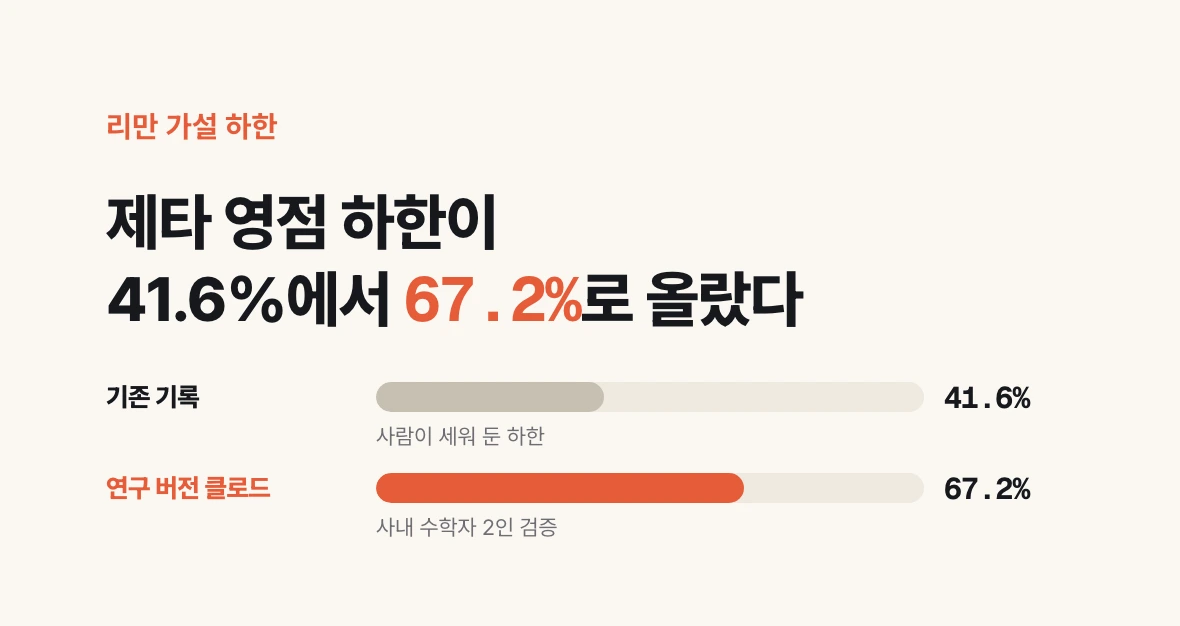
Anthropic asked an unreleased research version of Claude to take a stab at the Riemann hypothesis. It did not solve it. Instead it pushed on an adjacent problem, raising the lower bound for the fraction of zeros of the Riemann zeta function that satisfy the hypothesis from 41.6% to 67.2%.
The Riemann hypothesis is an old unsolved problem in mathematics. It claims that the points where a function called the zeta function equals zero all lie on one particular line, and it remains unproven. While no one can prove all of them, mathematicians have gradually raised a lower bound on what fraction must lie on that line. That figure had been sitting at 41.6%; it is now 67.2%.
What the model did was not invent new theory but find a way to combine existing results. Two mathematicians at Anthropic reviewed and validated the work, and a formally verifiable proof came with it. Formal verification means the argument is written so a computer can check each logical step rather than relying on a human reading it.
Anthropic itself said it does not expect this technique to lead to a proof of the hypothesis. The notable part sits elsewhere. This was not a higher score on a benchmark with a predetermined answer; it moved a record set by people on a problem that has no answer yet.
What to actually try this week
Reading and stopping leaves nothing behind, so here is what to do, in order.
First, stand up a local model once. Install Ollama and pull the four-bit quantization of Qwen3.8-27B. If your GPU memory falls short, start with something smaller. The point is not to measure performance but to feel it running on your own machine. After this step you will have a basis for judging which work to move locally.
Second, open your current API invoice and see where the money goes by model. If you run an agent pipeline, swap in Gemini 3.7 Flash and run it at half price through December 31. The promotion has a fixed end date, so the experiment window sets itself.
Third, if your team uses the ChatGPT desktop app, decide now whether Computer History goes on. It is off by default, so nothing happens if you do nothing - but in a business workspace it is better to settle the administrator policy first. That is cheaper than cleaning up after individuals have each turned it on.
Fourth, audit which windows you are putting sensitive material into. Listing which services hold conversations containing customer information, contract terms, or credentials naturally narrows down the work that should come down to local.