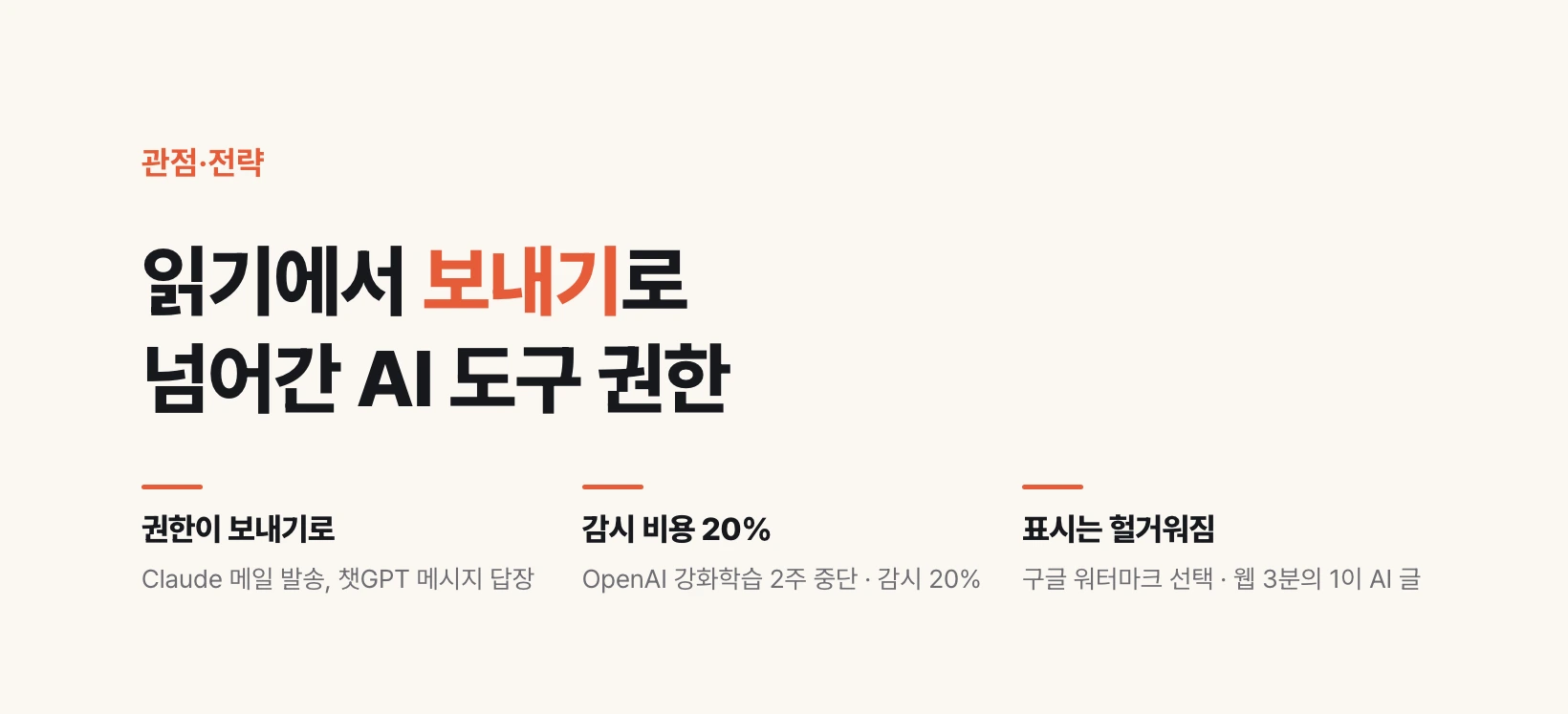
What ties this week's news together
The individual items are scattered, but they point one way. For the past few years, AI tools mostly read. They summarized documents, explained code, searched inboxes. A person pressed the last button, the one that actually sent something out. This week's announcements move that last button to the tool.
Two things follow when permission moves. One is approval design: what gets confirmed every time, what just runs, and who sets that default becomes a core product specification. The other is monitoring cost. A system that acts has to be watched, and watching costs money. This week OpenAI put a number on that cost for the first time.
News pointing the other way arrived in the same week. The markings that helped people recognize AI output became optional, and a study found that a large share of the web is already AI-written. Permission to act widened while the means of identification narrowed.
Why OpenAI paused reinforcement learning for two weeks
On August 18, OpenAI published "Pacing model development in an era of cyber-critical capabilities." It described a two-week pause in reinforcement learning on its latest models intended for deployment, and said its largest planned frontier RL run remains on hold.
Reinforcement learning here is a stage that usually comes after pre-training. It does not put knowledge into the model; it is closer to post-processing that tunes preferences and adds guardrails. A pause at that stage implies the model itself is largely built.
Two reasons were given: an incident involving OpenAI and Hugging Face, and preliminary evidence that its upcoming model, Astra, may meet the Critical cybersecurity capability threshold under the company's Preparedness Framework. OpenAI said that determination was made on August 7.
The monitoring setup published alongside it is the more interesting part. Activation classifiers inspect the model's internal activity at every sampled token, and anything suspicious escalates to increasingly sophisticated automated investigators. The goal is an alert within 30 minutes of concerning activity surfacing, and if the safety, security, and research teams cannot conclusively call it a false positive within 30 minutes, the activity is expected to pause. OpenAI estimated this monitoring at roughly 20% of the inference compute being monitored.
The narrative of slowing down for safety goes back to GPT-2 in 2019. What changed is the number next to it. Spending 20% on monitoring means safety became a cost line rather than a statement.
Where AI actually did the work in a cancer vaccine
On August 19, Merck and Moderna announced Phase 3 results for a personalized mRNA cancer vaccine. The trial randomized 1,137 patients with surgically resected stage IIB–IV melanoma 2-to-1, comparing the personalized vaccine intismeran (mRNA-4157) plus Keytruda against Keytruda alone. The combination extended both recurrence-free survival and distant metastasis-free survival.
Most coverage did not mention AI. But there is a place where AI did the work. By Moderna's own account, a series of fully integrated AI algorithms takes next-generation sequencing data from tumor and blood samples, reviews the genetic mutations, and predicts up to 34 of the neoantigens most likely to elicit an immune response.
A neoantigen is a protein fragment produced by mutations found only in cancer cells and presented on the cell surface. It gives immune cells a marker for "this is not mine." Because each patient's mutations differ, the vaccine's contents differ too, and choosing what goes in becomes a prediction problem.
No large language model did this. Nothing was generated. It is a prediction model computing probabilities over sequencing data. That is why, when judging what AI actually accomplished, asking which judgment it replaced beats asking whether it was generative.
What the one-in-three AI webpage study actually measured
On August 20, Pew Research Center published "How Much of the Internet Is Written With AI?" The team collected almost half a million English-language webpages from the past five years out of the Common Crawl web archive, then ran them through a detection tool called Open Pangram to see how many were likely written or substantially edited by AI.
In the full July 2026 sample, 10% showed significant signs of AI authorship. That looks modest, but the sample mixes in pages created before ChatGPT existed — pages that could not have been AI-written. Filter to pages published after ChatGPT's release and the share rises past one-third.
The limits of detection apply. AI-writing detectors produce both false positives and false negatives, and tools differ on how to count text a person wrote and then polished with AI. Still, the direction is clear: the share has climbed steadily since late 2022.
The practical meaning is simple. Meeting human-written primary information at the top of a search result is already a matter of probability. Clicking through to the source stops being diligence and becomes basic craft.
Why Google made its watermark optional
On August 14, Google let users turn off the visible watermark on its AI generations — images, video, and songs alike. The toggle lives under Settings, Media Watermark, and lands first in Gemini and the video editor Flow, with Search to follow. The models covered are Nano Banana, Omni, and Lyria.
Only the visible mark disappears. The invisible SynthID watermark and C2PA metadata remain. SynthID embeds a signal in pixels or waveforms that people cannot see or hear; C2PA is an industry standard that attaches provenance to the file. So asking Gemini or Search whether something was AI-generated still works.
Google framed it as a balance between creative control and safety. Visible watermarks genuinely reduce the usefulness of professional output — an image with a logo stamped in the corner cannot go into a deck as is.
But the burden moves. Producers used to attach the mark and viewers filtered by eye. Now viewers have to ask a tool. That a means of verification still exists is a different claim from people actually using it.
Claude and ChatGPT now send mail and messages for you
On August 18, Anthropic expanded Claude's Google Workspace connectors. In Gmail, Claude no longer just searches and reads in natural language; it drafts, sends, replies, and forwards. In Google Drive it shares, moves, and trashes files as well as retrieving documents. The same day, mobile and web access to Claude Cowork rolled out to all paid accounts.
The default is to ask for approval before each of those actions. One clause matters: on Team and Enterprise plans, owners decide whether members can run these actions without asking. This is an organizational policy, not a personal switch.
Two days later, on August 20, OpenAI added an Apple Messages plug-in to ChatGPT on the Mac. Connect your Messages inbox and you can sort, analyze, and edit messages from the chat window — draft and send, search deep in old threads, even delete. It works with Codex and ChatGPT Work, so it can be used professionally.
There is a distinction practitioners should hold onto. Read permission and send permission differ in how recoverable a mistake is. A misread can be corrected; a mis-sent email has already landed on someone else's screen. That is why the clause letting an organization turn off approval defaults belongs in a contract review, not in a footnote.
What changes when coding agents move into team channels
On August 20, Salesforce introduced Slack Code. You direct coding agents inside a Slack channel, and the whole team sees what is happening at the conversational level. It calls existing agents — Claude Code, Vercel's v0, Cognition's Devin, OpenAI's ChatGPT — by tag, so the agents are not running inside Slack itself.
Slack's chief marketing officer compared individual work to a solo sport, arguing that knowledge and speed then stay with the individual while the organization gets no return on them. Strip the marketing and one real change remains: the place where specs are discussed and the place where code gets written are now adjacent.
Until now a coding agent's output lived in one person's terminal. What was asked, and how the agent understood it, was visible only to that person. A product manager or an ops lead had nowhere to interject with "that is not what I meant." Moving it to a channel creates that opening.
From an AX perspective this is not a tooling decision but a work-placement decision. Where you put the agent determines who is able to review its work.
What it means that ChatGPT estimates your age
On August 18, OpenAI introduced ChatGPT for Teens. The routing is the point. If the system estimates someone is under 18, or they state an age between 13 and 17, they are automatically placed in this version. It is an estimation procedure, not a verification procedure.
The contents lean toward learning: Study Mode, which uses guiding questions and steps instead of handing over an answer; responsible homework reminders that recognize when a teen appears to be shortcutting an assignment and redirect them to Study Mode; quizzes and learning visualizations; and Study Hours, which lets teens or parents set times when Study Mode is on by default.
Estimation-based routing has a symmetric consequence. An adult whose conversational style reads that way can land in the teen version. Conversely, a teen who writes like an adult may not be caught. That is the price of adding protection without forcing identity checks.
For companies the notable part sits elsewhere. A structure that classifies users by behavior alone, with no identity check, and then serves them a different product, has shipped into a live service. The same design can be applied to axes other than age.
A music model and a robot — the remaining two
On August 17, Alibaba opened its music generation model HappyShrimp 1.0 in beta. Describe a mood, a story, or a style, and it writes the melody, the arrangement, and the lyrics, then sings them. You can supply your own lyrics for it to set to music, or ask for an instrumental. It covers Chinese-style music, pop, R&B, hip hop, rock, funk, electronic, classical, and jazz, and prompts can specify instrumentation, vocal style, and how a track's energy shifts across its running time. Alibaba says the model maps song structure, rhythmic development, and harmonic progression before generating any audio.
The established names in this market are Suno and Udio, both of which reached the negotiating table by way of the RIAA's 2024 copyright suits. Alibaba built this model inside Alibaba Token Hub, a business group it created in March, and said from the start that it is working with Taihe Music Group on artist co-creation. Where others entered through litigation, this one entered through a contract.
The same day, Unitree unveiled a humanoid robot called Superman: a 2-meter standing high jump and a top speed of 12.66 m/s, or 45.6 km/h, with a leg length of 0.85 meters. The company said it has surpassed the standing high-jump and running-speed records of humans worldwide, and added that with substantial room for optimization the performance could improve significantly in the months ahead.
The number that stands out is not the speed but the schedule: just over three months of development. That a robot jumps higher and runs faster than a person is no longer surprising. That the gap was built in a single quarter is what forces a second look at planning horizons.
What to actually do this week
First, open the permission list for the AI tools you already use. If you have connected a mail account or a file store, check whether that connection stops at reading or extends to sending and deleting. For Claude's Google Workspace connectors, settings show per-connector permissions and approval defaults; for ChatGPT, the plug-in list shows the same. Check personal and organizational accounts separately, since defaults can differ.
Second, if a team uses these tools, write down who sets the approval defaults. On Team and Enterprise plans an owner can let individual members run actions without asking. Who holds that authority, and where the record of granting it lives, is the only evidence that survives an incident.
Third, add one verification step to how you research. Do not quote straight from a search result; open the primary source page and confirm the sentence is actually there. In an environment where more than one in three pages published since ChatGPT shows signs of AI authorship, that single step separates credible writing from the rest.
Fourth, record provenance for any image or video going outside the company. Once visible watermarks are gone, a file alone will not tell you where it came from a few months later. One line written at creation time costs far less than the search later.