Why YouTube instead of docs
Official docs are the most accurate source for any AI tool. But what blocks a beginner is not syntax, it is flow — when to ask for what, and where to backtrack when the output is wrong. That only shows up on someone else's screen while they fumble through it.
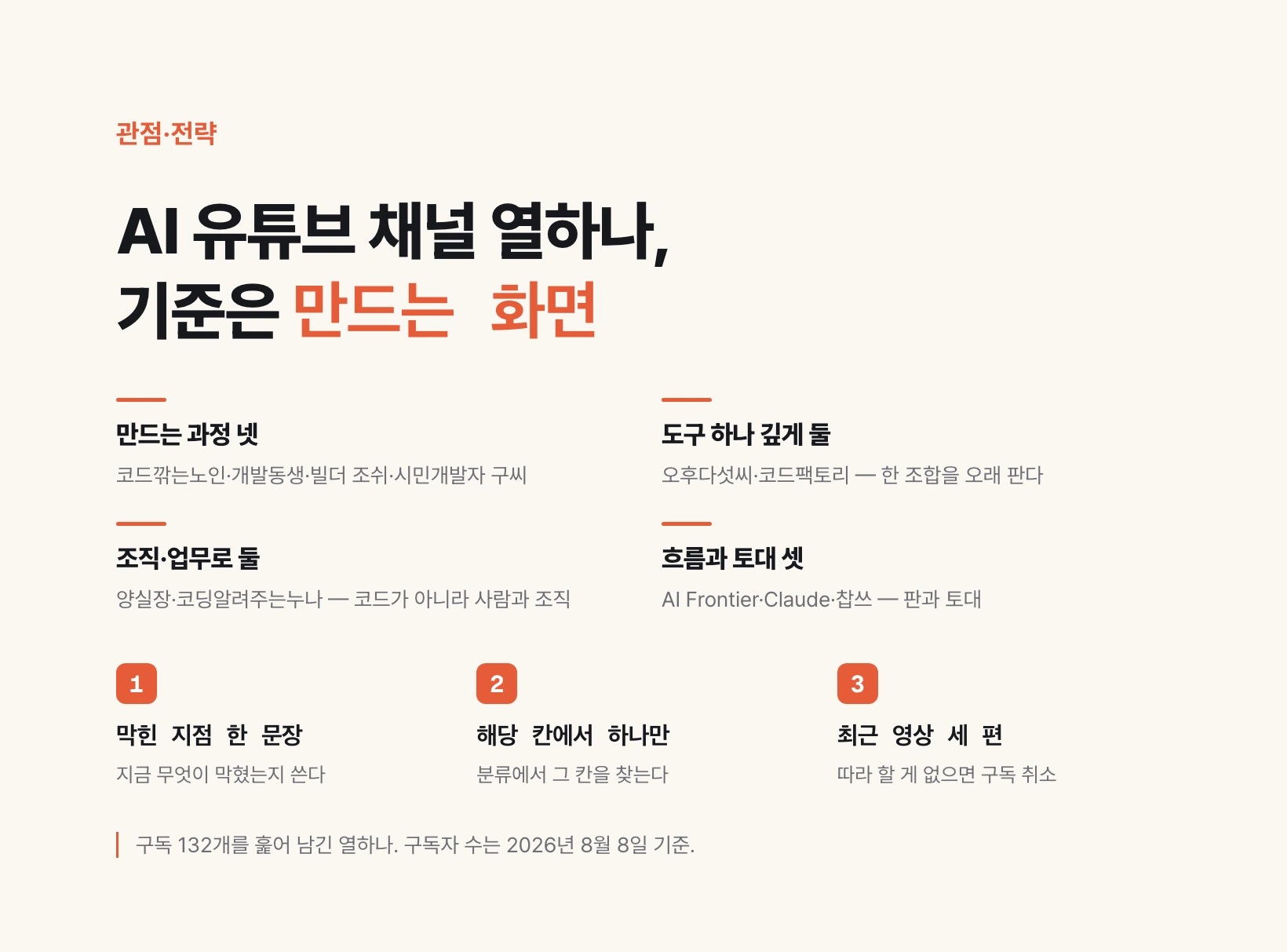
So I used a single filter: does this channel show the building, or only summarize the result? Running 132 subscriptions through it left eleven.
Subscriber counts are as of 8 August 2026. The channels serve different purposes, so the order below is the order I would watch them in.
Four that show the whole process
코드깎는노인 (youtube.com/@코드깎는노인, 52K). Mostly footage of actually wiring up agents — attaching a voice model, building a stock-trading agent. The wiring is the content, not the finished product.
개발동생 (youtube.com/@개발동생, 36K). Harnesses and loop engineering. Dissects someone else's harness and gets into cost control — few Korean channels work at this layer.
빌더 조쉬 (youtube.com/@builderjoshkim, 69K). Brings guests to dig into real cases, such as a security researcher showing how an agent with all permissions open gets breached. You learn the risk alongside the build.
시민개발자 구씨 (youtube.com/@citizendev9c, 57K). Clearly framed for non-developers — attaching agents to Notion, Excel and slides you already use. Lowest barrier of the eleven.
Two that go deep on one tool
오후다섯씨 (youtube.com/@mr.5pm, 53K). Keeps mining one combination: Obsidian plus Claude Code. Not tool tours but a single pairing worked over time, so there is always something to copy if you use the same stack.
코드팩토리 (youtube.com/@codefactory_official, 76K). Fast comparison reviews whenever a new model ships, useful when choosing which model to run. Also carries programming fundamentals.
Two that move it into an organization
양실장의 바이브코딩대학 (youtube.com/@vibecodinguniversity, 24K). Trains AX consultants. Corporate hackathon results, client diagnosis calls — the process of putting AI into an organization rather than the tools themselves.
코딩알려주는누나 (youtube.com/@코딩알려주는누나, 134K). Draws on a lot of corporate training experience: why companies spend the money and still fail at adoption. Worth watching first if you are on the adopting side.
These two are about people and organizations, not code. Watch them while you are learning the tools, not after — what to build gets decided there.
Two for the weekly picture
AI Frontier Korea (youtube.com/@chester_roh, 36K). Chester Roh sums up the field weekly. One episode catches you up on releases and industry moves, so you can stop chasing daily news.
Claude (youtube.com/@claude, 531K). Anthropic's official channel. English, but the feature explanations are short and precise — I use it to check the original design intent when something ships.
One for foundations
찹쓰 (youtube.com/@data_chopsticks, 25K). The channel name contains AI, but what actually ships lately is statistics fundamentals — what regression means, why Student's t carries that name.
Filing it under AI would be inaccurate, yet I kept it. Understanding why a model answers the way it does eventually requires this layer, and few channels explain it this plainly.
What order to watch them in
Subscribing to all of them just fills your feed with AI. Better to name what is blocking you right now and pick one or two.
Never built anything yet: 시민개발자 구씨. Already building but the structure is tangling: 개발동생 and 코드깎는노인. Have to put it into a team: 양실장 and 코딩알려주는누나. Stuck on model choice: 코드팩토리. Only want the overall picture: AI Frontier Korea alone is enough.
What to do today
Write down what is blocking you in one sentence. Find the group above that matches it. Subscribe to exactly one channel from that group and watch its three most recent videos. If even one thing is copyable, keep it; otherwise unsubscribe.
Collecting channels is not the goal. Building one thing this week is.