
Anthropic's IPO Filing — Listing Date and Offering Price Still Undecided
Anthropic, PBC, the maker of Claude, submitted an S-1 to the U.S. Securities and Exchange Commission (SEC) on October 26. An S-1 is the registration document a company files when it wants to sell stock to the public market for the first time, and it lays out the business, finances, and risk factors. Anthropic said it intends to list Class A common stock on the Nasdaq Global Select Market under the ticker ANT.
Many people are looking for the listing date, but no date has been set. The company's notice said the number of shares to be sold and the price range have not been determined, and that shares cannot be sold and offers to buy cannot be accepted before the registration statement becomes effective. The preliminary prospectus will be available from Goldman Sachs and Morgan Stanley, the notice said.
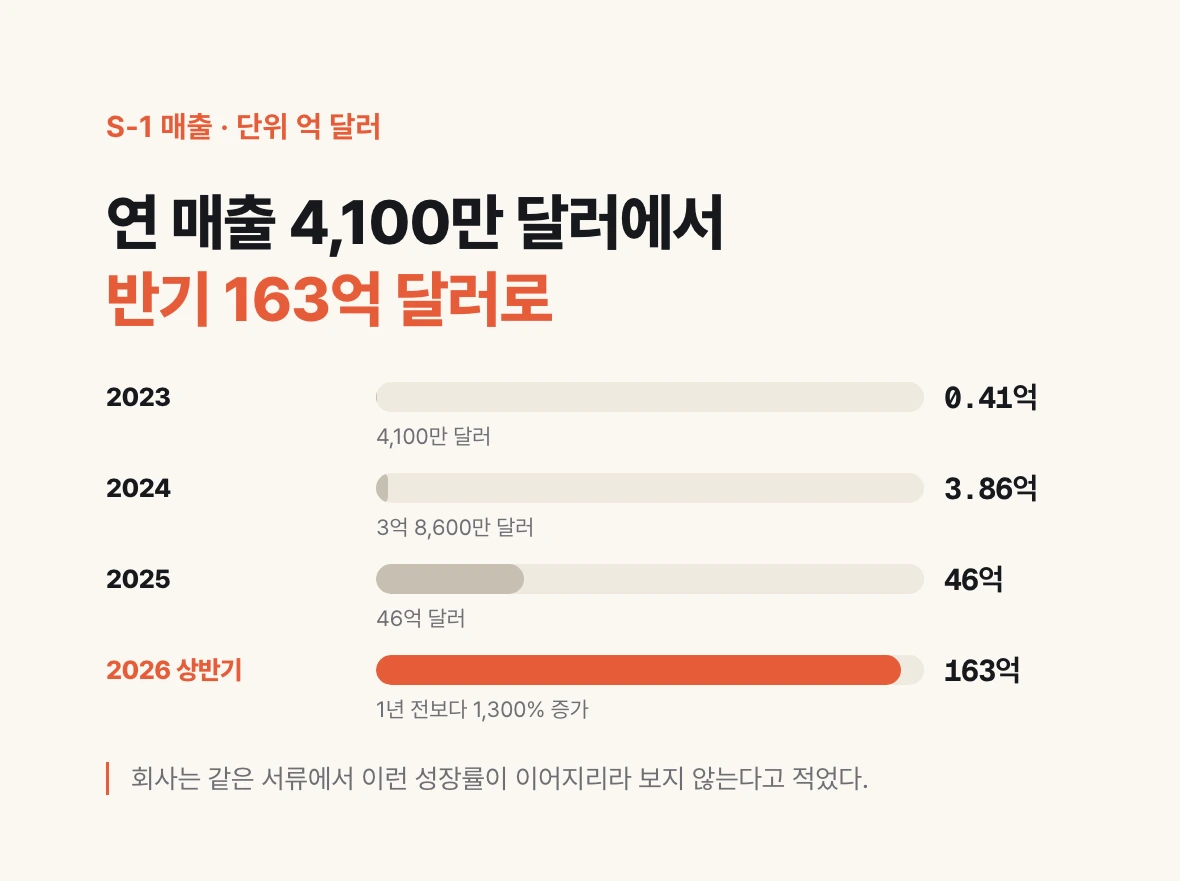
The revenue figures in the S-1 show the pace of growth. Annual revenue was $41 million in 2023, $386 million in 2024, and $4.6 billion in 2025, and first-half 2026 revenue was $16.3 billion, up 1,300% from the same period a year earlier. In the same filing, the company listed as a risk factor that it does not expect this growth rate to continue and that revenue could slow faster than expected.
Nothing changes right away for those who use Claude at work. However, once it becomes a public company it will disclose results every quarter, so there will be more material for seeing what business pressures lie behind product decisions such as pricing and usage limits.
GPT-6.1 Terra — The Price of Handing Off Screen Work Is Cut in Half
OpenAI released GPT-6.1 Terra on October 26. It is a fast model strong at computer use. Computer use is a capability in which AI looks at the screen and moves the mouse and keyboard on your behalf, handling the clicks and typing that people used to do. OpenAI said it is aimed at the screen work that fills the working day, such as writing proposals, reading technical drawings, filling in forms, and editing video.
The biggest change is the price. An API is the doorway through which your own program calls an OpenAI model, and the price is charged per token. A token is the unit in which AI splits text into small pieces and counts them. Terra's standard API price is $1 per million input tokens and $5 per million output tokens, which is 50% lower than the previous GPT-5.6 Terra and the higher-tier GPT-6.1 Sol. OpenAI gave as an example the high-volume job of reading incoming invoices and copying them into accounting software.
The company also said performance improved. On Agents' Last Exam, a test of handling professional tasks on screen, Terra at medium reasoning settings scored 15 percentage points higher than GPT-5.6 Terra at about one-third of the cost. On a set of questions deliberately built to be easy to get wrong, the error rate at low reasoning settings fell from 53.6% to 16.7%. However, the company itself wrote that GPT-6.1 Sol and GPT-6 Astra are better for the most complex coding tasks.
ChatGPT Plus, Pro, Enterprise, and Edu users can use it right away in ChatGPT Work and Codex, and developers call it in the API as gpt-6.1-terra. The company's explanation is that the same subscription usage handles more work than the previous model.
Kimi K3.1 Pro — Downloadable Models Close the Gap, and K2 Shuts Down at Year-End
China's Moonshot AI released Kimi K3.1 Pro on October 24. It is a 3-trillion-parameter-class open-weight model that the company says is its strongest. Open-weight means the files holding the model's training results (the weights) are published so anyone can download them and run them on their own server, and parameters are the numbers that measure a model's size. It reads up to 1 million tokens at a time, and the company said the full weights will be released by November 4.
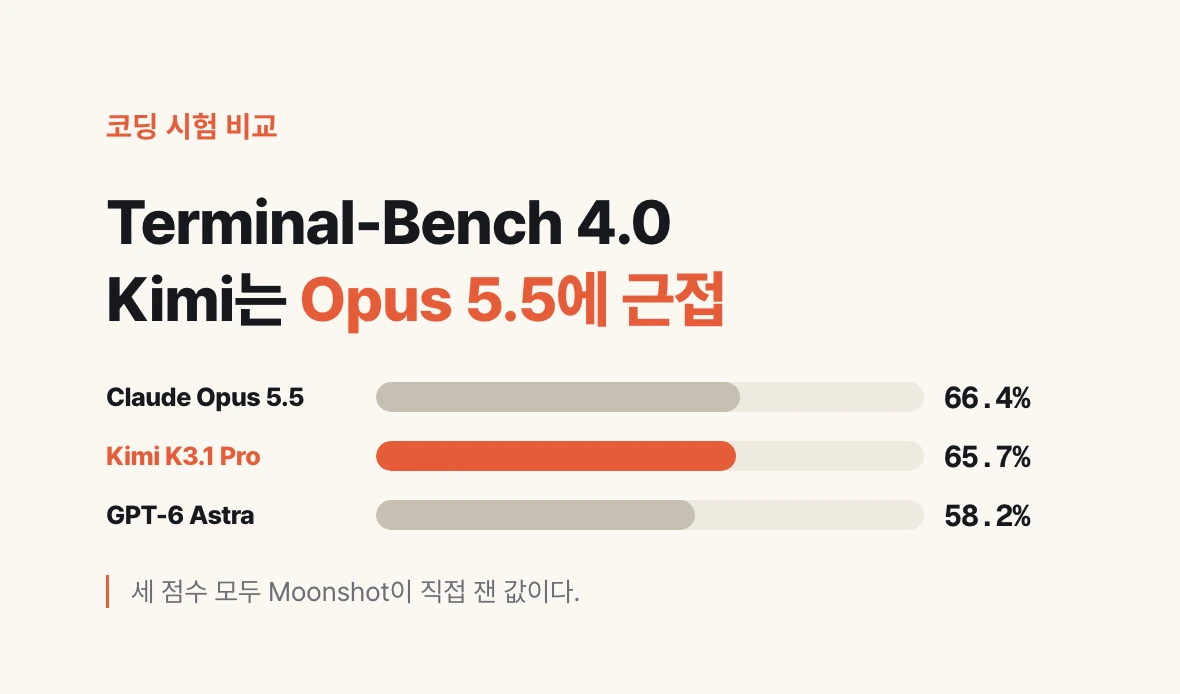
By the company's own figures, it scored 65.7% on Terminal-Bench 4.0, a command-line coding test, higher than GPT-6 Astra (58.2%) and close to Claude Opus 5.5 (66.4%). A benchmark is a test sheet on which models solve the same problems for comparison, but these numbers are values Moonshot measured itself. Whether the same results hold for your own work, you can only know by running it yourself.
The security decision is also worth noting. Moonshot said it removed cyberattack-related data when training the open-weight version, and that the accuracy on its own attack test dropped from 90.5% to 81.0%. The explanation is that it wants to keep a model anyone can download from pushing forward the frontier of attack capability.
The news that directly affects practical work is separate. The Kimi API pricing documentation announced that from October 31 it will not offer the K2 series to new sign-ups and plans to retire the entire K2 series by the end of December. If you are running automation on Kimi K2, you need to move to the K3 family before year-end and recheck the results.
Gemini 4 Carbon — The Strongest Model Goes to Security Defenders First
Google announced Gemini 4 Carbon on October 28. The company introduced it as its strongest model, and put particular emphasis on its ability to find and fix security vulnerabilities. It said it scored 88.2% on SEC-bench Pro, a test of finding vulnerabilities in real software, and 71.0% on CWE-bench, a test of fixing them.
The release approach is different. Google said it will open the model first to some cyber defense personnel starting this week, expand it in stages to trusted partners, and then, after refining the safeguards, release it to developers, enterprises, and general users. It also said it is taking part in the U.S. government's pre-release model testing process. Most users cannot use it yet.
The price came out first. During the introductory period it is $2 per million input tokens and $10 for output, the same as the previous Gemini 4 Argon, and after the introductory period ends it doubles to $4 and $20. If you are considering adopting it, it is safer to set your cost plan at the higher price.
Genie 4 — A World That Moves on the Spot When You Instruct It in Text

Google DeepMind unveiled Genie 4 on October 27. A world model is an AI that, instead of drawing a scene one frame at a time, keeps generating how that world will move in the next moment. When the user walks with the keyboard and turns the viewpoint, Genie 4 generates the screen in real time to match.
This version generates sound together with the picture from the start. Ambient sounds such as wind and waves and the characters' dialogue are generated at the same time as the scene, and characters speak in response to the user's input or events in the scene. You can also instruct it in text mid-session to change the weather or add a new character.
Google also sees Genie 4 as an environment for testing robots and AI agents before sending them into the real world. An agent is an AI program that takes a goal and handles multiple steps on its own. Gemini 3.8 Flash watches the generated scene, breaks the goal into steps, and checks whether each step succeeded.
For now it is a research preview for trusted testers, and Google plans to expand it to Project Genie for Google AI Ultra subscribers and to early partners of the Gemini API. The Project Genie waitlist is open.
The Claim That AI Solved a Hard Math Problem — Verification Is Left to Humans
On October 26, OpenAI announced that an internal model produced three new results in mathematics, computer science, and physics. The one with the biggest impact is the claim that it disproved the Exponential Time Hypothesis (ETH). ETH is the hypothesis that for a particular problem of finding values that make a logical formula true, the time required grows exponentially as the problem gets larger, no matter what method is used, and hundreds of papers so far have taken it as a premise to prove the hardness of other problems.
OpenAI said the model found the disproof on October 16 and confirmed it with Lean the next day. Lean is a language in which a computer mechanically checks each step of a proof. A group of Russell Impagliazzo, Ramamohan Paturi (UC San Diego), and Ryan Williams (MIT), including the two scholars who originally proposed this hypothesis, agreed to review and explain the result.
However, it should not yet be read as established fact. The review group said its participation does not mean it certifies the claim and that independent, careful review is needed. The group is taking part without a nondisclosure agreement and without pay, and OpenAI accepted full release of the raw materials and support for an academic conference.
The same day, OpenAI also claimed proofs of hard problems in analysis, including the Kakeya conjecture, and a proof that theories such as quantum chromodynamics (QCD) exist mathematically. The physics materials are to be written up directly by an outside group and have not yet been released. OpenAI said it does not claim academic credit for these discoveries.
This Week's Checklist — Cost, Migration, Verification
First, recalculate cost. If you have work that is copied by hand on screen, such as entering invoices, run one case through Terra and compare the result against the original. Now that the price has halved, it is time to see whether automation you once dropped for being too expensive makes sense again.
Second, make a migration plan. A notice that a model you use is being shut down, like Kimi K2, arrives suddenly. List which model names your current automation is tied to, and starting with the ones that have received retirement notices, switch to the new model and compare the results with the same input.
Third, separate announced figures from verified facts. Most of this week's benchmark scores are values the companies measured themselves, and the ETH disproof is a claim for which outside review has just begun. When carrying them into an internal report, note whether each is a company announcement or confirmed by a third party.
| Check item | This week's basis | First step |
|---|---|---|
| Screen-work automation cost | GPT-6.1 Terra API price cut 50% ($1 input, $5 output per million tokens) | Test one hand-copied screen task with Terra |
| Model migration | Kimi K2 series to be retired at end of December; Gemini 4 Carbon price doubles after the introductory period ends | List the model names tied to your automation |
| Claim verification | Companies' own benchmarks; outside review of the ETH disproof claim | In reports, distinguish company announcements from third-party confirmation |
| IPO schedule | Anthropic S-1 filed; listing date and offering price undecided | Do not assert a schedule before an official announcement |