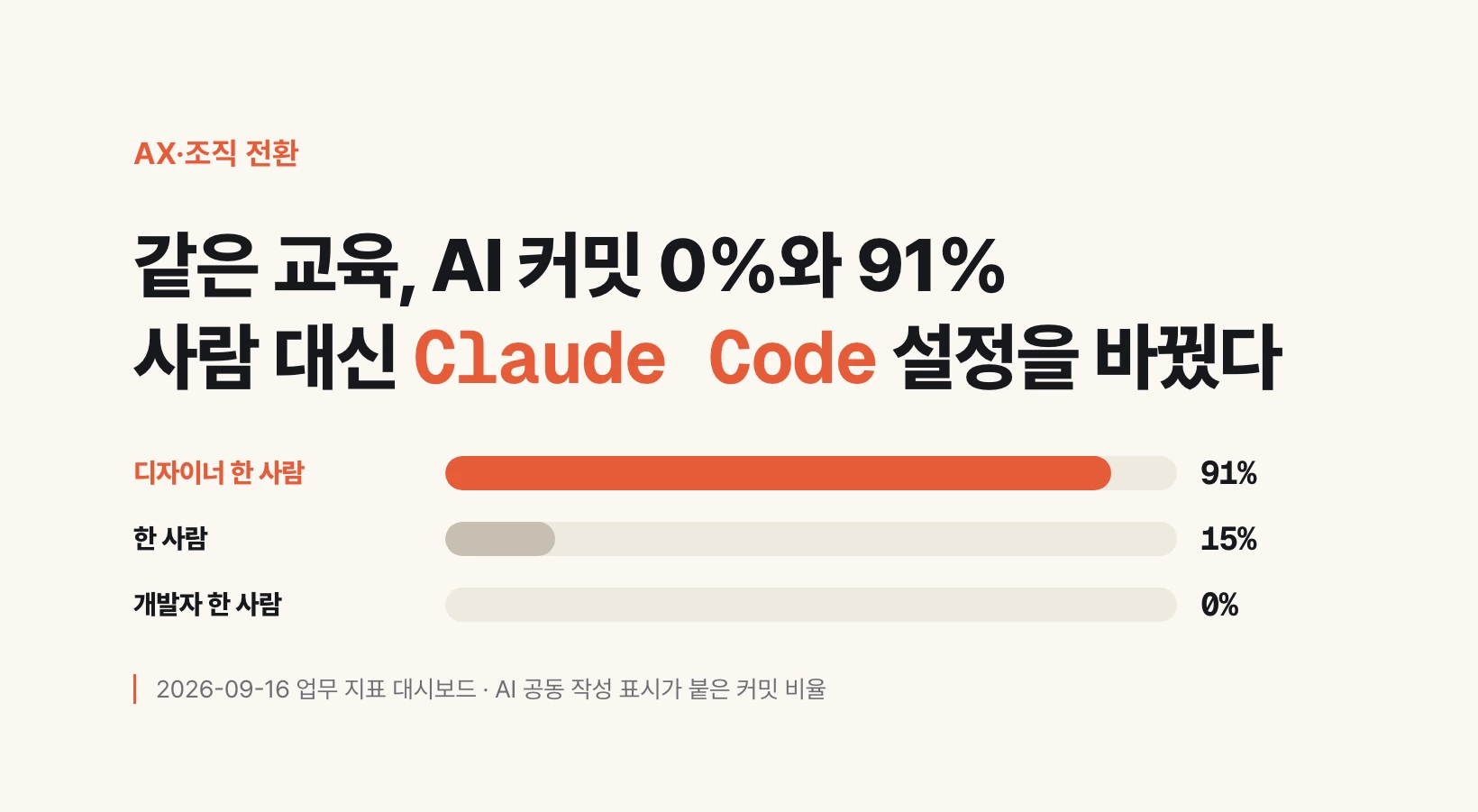
Same training, same tools, 0% and 91%
This series covers what I put in place from June to October 2026 while leading AX (AI transformation) in a development organization that builds services for pharmacies. Part 1 is the starting point, parts 2 to 6 take the five steps one at a time, and part 7 covers the principles that stuck and what was dropped.
The starting point was a single number. On September 16, I counted each person's commits on the work-metrics dashboard. A commit is one record left when work is saved, like a save file in a game: it shows what changed and when. When you work with an AI tool such as Claude Code, a line saying AI co-wrote the work is added to the end of that record.
In an organization with the same training and the same tools, the share of commits carrying that line was 91% for one designer and 0% for one developer. In between were four people in the 80s, two in the 40s and one at 15%. The number was meant to show where people were stuck, not to rank them, and the result was clear. Another round of training was not going to close that gap.
It is worth noting that the heaviest AI user was a designer, not a developer. What separated people was less their job title than whether they had fitted AI into the work they did every day.
The first sentence of the shift — change the AI, not the people
The direction had been left in one sentence in the development channel earlier, on August 27: "Minimize changes to how people behave, and let AI cover it." Every case that followed came out of that sentence.
The meaning is simple. Instead of training people not to show AI a file that holds passwords, the settings block the AI the moment it tries to read that file. Instead of asking people to write reports conclusion first, the settings fix the format of what the AI writes. People keep working as they did, and the rules live inside the AI everyone shares.
This way the rules do not depend on anyone's memory. A new person works under the same rules from day one, and a fix to a rule reaches everyone at once. Training still happens, but the system takes over what training used to enforce.
From 2022 to October 2026
The road here was not straight. Things we tried alternated with problems we ran into. The table below lists them in date order.
As the table shows, while we bought tools (August 2025), considered switching to another model (December 2025) and proposed a hackathon (March 2026), the people who used AI kept using it and the rest did not. The approach changed in September once the spread was confirmed in numbers, and in October the finding that only 33 of 175 review comments had been fixed pushed the next step.
| When | What happened |
|---|---|
| 2022.02 | AI was a research topic |
| 2025.08 | Opened Cursor and Claude team accounts |
| 2025.12 | Considered switching to Gemini |
| 2026.03 | Proposed a hackathon |
| 2026.09 | Confirmed a 0–91% spread in AI commit share |
| 2026.09 | Moved code repositories to GitHub; started the KB and measurement |
| 2026.10 | Found only 33 of 175 review comments had been fixed |
| 2026.10 | Claude Team managed settings reached their 19th version |
Five things — at a glance
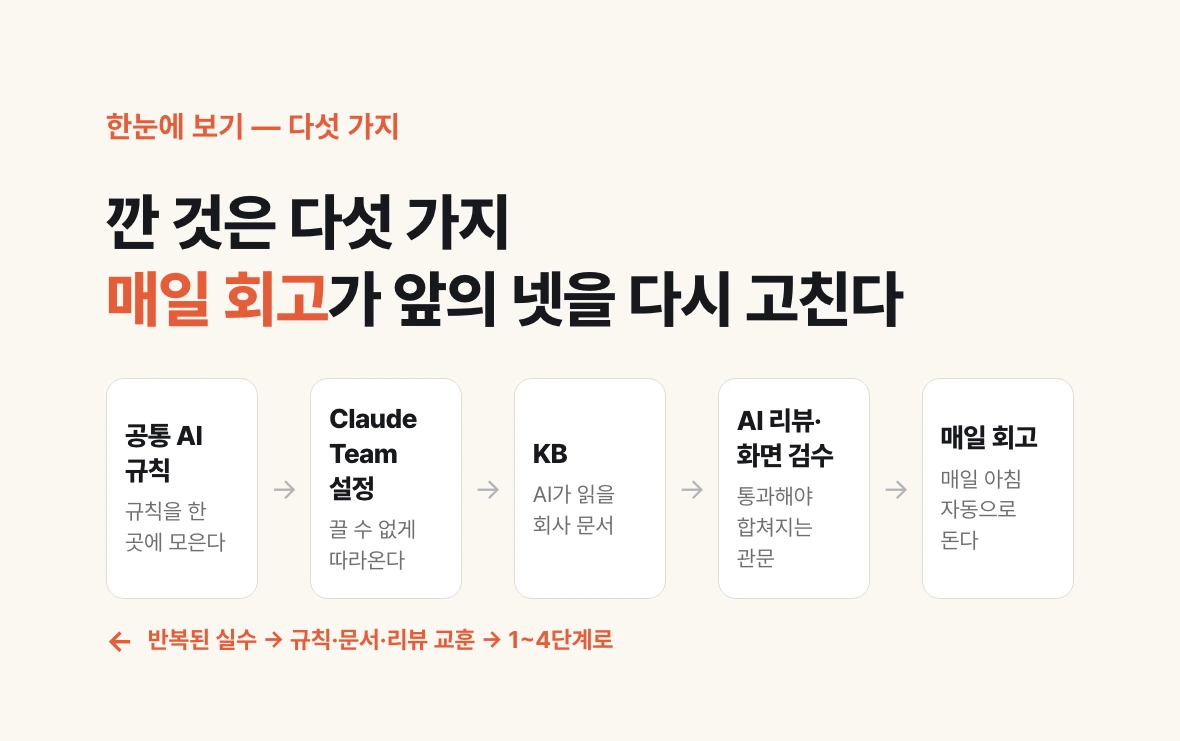
From the rules repository in June to the daily retrospective jobs in October, there were five things. The first four hand what people used to remember over to AI and settings; the fifth fixes the first four every day.
The fifth matters most. Retrospective jobs that run automatically every morning find repeated mistakes and turn them into rule changes, corrections to company documents and review lessons, which flow back into steps 1 to 4. The goal of this journey was not something set up once, but a loop that fixes itself.
The terms in the table are explained with real screens in their own parts. For now, just follow the flow: gather the rules in one place, make them follow people in a way that cannot be turned off, write company documents the AI can read, set up gates that work must pass before it is merged, and fix all four every day.
| Step | What it does | Start | As of October |
|---|---|---|---|
| 1. Shared AI rules | Fix one place and the AI in 7 projects and on every PC changes with it | 2026.06 | 95 automatic copies, all successful |
| 2. Claude Team managed settings | Settings that follow an organization login and individuals cannot turn off | 09-18 v1 | 10-23 v19 |
| 3. KB | Bots, coding AI and people read the same company documents | 2026.04 | 10-02 canonical for all staff |
| 4. Gates | Work is merged only after AI review and screen checks | 10-01 trial | Required in 47 projects from 10-13 |
| 5. Daily retrospectives | Morning jobs fix rules, documents and review lessons | 09-24 | Five jobs a day |
The order of the series
Part 2 (November 9) covers shared AI rules, with real screens of how fixing one rules repository copies the change to seven projects two to five minutes later.
Part 3 (November 16) covers Claude Team managed settings, part 4 (November 23) the KB, part 5 (November 30) the AI review and screen-check gates, part 6 (December 7) daily retrospectives, and part 7 (December 14) the principles that stuck, what was dropped and what remains to do.
Each part ends with one thing to try today, chosen so that someone who uses AI alone, not just a development organization, can try it on their own computer.
Try this today — count the AI commit share in your repository
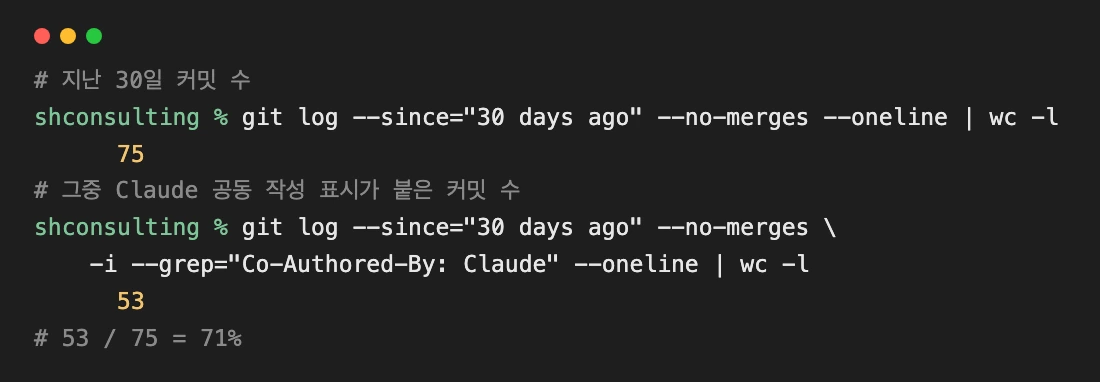
You can count the starting number yourself. A repository is a folder that holds a project's files together with their change history, and git is the tool that handles that history. Open Terminal on a Mac or PowerShell on Windows, move into the repository folder and run the two lines below in turn.
The first line counts commits in the last 30 days; the second counts those carrying a "Co-Authored-By: Claude" line. When you commit with Claude Code, this line is added to the end of the message by default. Divide the second number by the first to get the share. My site repository came to 53 of 75, or 71%.
For a team, add --author="name" to count each person separately. Read the number as a lower bound: if people commit AI-written code themselves or turn the line off, it is not counted. Even so, if the numbers vary widely from person to person, look at the settings of the AI everyone uses before another round of training. The first step there is shared AI rules, the subject of the next part.
git log --since="30 days ago" --no-merges --oneline | wc -l
git log --since="30 days ago" --no-merges -i --grep="Co-Authored-By: Claude" --oneline | wc -l