What is Claude Opus 5?
Claude Opus 5 is a top-tier general-purpose AI model released by the US AI company Anthropic on July 24, 2026. 'General-purpose' means a single model handles a wide range of work — writing code, summarizing documents, researching, operating a computer. 'Frontier' is the industry term for the most technically advanced models of the moment.
Anthropic's smartest model is Fable 5, and Opus 5 comes close to that intelligence at about half the price. The company positions it as a model designed to be used every day: the default model on Claude Max and the strongest model available on Claude Pro.
Developers can use it on the Claude API under the model name claude-opus-5. There is also a Fast mode that runs about 2.5 times faster, offered at twice the base price for quicker answers.
Same price, higher performance
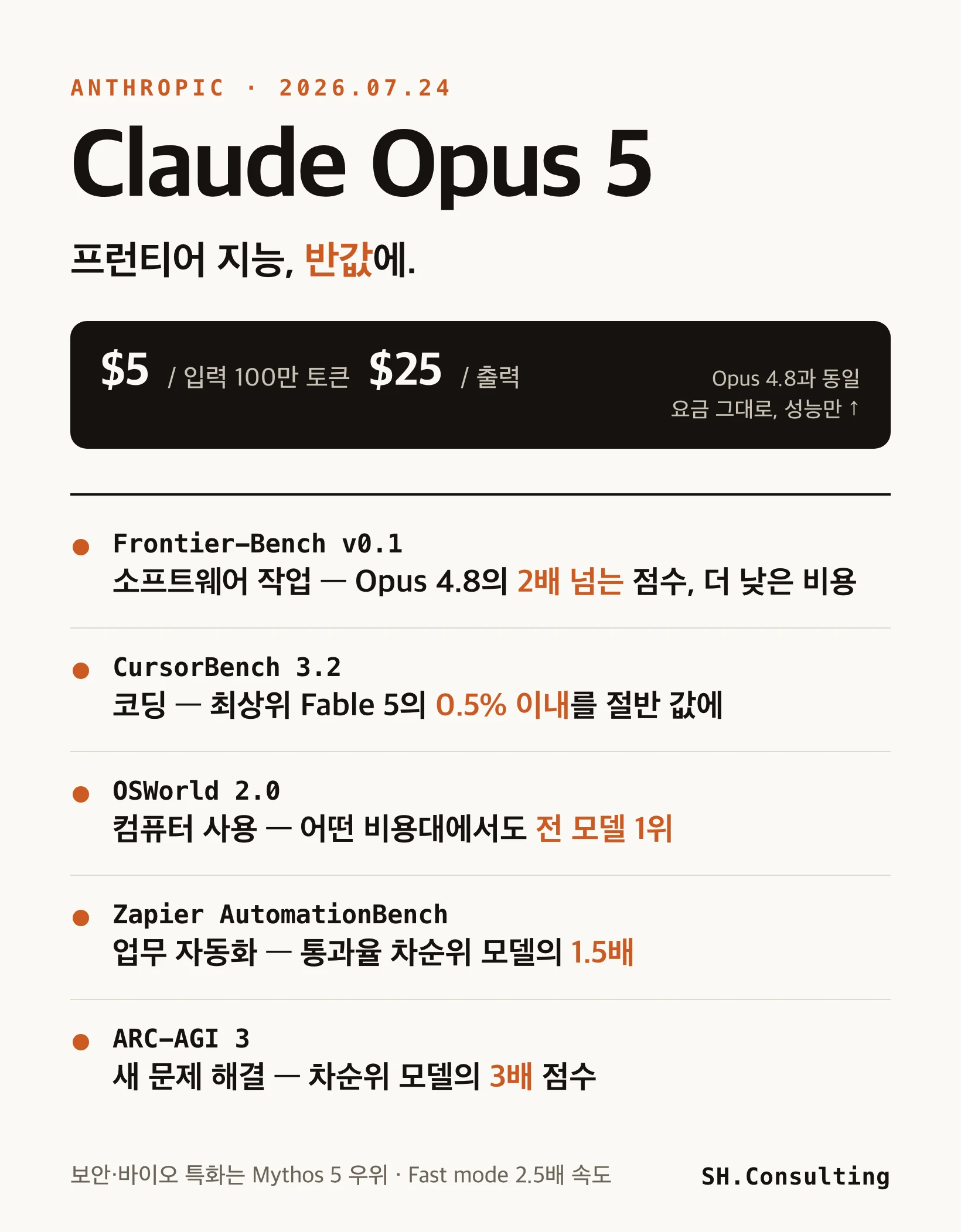
Pricing is $5 per million input tokens and $25 per million output tokens. A token is the unit an AI counts as it reads and writes text — roughly one to two tokens per English word. The key point: this is exactly the same price as the previous model, Opus 4.8.
So you pay the same and get better output. Anthropic describes it as greatly improved performance for the same cost as Opus 4.8. Across most benchmarks, Opus 5 posts higher scores at a lower cost.
The model has an effort setting that lets customers choose between faster answers and deeper, more deliberate reasoning. At high, extra-high, and max effort, Opus 5 delivers more performance per dollar than other models.
What the benchmarks say
A benchmark is a scorecard that pits models against the same tasks. Opus 5 is especially strong in software development, coding, computer use, and business automation.
In plain terms: it more than doubles the prior generation's software score at a lower price, and in coding it comes within 0.5% of the top model's peak at half the cost. On OSWorld, where the model clicks and types to operate a computer like a person, it ranks first at any cost level.
| Benchmark | Area | Result |
|---|---|---|
| Frontier-Bench v0.1 | Software engineering | More than double Opus 4.8's score at a lower cost |
| CursorBench 3.2 | Coding (agentic) | Within 0.5% of Fable 5's peak at half the cost (max effort) |
| ARC-AGI 3 | Novel problem solving | 3x the next-best model's score |
| Zapier AutomationBench | Business automation (end-to-end) | About 1.5x the next-best model's pass rate |
| OSWorld 2.0 | Computer use | Best of all models at any given cost |
| Organic chemistry / protein (internal) | Scientific research | +10.2 / +7.7 percentage points vs Opus 4.8 |
What is stronger as an agent
Most AI value today comes not from a single question-and-answer but from an 'agentic' approach, where the model takes multiple steps on its own to finish a task. Opus 5 is notably better at this. Anthropic says it is stronger at verifying its work and iterating carefully.
In practice that means it doesn't just write code and stop — it runs the result, finds what's wrong, and tries again. That's the same reason its pass rate on AutomationBench, which measures completing business tasks end to end, was about 1.5 times the next-best model.
Its computer-use ability and visual output generation also improved. For real work, it is closer to an assistant that handles several steps on its own from a single instruction.
What it means for leaders — and its limits
From a management view, the headline isn't raw performance — it's the cost-performance inflection. When performance doubles at the same budget, automation you shelved last year as too expensive may clear the break-even line this year. The shelf life of wait-and-see just got shorter.
This is felt first in areas heavy on human hours: coding, computer operation, repetitive back-office tasks. If you're evaluating adoption, start with the work people repeat today that a model can carry from start to finish.
But the limits are clear. Anthropic itself notes that Opus 5 trails a dedicated model, Mythos 5, in specialized areas like offensive cybersecurity and biology research (details are in the company's System Card). The best generalist isn't best at everything — some high-risk, specialized domains still call for other tools.
How to get started
The easiest path is a Claude subscription. With Claude Pro or Max, Opus 5 appears in the model picker in the app and web (it's the default on Max); just chat with it. Turn on Fast mode when you need quicker responses.
Developers call it on the Claude API with the model name claude-opus-5. You pay per use ($5 input / $25 output per million tokens), and raise the effort setting when you need deeper reasoning.
For a first organizational rollout, pick one or two repetitive tasks, validate results in a small scope, then expand. Even with higher performance, choosing what to delegate and checking the output remains a human job.