What ARC-AGI-3 Measures
Most AI benchmarks ask what a model knows. Solve the math problem, write the code, answer the exam question. Models that memorize and organize well score well.
ARC-AGI-3 does the opposite. It drops the model into an environment it has never seen and hands it no manual. It does not say what the rules are, what the goal is, or what counts as success. The model has to press things, observe what happens, and work it out.
It is the situation of a child holding an unfamiliar game console. No manual, just buttons. The child presses, watches the screen change, guesses what each button does, and infers the goal. This benchmark asks whether an AI can do that.
A nonprofit called ARC Prize built and scores it. That is why its authors treat it as an AGI indicator: it measures not recall but the ability to invent a method in a situation the model was never taught.
From 7.8 to 99.9 — How to Read the Number Correctly
The benchmark launched in March 2026. At first the best model scored 0.37%. Effectively, nobody could do it.
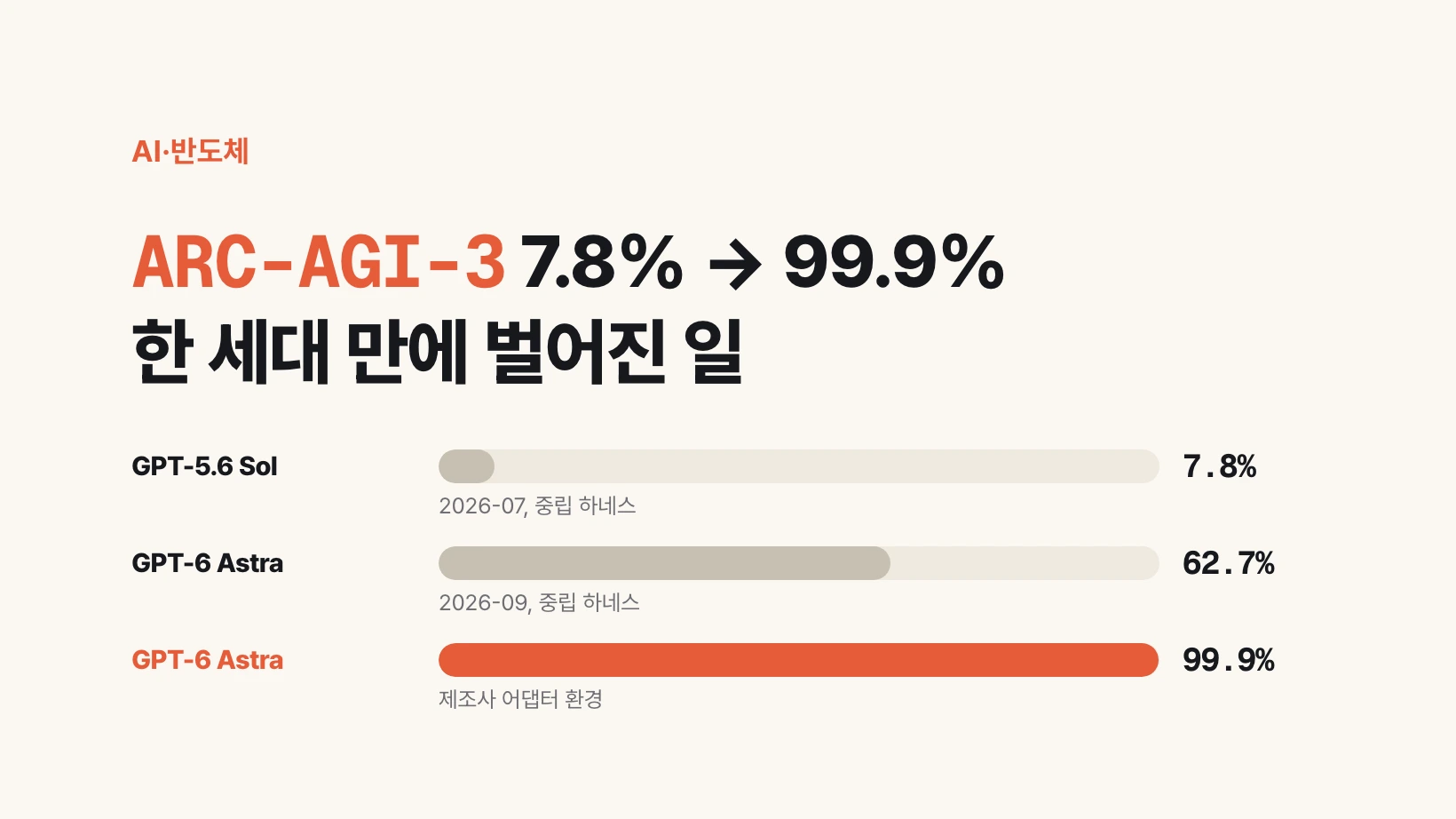
In July, OpenAI's GPT-5.6 Sol scored 7.8% — the first model to actually beat a single game on it. On the same basis, Claude Opus 5 scored 30.2%.
Then on September 3, 2026, GPT-6 Astra scored 99.9%. There is one condition you must carry along with that figure: there are two scores, not one.
ARC Prize measures on two harnesses. One is the Standard harness, applied identically to every vendor. The other is the Provider Adapter harness, which uses the vendor's own context management. Astra scored 62.7% on the Standard harness and 99.9% with the provider adapter. Same model, 37 percentage points apart.
The gap exists because the adapter preserves the model's internal reasoning state between requests. For a person, that is the difference between continuing a train of thought and starting over each time. By ARC Prize's measurement, it made runs roughly 3.66x faster overall and used 49% fewer tokens.
So 99.9% is not a wrong number; it is a conditioned one. And even stripped to the neutral basis, it went from 7.8% to 62.7% — roughly eight times in one generation. Measured either way, the direction is the same.
What Changed Is the Kind of Capability, Not the Score
More important than the number is what became possible.
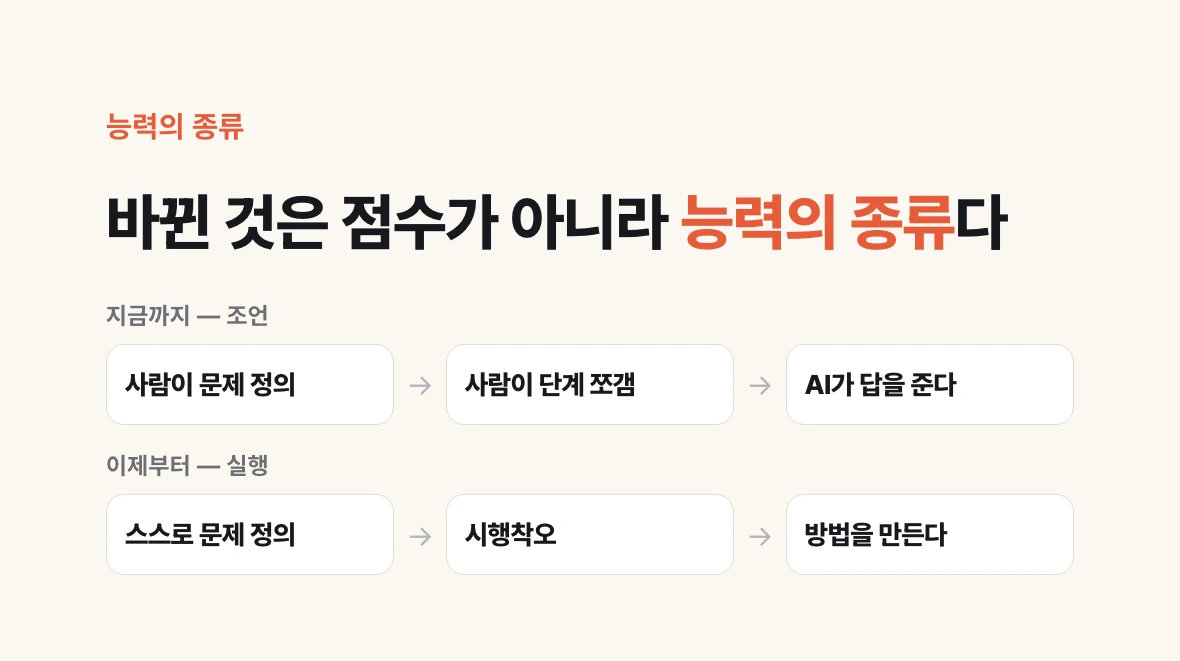
Until now, AI's usefulness was mostly advice. Ask and it answers, writes the spreadsheet formula, drafts the email, outlines the deck. It does all of this well, but a person has to start it. A person defines the problem, splits it into steps, and decides what comes next.
ARC-AGI-3 measures the step before that: defining the problem, going through trial and error, and inventing a method. A jump on this benchmark means AI can now begin unfamiliar work without human instruction.
The observations ARC Prize published alongside the score make the shift concrete. Astra used fewer actions than the human baseline on 96.0% of levels, averaging 51.7% fewer actions per level. It invented its own notation to track game mechanics, and when given a sandbox, built game-specific tooling for itself.
Economically, this difference is everything. AI that advises saves a person's time. AI that works replaces the labor itself.
Why This Becomes a Memory Story
Here is the bridge to semiconductors, and the link is tokens.
A token is the unit in which AI processes text — roughly a character or two in Korean, a word fragment in English. The cost and the compute of any AI task ultimately come down to how many tokens were processed.
Say a person asks a chatbot ten questions a day. Questions and answers together come to a few thousand tokens. An agent given one job and left running for hours is a different matter. It opens a browser, searches, reads results, changes course, runs a program, reads the failure, and tries again. Every intermediate step is tokens.
Then parallelism compounds it. Run five agents at once and consumption is not five times higher. Each agent is already doing a person's worth of trial and error, so the order of magnitude changes.
More compute needs more than GPUs. To hold a long context and carry state across many steps, that state has to live somewhere — high-bandwidth memory, HBM. And servers packed with HBM take conventional DRAM alongside it. More agents means more memory.
This is the same structure that moved semiconductor stocks when ChatGPT first arrived. What is different now is that the demand is generated not by a person typing questions but by AI working on its own for hours.
The Market Already Read It That Way
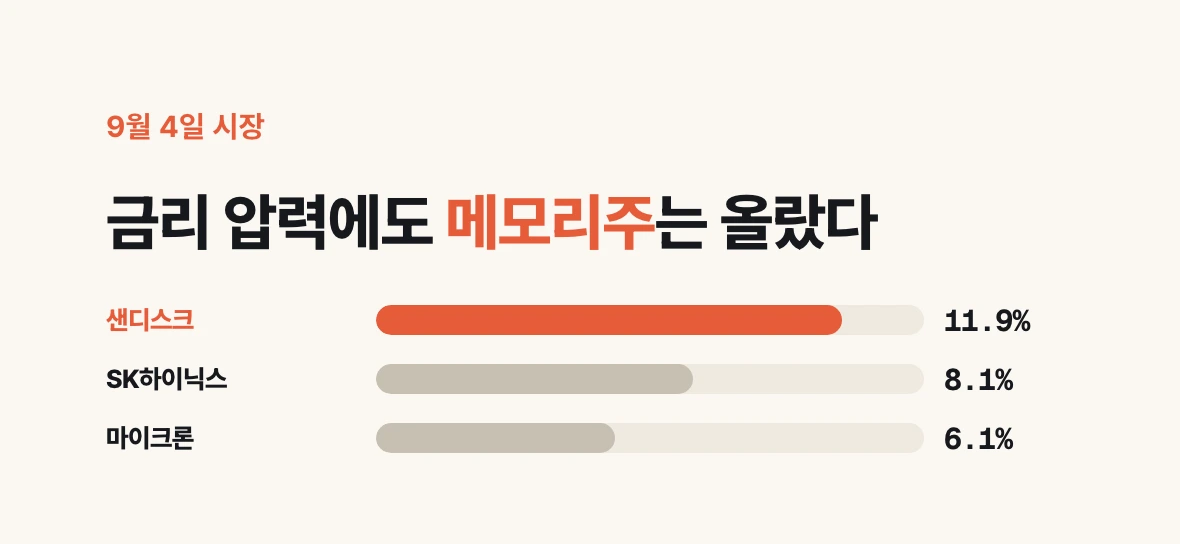
Market behavior on September 4, 2026, the day after the announcement, supports the reading.
One condition that day worked against memory stocks: US jobs data came in far above expectations, raising rate pressure, which weighs on equity valuations. Even so, SanDisk rose 11.9%, SK Hynix 8.1%, and Micron 6.1%.
Supply-side figures point the same way. Susquehanna expects DRAM contract prices to rise more than 50% this quarter and NAND about 60%. That is someone else's forecast, so it is recorded here in one attributed line and nothing more.
This piece is not a recommendation to buy anything. One benchmark does not determine a stock's future. What can be observed here is a direction, not a price.
What You Can Try Today
Reading about this change and feeling it firsthand are different things. Two things you can do today.
First, change how you instruct. If you have been spending time engineering elaborate prompts, this time state only the result you want in a sentence or two and hand it over. Do not split the steps. Do not interrupt. This is the change people who used Astra early describe consistently: stating the outcome works better than designing the instructions.
Second, check how many tokens that single run consumed. You can see it in the usage screen of ChatGPT or Claude, or in the dashboard if you use the API. Compare it to a normal single question. The basis of the supercycle argument lives in the gap between those two numbers.
One more thing worth carrying. There is a reason this piece never writes 99.9% without 62.7% beside it. Announced figures usually come with conditions, and checking the conditions is the only way to read a benchmark. The same habit applies when choosing AI tools.