Zombie UI — A Name Borrowed from the Postwar Building Boom
The analogy Katie Dill, Stripe's head of design, brought up in her Lenny and Friends Summit 2026 talk comes from architecture. When World War II ended, America saw the biggest building boom in its history. New construction methods arrived and buildings went up fast. The architects of the time borrowed the modernist style of the 1920s, a style marked by simple geometry, unadorned surfaces, and one or two colors.
Dill says the people who created modernism had intent. The problem came afterward. Buildings had to go up in a hurry, and the style was copied without reason. Thought grew thinner, and what remained was a generic template that did not fit its context. Older bank buildings showed trust, stability, and safety in their very appearance, but banks after the boom were indistinguishable from other buildings.
Dill calls such buildings zombie buildings: buildings indistinguishable from anything else, built with no regard for the people who use them, the surrounding context, or the brand. And Dill sees the present as another building boom, because AI lets 3 people do what 30 once did and lets anyone make screens. If the screens coming out of this boom follow the same path, that is zombie UI: screens that are monotonous, empty, and cared for by no one.
Three Ways AI Produces Zombie UI

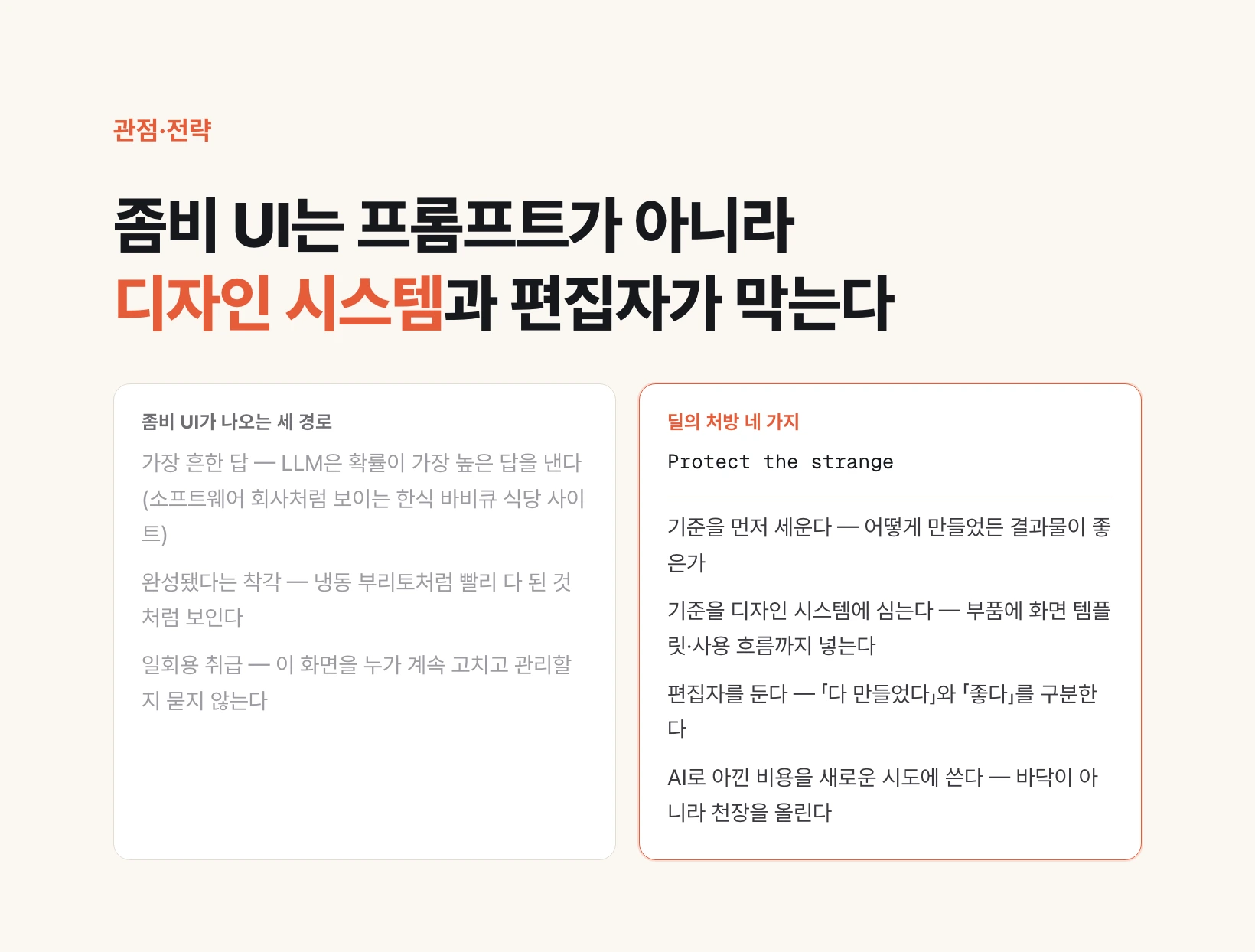
First, the most common answer. The LLM (large language model) underlying conversational AI such as ChatGPT and Claude is good at producing the most probable answer. An LLM is a model trained to predict the next word after reading enormous amounts of text. So it is good at telling you what has already been popular or has already worked. It is weak, by contrast, at answers that fit only my brand and my users. Dill's example was a Korean barbecue restaurant website that looks like a software company's. It is a perfectly decent site, but nothing about it feels like a restaurant.
Second, the illusion of being finished. AI makes something look done very quickly. Dill compared it to a frozen burrito. Take it out of the freezer, microwave it for 90 seconds, and you have lunch. Even if it tastes almost inedible, its speed lets it pass. Type one sentence and you get a screen with rounded corners and drop shadows. It looks finished, but whether it truly solves the problem and whether it stands apart from other things must be asked separately.
Third, treating it as disposable. Because things are made so easily and quickly, they feel like something you can throw away. Then responsibility for decisions slips away. Long-horizon questions go missing, such as who will keep fixing and maintaining this screen.
Dill warns that when these three combine, screens end up like a city covered in identical buildings. For the opposite case, Dill cited screens where small acts of care show: a browser tab with the calendar open that displays today's date, or a guide to solving the problems that an agent paying on someone's behalf would run into, put in ahead of time. An agent is an AI program that handles multiple steps on its own on behalf of a person.
Prescription 1 — Set the Standard First: "Is the Result Good, However It Was Made?"
Stripe puts its brand value of optimism into details large and small: color, sentences, the subjects it covers, the products it ships. Because many people build at the same time and a lot is changing, Dill says aligning on this standard together matters.
Dill also described a scene in which the standard was tested. In a design review of ad drafts, a colleague from a partner department who wanted to ship fast asked: what is the quality bar for things made with AI? Dill's answer was that how something was made does not matter to users. What users care about is whether it is good or not, and Stripe should too. After the standard was aligned on the spot, the team came out with 17 things to fix. They tweaked the frost effect bit by bit, softened the edges, made the bubbles a little smaller, and so on. Inside the company, this kind of meticulous touch-up is reportedly called by the verb "Pepsi bubbling."
The goal is not perfection. It is going one level deeper than a customer could see. Dill believes that care ultimately reaches the customer.
To build this standard, Dill points to the power of noticing: look not only at what users say but at what they actually need, and keep an eye out for what is excellent and what is merely so-so around you. Look not only in the products you use but in other fields such as art and science, Dill said.
Prescription 2 — Build the Standard into the Machine: Design the Design System, Not the Screen
Dill says that going forward, people will not be in every decision. Screens built without designers, agents that find and fix problems while people sleep, and screens generated in real time to fit each user are already appearing. That is why Dill sees design systems getting attention again. A design system is a company's screen-design convention that gathers parts such as colors, fonts, and buttons together with the rules for using them.
Past design systems did not need to spell everything out. Blanks were filled by the designer who was always there. Now that many people and agents build in scattered fashion, decisions have to be defined more clearly. In Dill's words, "the object of design is no longer the screen, it is the system itself."
Dill's historical example is Gutenberg. Gutenberg made not just 26 lowercase and 26 uppercase letters but 290 types, including letters of different widths, abbreviations, and ligatures. The aim was to avoid awkward gaps between words when printing with justified margins on both sides. In effect, he made the system broad enough and firm enough that machine-printed text looked handwritten. Dill sums it up: "the old system scaled consistency, the new system needs to scale intent."
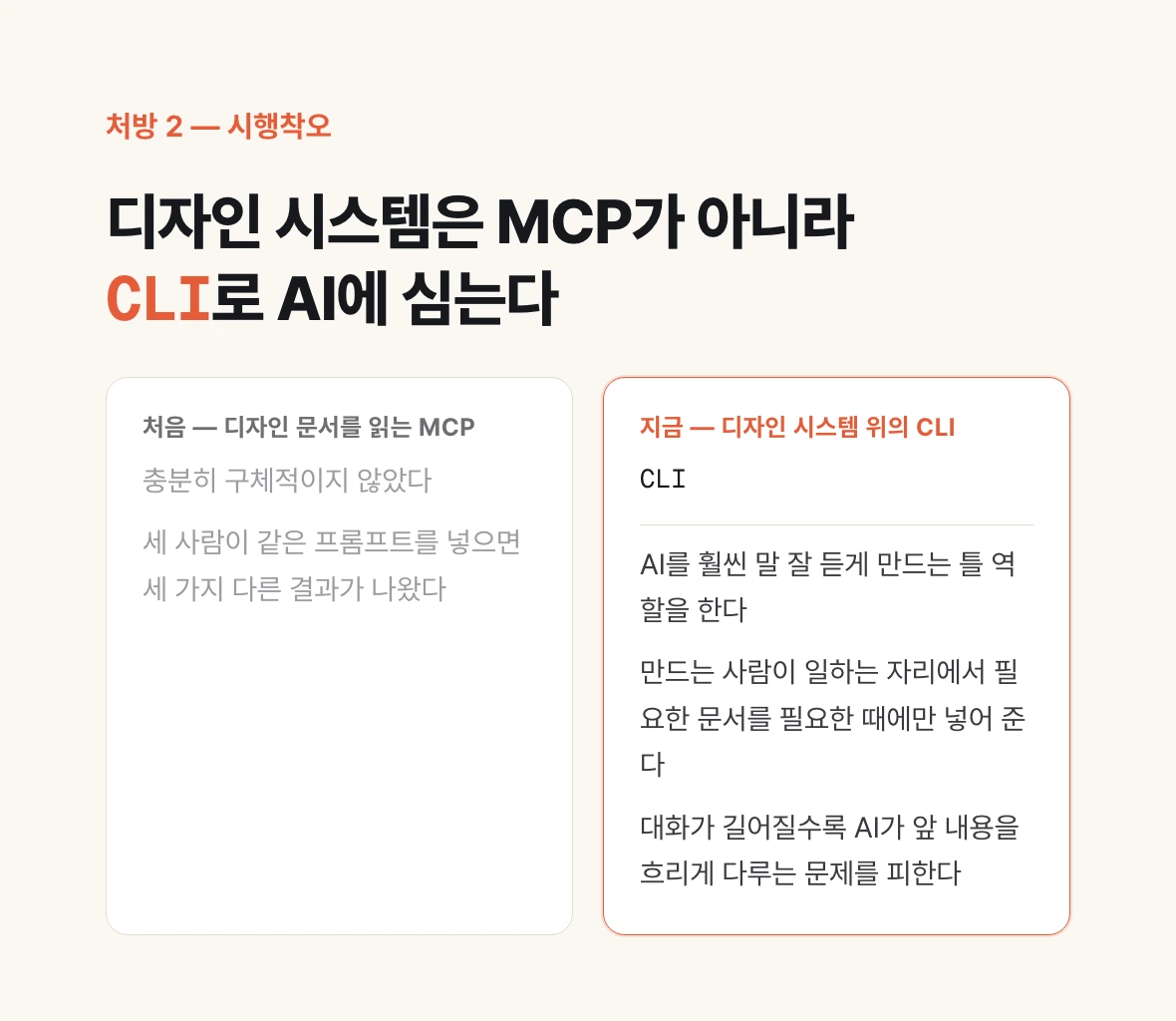
Dill also described Stripe's own trial and error. At first they attached an MCP that reads design documents. MCP is a connection standard that lets AI read and write external documents and tools. The results fell short. It was not specific enough, and when three people entered the same prompt (the request sentence given to an AI), they got three different results. Now they build and use a CLI on top of the design system. A CLI is a program operated by commands in a terminal. This CLI works as a frame that makes the AI far more obedient, and it supplies the needed documents only when needed, right where the builder is working. The aim is to avoid the problem where the longer a conversation gets, the more vaguely the AI handles earlier content.
The biggest difference is that it does not hold only parts. It includes screen templates and usage flows, so the system knows how Stripe products should behave. Dill describes it as a system with far firmer opinions than before. But Dill adds that this is only the floor. Borrowing a line from the architect Christopher Alexander, Dill said that "a system can satisfy every rule and still be dead."
Prescription 3 — Don't Confuse "Built" with "Good": The Editor's Seat

In the past, quality filtering was woven throughout the development process. Even with 20 ideas, only one could get people assigned to it, and you kept poking and polishing as you went. Now you can build 20 ideas in a week. It is good that you can touch real output instead of meeting over a hypothetical product. In exchange, filtering has been pushed to after the making, and saying no to something already built is much harder.
That is why Dill says the editor role matters most now: the person who looks from start to finish and judges whether these pieces become one whole product. Dill said we have to unlearn "built means done and done means good": being built is not being done, and being done is not being good.
To build editing skill, Dill says to experience the product yourself as the user would. Check whether it truly solves the problem, whether it fits how users think, and whether the front and back connect. A screen that looked fine on its own often looks off once stitched into a user journey, that is, the flow from entering to finishing the task and leaving. Editing is not only sorting pass from fail; it is also pushing the unfinished through to the end.
Citing Nabil Qureshi's writing, Dill locates the reason AI-made sloppy output grates in a feeling that the details do not matter: the feeling that the cup is green but would have made no difference if it were blue. The editor takes responsibility for every decision, effectively every pixel.
As an example, Dill showed a case of redoing one animation 56 times. The first version was worth watching, but frame by frame the motion was choppy somewhere. After 56 revisions it became a more realistic and lively scene. Dill adds that without AI, such a complex scene or so many viewpoints could not have been attempted. It was not done in one pass, but AI widened the range of what could be attempted.
Prescription 4 — Protect the Strange: Use AI to Raise the Ceiling, Not Just the Floor
This is the last prescription, and the one Dill said is the most cherished. AI can mass-produce monotony, but it is also the greatest creative catalyst yet. The more everyone is making something, the harder and more important it becomes to be different from others.
Dill says the chat window, the chart, and the command line cannot be the final form of interfaces for this era. An interface is the window through which people exchange with computers, that is, the screen and the way of operating it. Just as multitouch enabled wholly new kinds of operation and the synthesizer made new sounds, it is time to make new interfaces and a new aesthetic with AI. A good methodology has not yet been written, and we can write it, Dill said. At Stripe, a publication cover was made from patterns by a human marbling artist, and AI then refined the colors and lines further. It is a case of extending human judgment with AI.
Dill offers two ways to use AI as a better creative partner. One is to give specific input. Do not stop at "I need a Korean barbecue restaurant website"; put in what we believe, what we see as good, and what we cherish, along with the material referenced in setting the standard. The other is to test the output. Do not give in to the burrito's temptation: push one step further, and attach an agent in a critic's role to pound on the result. Even so, Dill said, the one who demands better to the very end must be yourself.
Dill says these are only tricks and the harder part is culture, because following patterns that fit the mold is safer and more comfortable. To people leading teams, Dill recommends not just saying "use AI" but giving room to explore. Dill's phrase is "Protect the strange." Since AI has lowered the cost of making, let's spend part of those savings on making something truly special. If it is spent only on making faster what was already being made, you miss the most interesting part. AI can "raise the ceiling, not just the floor."
Closing — Like a Gothic Cathedral, a Product That Shows the Maker's Hand
As the opposite of postwar modernism, Dill cites Gothic architecture. The 19th-century English critic John Ruskin noted that no Gothic building is the same as another and that even a single pillar differs from the next. In every detail the hand and thought of the maker show, so the care can be felt.
Dill says that is exactly what users want. Users do not marvel that a 3D animation was made in 30 minutes. They marvel when it solves their problem, has details that anticipated their needs, and the brand has character. That we can avoid making a digital version of zombie buildings in this building boom, and make it a renaissance of creation instead, is the last thing said in the talk.
Try Today — Four Things Dill Recommended in the Talk
One, when asking AI for a screen or text, include in the request what the brand believes, the standard for what is good, and reference material. Do not stop at a single line like "Build me a restaurant website."
Two, use the result yourself from start to finish, like a user. Look at it not as a single screen but as the flow from entering to finishing the task and leaving.
Three, do not stop at the first result; revise once more. Having a critic-role AI review it separately to find weaknesses is also a method.
Four, if you lead a team, do not stop at producing the same results faster; leave time and room to try unfamiliar things.