What exactly are OpenClaw and Hermes?
Both are open-source AI agents. You install one on your PC or server, then write 'clean up this folder' or 'find this material and turn it into a table' from a messenger such as Telegram, Slack, or Discord, and it actually creates files, writes code, and searches the web. What separates them from a chatbot is that they do not merely talk — they run commands on your machine. Think of it as hiring an assistant.
OpenClaw was built by the Austrian developer Peter Steinberger and went viral in early 2026 (it was previously called Clawdbot and Moltbot). In February 2026 the founder joined OpenAI, and the project itself moved to an independent foundation that OpenAI funds and contributes to. Hermes is built and still directly operated by Nous Research.
The software itself is open source in both cases, so downloading it costs nothing. The models you can attach are also effectively the same — Claude, GPT, and Gemini as a baseline, plus Chinese models and local models, dozens in total. That is why 'which one has more features' is a question that does not resolve. Comparing feature lists side by side is not worth your time.
The five criteria in one table
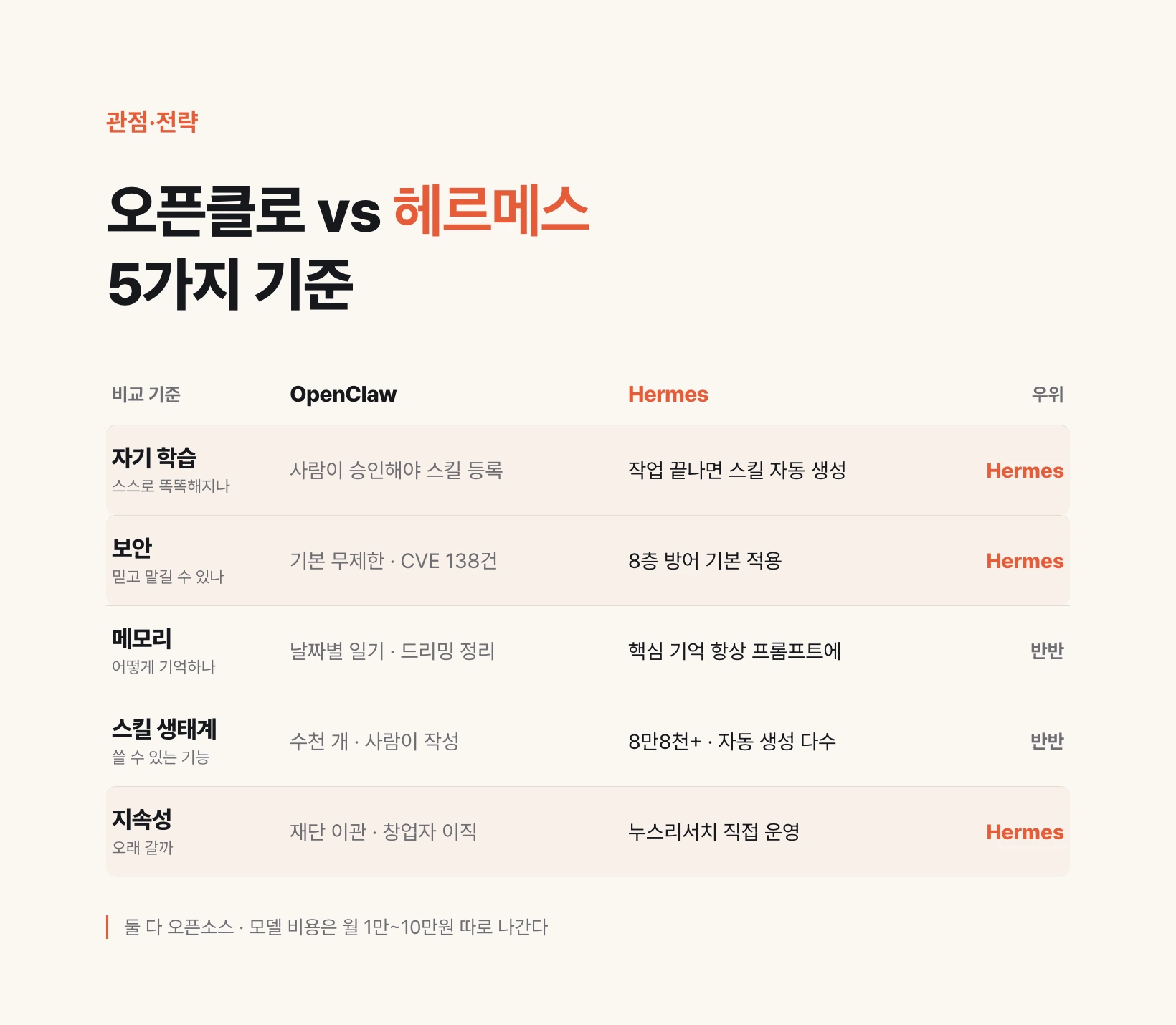
The table below is the conclusion of this article. The verdict column leans toward Hermes, but that does not mean Hermes wins outright. The two rows scored as a draw flip easily depending on how you work.
| Criterion | OpenClaw | Hermes | Verdict |
|---|---|---|---|
| Self-learning | Human approval required to register a skill | Skill created automatically after a task | Hermes |
| Security | Effectively unrestricted defaults · 138 CVEs | Seven-layer defense on by default | Hermes |
| Memory | Dated journal · dreaming consolidation | Core memory always in the prompt | Draw |
| Skill ecosystem | Thousands · mostly human-written | 88,000+ · many machine-generated | Draw |
| Longevity | Moved to a foundation · founder left | Operated directly by Nous Research | Hermes |
At which moments does Hermes save a skill on its own?
A skill here is a note that records how a certain kind of job gets done. The next time you assign something similar, the agent pulls up that note and follows it. It does not have to think from scratch, so it gets faster and the output gets more consistent.
OpenClaw creates skills too, but only as drafts. A human has to approve the registration before a draft becomes a real skill. That keeps control with the operator, which also means the operator has to keep tending it.
Hermes saves without approval — but it does not keep everything. Its documentation names four moments. First, after successfully finishing a complex task that took more than five tool calls. Second, after fighting through errors or dead ends and finding the path that works. Third, after the user corrects its approach. Fourth, when it meets a workflow it has never seen. The principle is simple: keep only what is worth reusing.
Skills live in ~/.hermes/skills/ under your home directory. They are plain files, so you can open, edit, or delete them at any time. That makes Hermes less of a tool that does everything the moment you install it, and more of a tool that shapes itself around how you work. An independent benchmark (TokenMix, April 2026) found that once an agent has more than twenty self-created skills, similar tasks finish about 40 percent faster. It does not carry over to genuinely different kinds of work.
What do 138 CVEs and a eight-layer defense actually mean?
A CVE is the identifier the world uses in common for a security flaw. When a way in is found in a piece of software, it gets a number and is published. So the count measures how many holes have been publicly disclosed.
OpenClaw had 138 disclosed between February and April 2026 alone — 7 rated critical and 49 rated high. They include remote code execution and privilege escalation, the kinds that let someone actually take over a machine. That is the price of a design philosophy where the defaults are effectively unrestricted and risk management is left to the operator.
Hermes takes the opposite stance and ships with the locks already on. Dangerous commands are surfaced for human approval before they run, the agent is confined to an isolated container so it cannot touch system files, credentials and tokens are filtered out, and documents pulled from the web are scanned for prompt-injection patterns before anything reaches the system prompt. The documentation calls this a eight-layer defense-in-depth model.
A vulnerability count is not the same as a risk level. A project with overwhelmingly more users also gets more flaws found and fixed faster. Still, if you are not confident you will harden the settings yourself right after installing, starting from safe defaults is the better bet.
Why are memory and the skill ecosystem a draw?
Memory is file-based on both sides. A person can open and edit it, and nothing about what is remembered is hidden. Neither is short on transparency. What differs is the layer built on top.
OpenClaw keeps a dated journal. It stacks up what happened that day in a file per date, and a background process called dreaming reads through that record and promotes only the important parts into long-term memory — the same structure as a person consolidating memories in sleep.
Hermes deliberately keeps its core files light, because those files are injected into the system prompt in full at the start of every conversation. The bulk of the conversation history is stored separately in a searchable form and retrieved when needed. It is the side that always starts already remembering you.
Skill counts are not a ranking either. Hermes exceeds 88,000 across all registries, but a large share are machine-generated and uneven in quality. OpenClaw has a few thousand, mostly written by people and correspondingly more trustworthy. It is a trade between volume and reliability, not a matter of one being better.
If the software is free, where does the cost come from?
The agent program is free. The AI model doing the thinking is billed separately. Start without knowing that and the first invoice is a surprise. That is why 'free' should not be taken at face value.
There are two ways to attach one: connect a subscription you already pay for (ChatGPT, Claude, and so on), or go pay-as-you-go through a broker such as OpenRouter. OpenRouter lets you pick among many vendors' models from a single account, which makes it a good place to start with something cheap.
Realistically, a cheap model on a cheap server runs about 10,000 to 20,000 won a month; running a strong model properly runs 30,000 to 100,000. Start cheap, give it real work, and move up only when the output falls short.
So which one should you install?
The rule fits in two lines. If you enjoy tinkering and assembling, and several people at work will share it with a transparent record, take OpenClaw. If you would rather set it up once and let it grow, security matters, and you work alone as a solo founder or developer, take Hermes.
Spend the first thirty minutes like this. One, settle the model connection — decide here whether you are linking an existing subscription or going pay-as-you-go through OpenRouter. Two, connect exactly one messenger; whichever you already open most often is enough. Three, hand it one job you genuinely repeat every week. With Hermes, open ~/.hermes/skills/ the moment that job finishes and see whether a skill appeared — that is the fastest way to understand what self-learning means here.
Plenty of posts in overseas communities describe starting on OpenClaw and moving to Hermes: try the flashy one first, then settle on the one you will run for the long haul. But that is a matter of taste and context, not one side being inferior. Just find your own row in the table above.