One sentence changes the answer
Ask the same problem two ways and the difference shows.
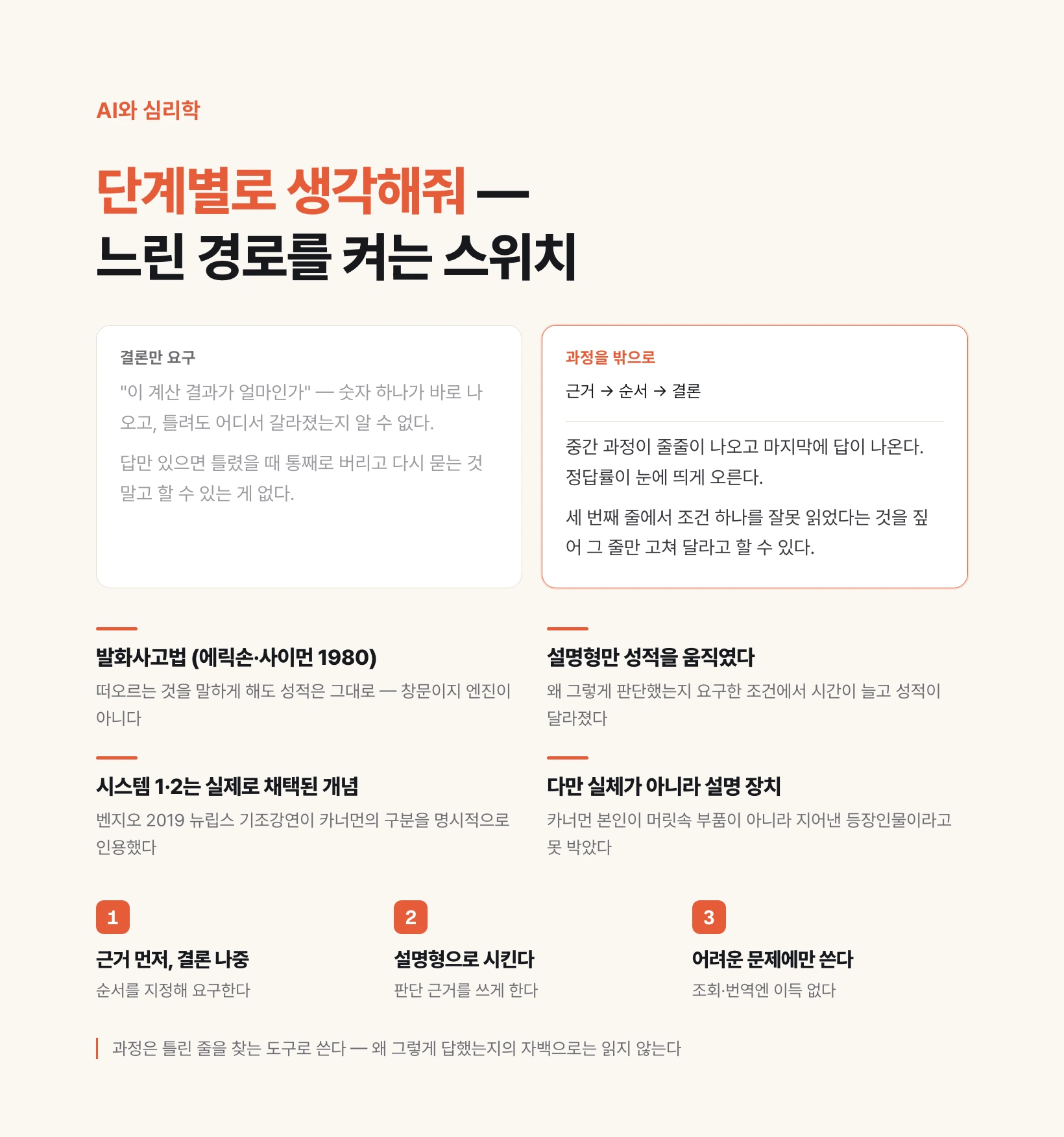
First: what is the result of this calculation? A single number comes straight back. Sometimes wrong.
Second: calculate this by thinking step by step. Intermediate work comes out in a line, and the answer arrives at the end. Accuracy rises noticeably.
Same model. Same problem. The only change was forcing the route to the conclusion outside. Why that works, and how far you should trust it, is this episode.
1980: thinking aloud
Studying what goes on in a head has an old difficulty. Look only at the answer and you cannot see how it was reached. Right answers hide how they were reached; wrong ones hide where things went off.
The method K. Anders Ericsson and Herbert Simon set out in a 1980 paper is the think aloud protocol. A person solving a problem keeps saying out loud whatever comes to mind while solving it.
Two conditions in the design matter. First, they speak while solving, not recalling afterward. Recall is already tidied and edited, so it differs from the actual process. The reconstruction seen in episode six operates here too.
Second, they are not asked to explain why they did what they did. They just say what is currently in mind. Why that second condition matters comes shortly.
But the point of the method was the opposite
Here is where it is easy to misread. The two authors' core claim was not that speaking makes you solve better; it was closer to the reverse.
What they were arguing is that speaking aloud barely changes the thinking process, and therefore what is said can be trusted as research data. If the act of speaking altered the thinking, then what you observed would differ from thinking unobserved, and it would be useless as data.
A later meta analysis pooling dozens of studies supported this. Across thousands of participants in total, performance under the say what comes to mind condition was effectively no different from not speaking at all.
So the method is a tool for observing thought, not a technique for improving it. A window, not an engine.
Though it depends what kind of speaking
The same meta analysis splits at one point. What you ask people to say changes the result.
Saying whatever came to mind had no effect on performance. Being asked to explain why you think that was different. Time on task increased and performance moved. On some tasks it improved.
The reason is guessable. To explain you must produce a reason, and to produce a reason you must look again at the judgment you just made. That looking back is itself new work. It is a fundamentally different task from reciting what surfaced.
This distinction matters because what we ask of AI is closer to the second than the first. Think step by step does not mean recite whatever surfaces; it means lay out grounds and order. In humans too, that was the side that moved performance.
Fast thinking and slow thinking
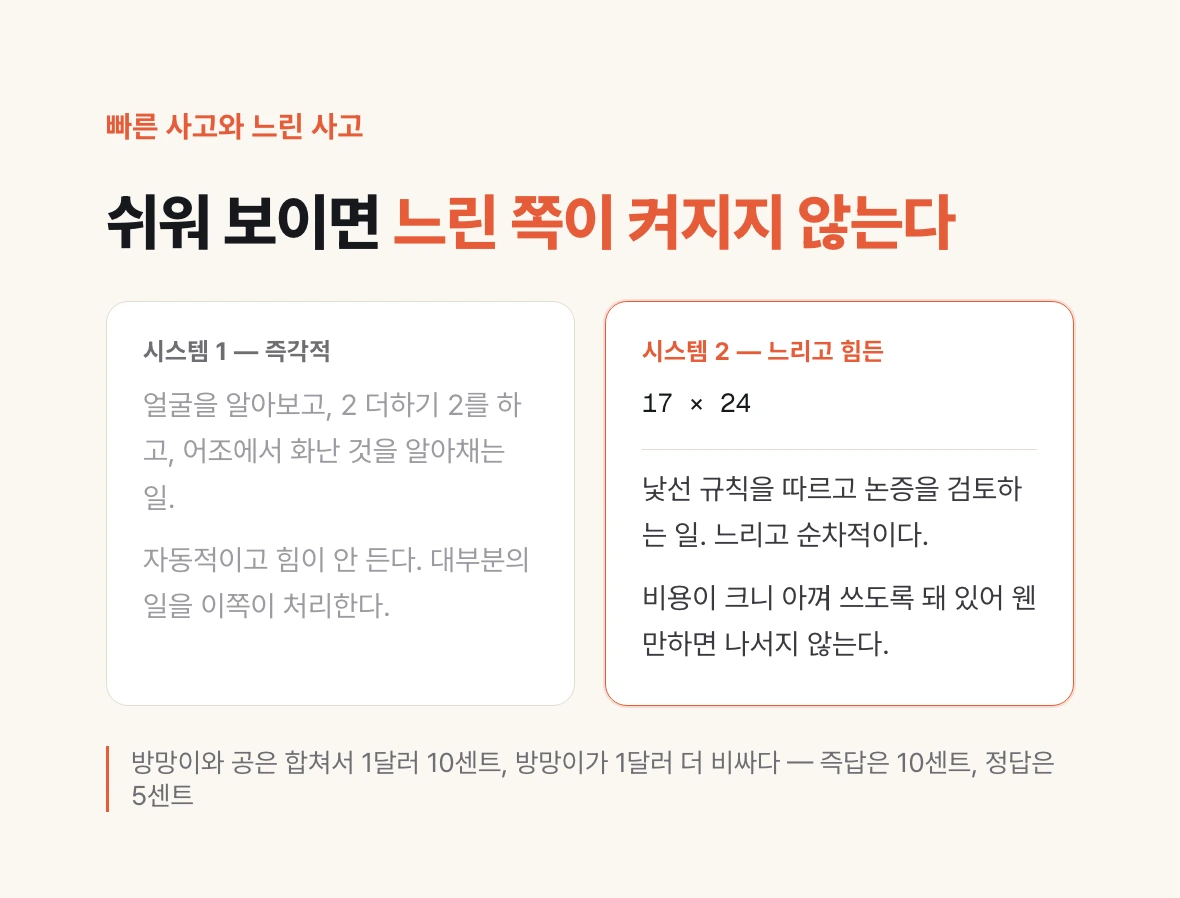
Now add the distinction Kahneman popularized. System 1 is immediate, automatic and effortless: recognizing a face, doing two plus two, hearing anger in a tone. System 2 is slow, sequential and effortful: multiplying seventeen by twenty four, following an unfamiliar rule, examining an argument.
The trouble is that System 1 handles most of the work and System 2 does not step in unless it has to. The slow side is expensive, so it is set up to be spent sparingly.
That is why people get easy looking problems wrong so often. With no signal of difficulty, the slow side never switches on and the answer that surfaced goes out as is. The famous case is the bat and ball. Together they cost one dollar and ten cents, and the bat costs a dollar more than the ball; how much is the ball? Ten cents surfaces instantly and many people say it. The answer is five cents.
The lesson is that this is not a failure of knowledge. People who can do the arithmetic get it wrong by not doing the arithmetic.
AI research borrowed the distinction
This is the lineage part. Yoshua Bengio titled his 2019 NeurIPS keynote From System 1 Deep Learning to System 2 Deep Learning and cited Kahneman's distinction explicitly.
The diagnosis ran like this. What deep learning does well is immediate pattern recognition: seeing a picture and recognizing a cat, seeing a sentence and picking a natural next word. All System 1 territory. What is missing is sequential reasoning, causality and planning, the things that have to be walked one step at a time.
What followed went that direction. Prompts that stop the model from answering immediately and make it produce intermediate work, and then reasoning models that build that process inside, thinking at length before answering. Think step by step works because it acts as a switch that forces the slow side on.
Two lineages part ways here. System 1 and 2 is a concept AI research genuinely took from psychology. The relation between think aloud protocols and intermediate step prompting, on the other hand, is not lineage but functional resemblance. The principle did not carry over; the job it does looks similar.
But its author said not to treat it as real
This is the part this series has to leave standing honestly.
First, the names System 1 and System 2 are not Kahneman's inventions. In the book he says he borrowed the terms from other researchers. His book was simply what made them widely known.
Second, and more important, is what he said the two are. He was explicit that System 1 and System 2 are not parts that actually exist in a head. They are closer to characters invented for exposition, used that way because telling it like a story aids understanding. There is no region of the brain in charge of System 2.
So this episode's badge is partial lineage rather than lineage. The concept really was adopted. But something that was already an expository device in psychology is easily read as structure once it crosses into AI. There is no System 1 circuit and System 2 circuit sitting separately inside a model.
The final episode of this series is about that family of problems: places where a word borrowed from psychology hardens into a different meaning in AI.
One term only: dual process
Dual process is the view that judgment runs along two routes, one fast and automatic, one slow and deliberate.
The caution is exactly as stated above. This is an explanatory frame, not anatomy claiming two parts in the brain. All the more so when carried into AI.
It is still useful because it tells you when to intervene. Problems that look easy but have tangled conditions; problems where an answer surfaces instantly and that answer is the trap. In people and in AI alike, those are the spots where forcing the slow route on pays.
What improves when the process is visible

The real gain from surfacing intermediate work is not only accuracy. Being able to point at where it went wrong is worth just as much.
With only an answer, a wrong result has to be thrown out whole. There is nothing to do but ask again. With the process, you can see that a condition was misread on the third line and ask for just that line to be fixed. Verification cost drops sharply.
One caveat must be attached here. There is no guarantee that the process a model wrote out is a record of the computation that actually produced the answer.
A 2025 study from Anthropic measures exactly this. Researchers slipped a hint into problems so that the model changed its answer because of the hint, then checked whether its written explanation mentioned the hint. In a substantial share of cases it did not. The hint was used, and the explanation gave a different reason.
So the right summary is this. The trace is extremely useful as something to inspect and unwise to treat as a confession. Use it to find the wrong line; do not accept it as the final account of why the model answered as it did.
So what changes tomorrow
Require the intermediate work. Not conclusion only, but specify the order: grounds first, then conclusion. Let the conclusion be written first and the rest becomes prose justifying it. Same reason as the source first rule from episode six.
Ask for the explanatory kind. Not list whatever comes to mind, but write what you judged on at each step. In the human studies too, the explanatory kind was the side that moved performance.
Use it only on hard problems. Demanding steps for lookups, translation or format conversion only makes output long and slow. The gain is in calculation, comparison and judgments with several tangled conditions. The same call applies when choosing to use a reasoning model.
The more instantly an answer surfaces, the more you should doubt it. That is the bat and ball lesson. Looks easy but conditions are tangled is exactly the spot to switch the slow route on. The same holds when you apply it to yourself.
Read the trace, but not as a confession. Use it as a tool for locating the wrong line, and do not conclude that its stated reasons are the actual ones.