Anthropic Lists on Nasdaq — $83 IPO Price, About $93.5 Billion Raised in the Offering
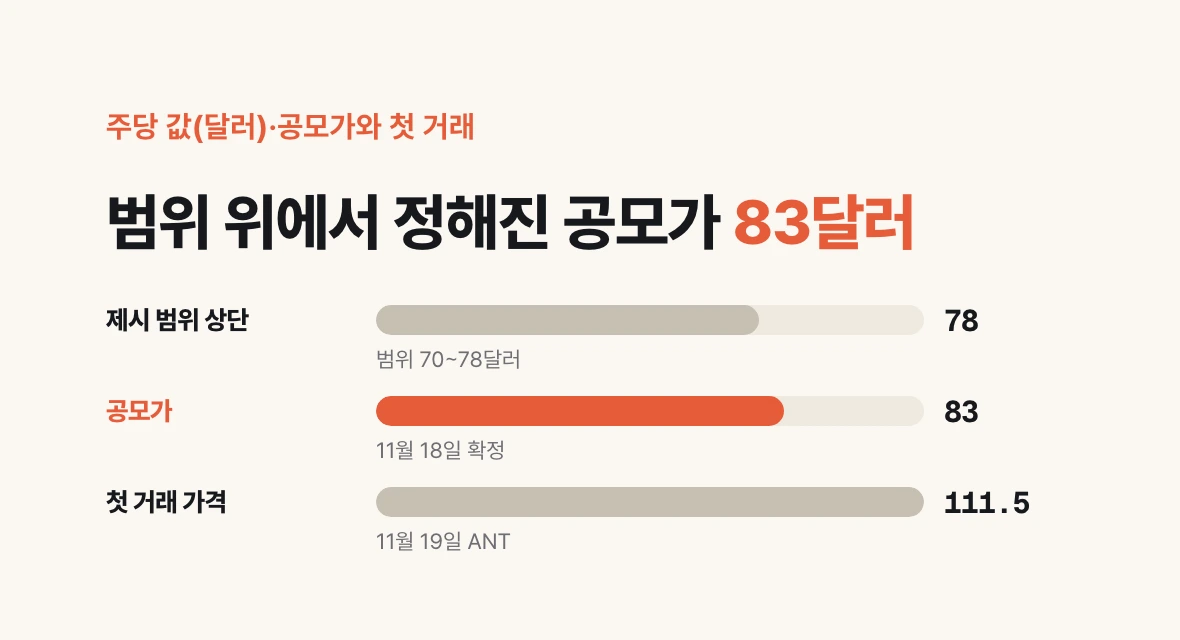
Anthropic, the maker of Claude, set its IPO price at $83 per share on November 18. The IPO price is the price at which shares are first sold to investors before listing. The range the company gave last week was $70 to $78, so the price landed above it. Trading began on Nasdaq on November 19 under the ticker 'ANT,' with a first trade at $111.50 per share.
According to the closing announcement the company made on November 20, the final offering was 1.127 billion shares. That is the 980 million shares originally offered, plus 147 million shares from the over-allotment (an extra portion the underwriters can buy if demand is strong), which was exercised in full. The total offering was about $93.5 billion before fees, of which about $91.6 billion went to the company. Shares sold separately at the same price (a private placement) to AMD, Broadcom, Google, Micron, Microsoft, Nvidia and TSMC came to about $26.0 billion as well, so the total raised this time is about $119.5 billion.
First-half 2026 revenue stated in the listing filing is $16.3 billion. A public company must report results every quarter, so if your company uses Claude for work, you can now follow in public filings the numbers behind decisions such as pricing and usage limits.
Gemini 4 Neon — Near-Top Performance at a Mid-Range Price
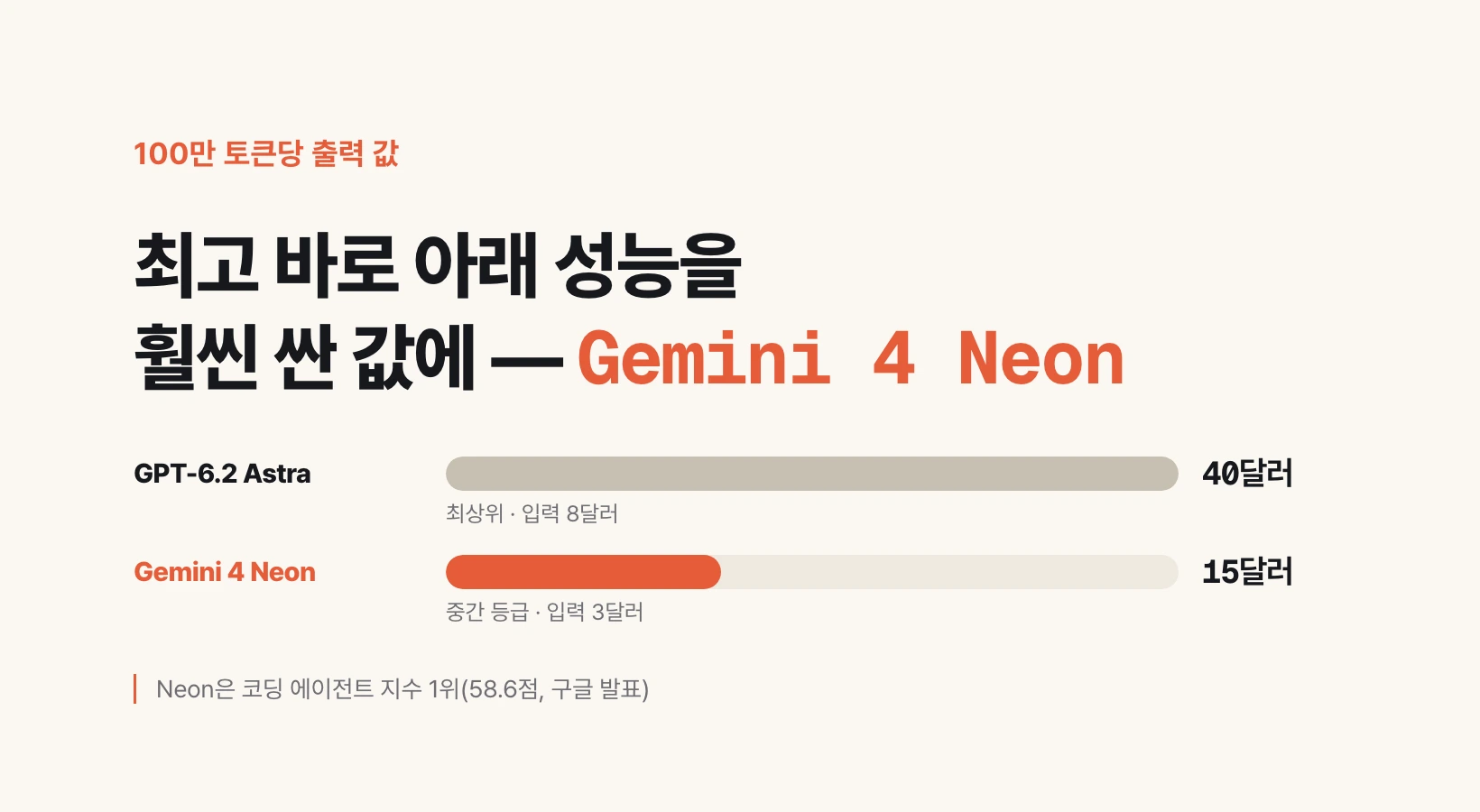
Google released Gemini 4 Neon on November 18. It is a mid-tier model that sits between Carbon, the largest in the Gemini 4 family, and Hydrogen, the fast and cheap one. It costs $3 per million input tokens and $15 per million output tokens. A token is the unit AI uses to count text in small pieces; one Korean character is roughly one to two tokens. Input that has been stored for resending the same content (cache) costs $0.15 per million tokens, 95% cheaper. The amount it can read at once (the context window) is 1 million tokens.
Google said that on the composite index of Artificial Analysis, an independent site that compares model scores, Neon scored 61 and ranked 3rd overall, and on the coding agent index it scored 58.6 and ranked 1st. An agent is an AI program that takes a goal and handles several steps on its own. Google also said the cost of finishing one task under default settings is 32% lower than Carbon. These comparisons use conditions the company chose.
Compared with OpenAI's top model GPT-6.2 Astra, covered in the November 19 daily, at $8 per million input tokens and $40 per million output tokens, this week's models all point the same way: 'slightly below the best performance at a much lower price.' Neon is open to the developer Gemini API (the connection point that lets other programs call AI, via Google AI Studio), Gemini for enterprise, paying subscribers of Antigravity (Google's AI coding tool), and Pro and Ultra subscribers of the Gemini app. Try running one daily document-cleanup or code-fix task on Neon and compare cost and results side by side with the model you use now.
Microsoft MAI Code 2 — Everyday Coding at a Lower Price
At its Ignite event on November 17, Microsoft released the coding model MAI Code 2 and a lighter version, MAI Code 2 Flash. Using the average of four tests that measure everyday coding tasks common in GitHub Copilot, the company said MAI Code 2 delivers 98% of GPT-6.1 Sol's performance at 40% of the cost, and 96% of Claude Opus 5.5's performance at 5% of the cost. However, that cost is based on the 50% launch promotion price, and all the numbers were measured by Microsoft itself.
The company itself wrote that the models are not yet tuned for hard problems such as scientific research or very long agent tasks. Both models can be used right away in GitHub Copilot and will soon be added to OpenRouter, Vercel and others. On the same day it also released the image-editing model MAI Image 2.7 (about $35 per 1,000 images, public preview on Microsoft Foundry) and the real-time voice conversation model MAI Realtime 1 ($0.01 per minute for basic voice conversation). All three promote themselves as 'close to the best and much cheaper.'
Gemini Notebook — Turn Your Materials into a Website with One Line, 'make me a site'
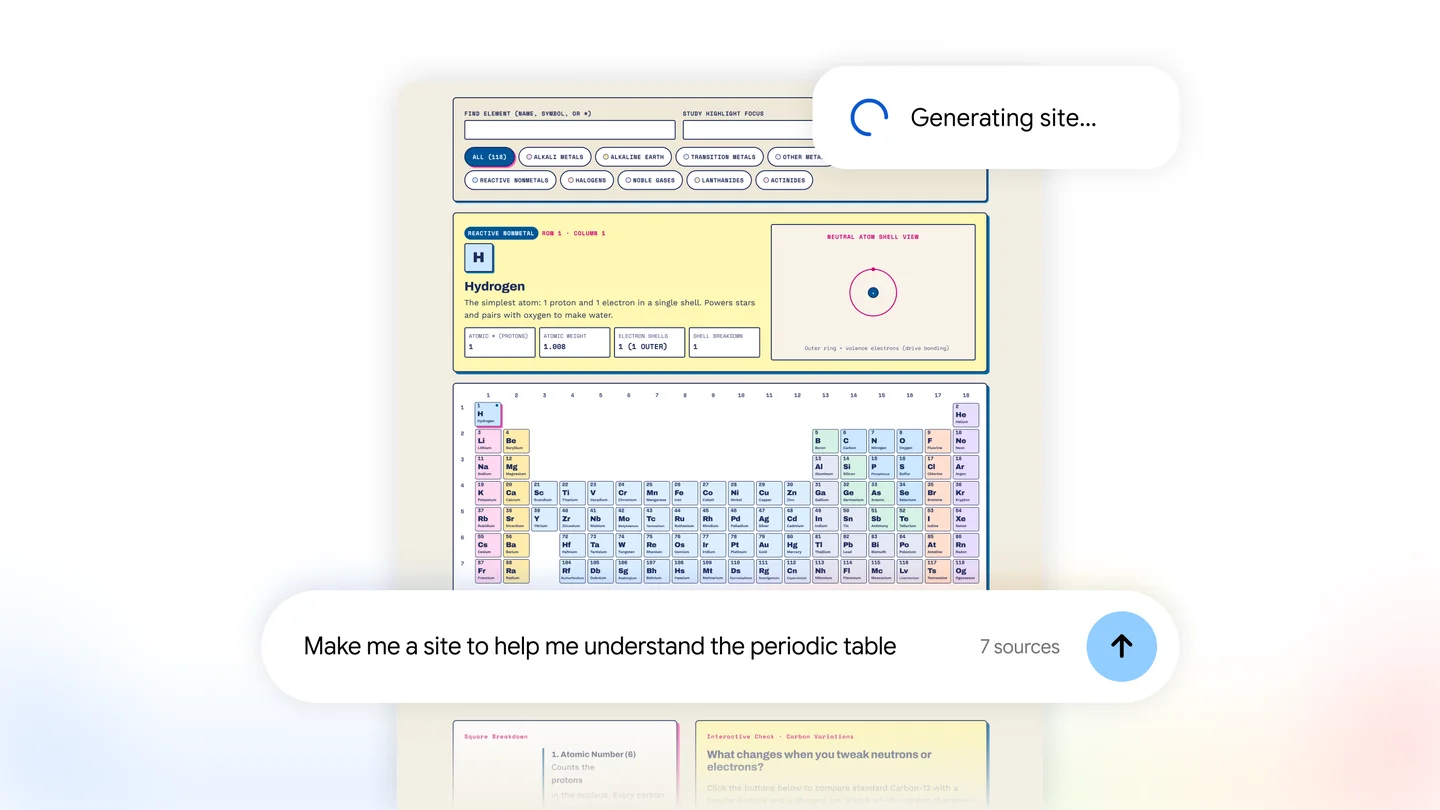
Gemini Notebook is the new name for the former NotebookLM. It is a tool where you upload your notes, documents and materials and ask questions inside them. On November 16, Google added website building to it. Type 'make me a site' in the chat box along with what you want to build, and it creates a website you can click through using the materials you uploaded.
Google's examples include a periodic table or history timeline for exam study, a dashboard for exploring quarterly sales, and a project tracker that organizes tasks and deadlines. When it is done, you can open it with 'Open in new tab' or share it with others. It opened worldwide at once on the web for users 18 and older, including Google Workspace subscribers. The mobile app is coming soon. Even without knowing code, you can turn meeting materials or a bundle of reports into a one-page explainer site, so try it with one set of materials this week.
Gemini Mac App Computer Use — Handing Off Repetitive Clicking to Work in the Background
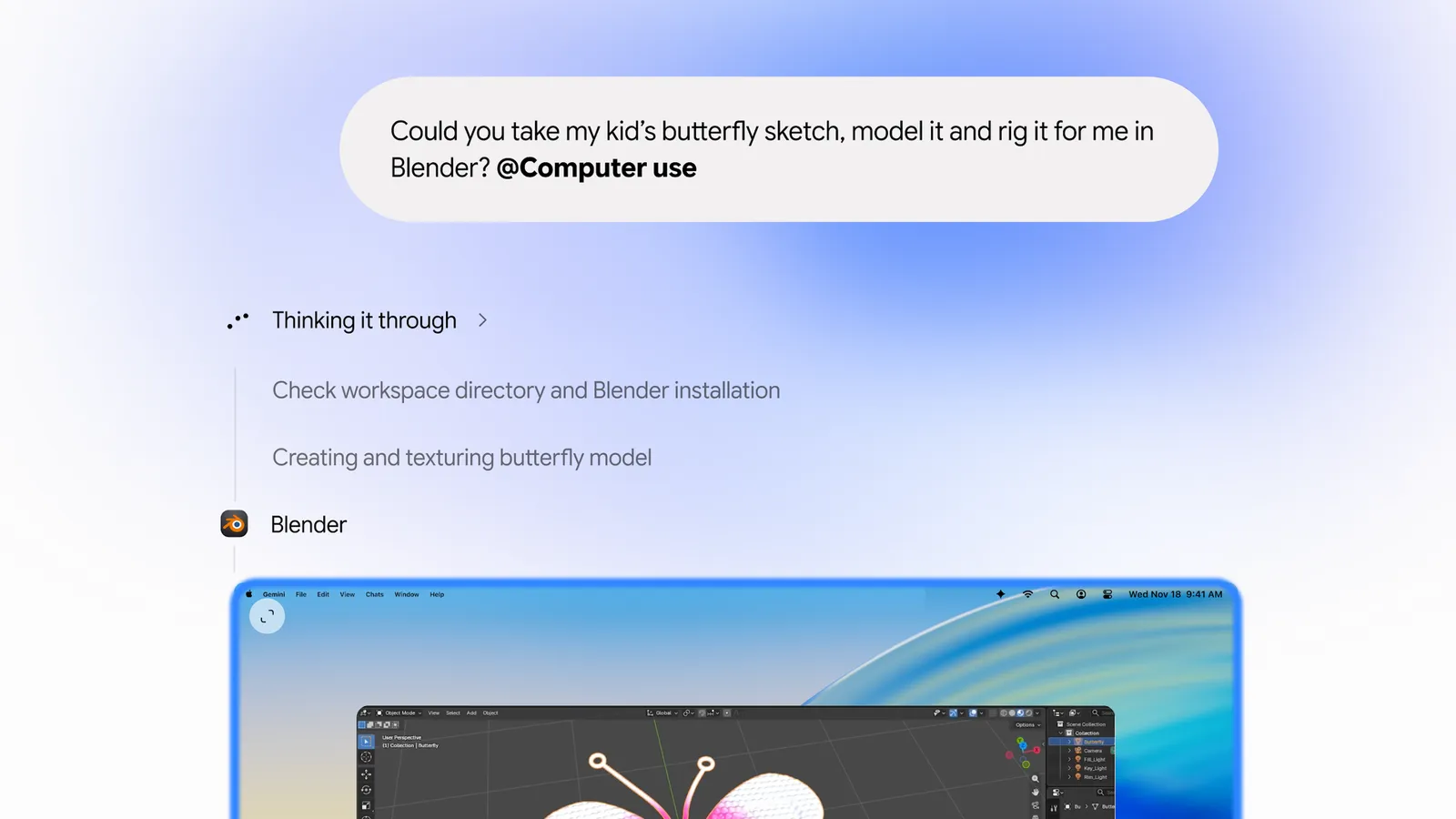
On November 19, Google added a computer use feature to the Gemini app for Mac. When you describe a task in words, Gemini moves across your files, desktop apps and the web, clicking, typing text and filling in forms. The work runs in a separate window in the background and a live preview appears in the chat window, so you can keep using your own screen and mouse in the meantime.
You choose which apps Gemini can touch, you can stop it at any time, and important actions need your approval before they run. For now it is open only in the United States and only in English, and it requires an Apple Silicon Mac (macOS 15 or later) and a Google AI Plus, Pro or Ultra subscription. It is not yet available in Korea, so for now prepare by writing down a list of repetitive tasks you click through dozens of times a week.
Stitch Loop — A Google Experiment That Handles Post-Launch Checks
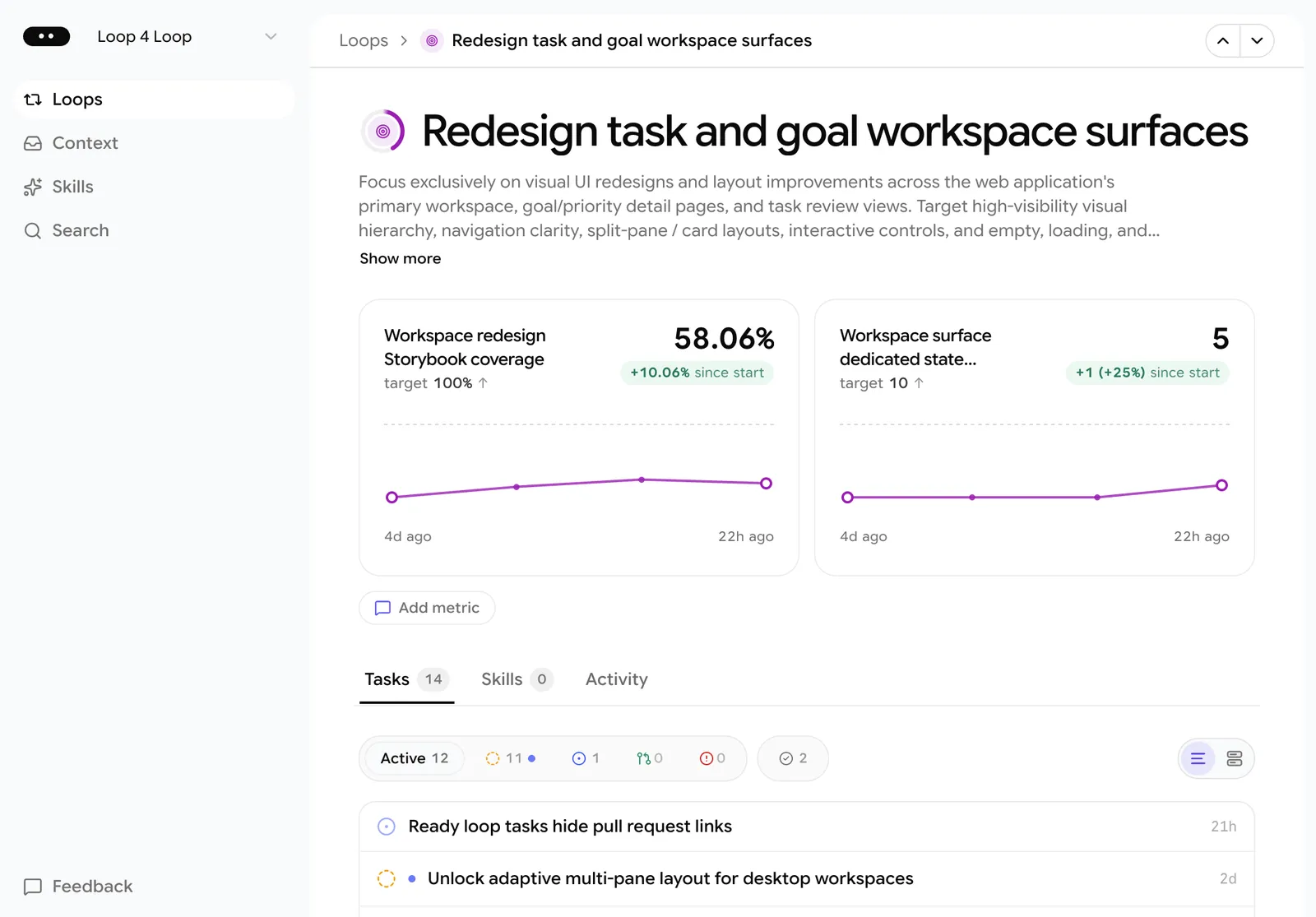
Google Labs unveiled Stitch Loop as an experiment on November 18. When a coding agent builds a feature, its job ends the moment the code is merged, but the real work remains afterward: closing security holes, fixing slow screens, finding out why sign-ups drop off midway. Once you connect a GitHub repository (the place where code is kept) and product data such as logs, user behavior and feedback (more than 180 integrations), Stitch Loop finds what to fix, writes the fix in an isolated space, and then opens a pull request. A pull request is a change proposal that says 'let's fix it this way.'
Every pull request must be approved by a person before it takes effect, so if you do not approve, nothing changes. Security, speed and accessibility checks run separately. For now it is accepting sign-ups only through a waitlist, and pricing has not been announced. It is worth watching if you run an app built through vibe coding, meaning describing it in words and having AI build it, and have never done a security check on it.
ChatGPT Wallet and ChatGPT for Sales — Agents Pay, and Help with Sales

OpenAI released ChatGPT Wallet on November 13. It is a payment method that lets an agent buy things on the user's behalf, built together with American Express, Chase, Mastercard and Visa. Once you register a card, you confirm the item, total and card at each payment and approve with Face ID or a fingerprint. The card company then issues a substitute number (a payment token) in place of the real card number, so neither the agent nor the seller sees the actual card number. At first it opens to ChatGPT Pro subscribers in the United States through dots, OpenAI's always-on assistant.
OpenAI also released a guide for sellers, the Commerce Partner Playbook. It says that if a site's security settings unintentionally block agents, payment fails, so you should check your firewall and CDN (a network of servers that delivers a site quickly around the world) settings so they recognize signed agent requests. If you sell online, it is worth checking now that your site is not blocking AI agent access.
On November 17, OpenAI also released ChatGPT for Sales. It is a Sales plugin that bundles sales tasks such as choosing which customers to pursue, preparing for calls, writing follow-up emails and spotting risky deals into ready-to-use workflows, plus more than 30 partner plugins that connect to tools like HubSpot and Salesforce. ChatGPT Business and Enterprise administrators turn it on in the admin console, and the features available differ by plan and region.
Also — Genie 4 Opens to Subscribers, Genie 3 Extends to 3 Minutes
Google DeepMind's Genie 4, covered in the November 2 roundup, opened to Google AI Ultra subscribers on November 18. It is a model that builds a moving world on the spot from written instructions. This time, while you are inside it, you can change the weather or add characters with text, and it generates sound as well. Pro subscribers can join a waitlist. For the earlier model, Genie 3, the time you can explore at once has been extended from 60 seconds to 3 minutes.
This Week's Checklist — Compare Model Prices, Materials Site, Agent Access
First, compare model prices again. Run one AI task you use often on a mid-priced model such as Gemini 4 Neon or MAI Code 2, and look at the results and cost side by side with the top-tier model you use now.
Second, try turning materials into a site. Put a few meeting documents or reports into Gemini Notebook, build a one-page explainer site with 'make me a site,' and share it with a colleague.
Third, check your site's agent access. As agent payments like ChatGPT Wallet grow, a site whose security settings block agents will miss orders.
| Check item | This week's basis | What to do first |
|---|---|---|
| Compare model prices | Gemini 4 Neon ($3 input, $15 output), MAI Code 2 (GitHub Copilot) | Run one repetitive task on a mid-priced model and compare results and cost |
| Materials into a site | Gemini Notebook 'make me a site' (11-16, web worldwide) | Build a one-page explainer site from meeting materials and share it |
| Agent access and payment | ChatGPT Wallet (11-13, US Pro) and the seller guide | Check whether your firewall and CDN block AI agents |
| Filings after listing | Anthropic Nasdaq listing (11-19, IPO price $83) | Put the quarterly earnings filing dates on your calendar |