
Businesses in ChatGPT — Companies Register Themselves and See Their Exposure Numbers
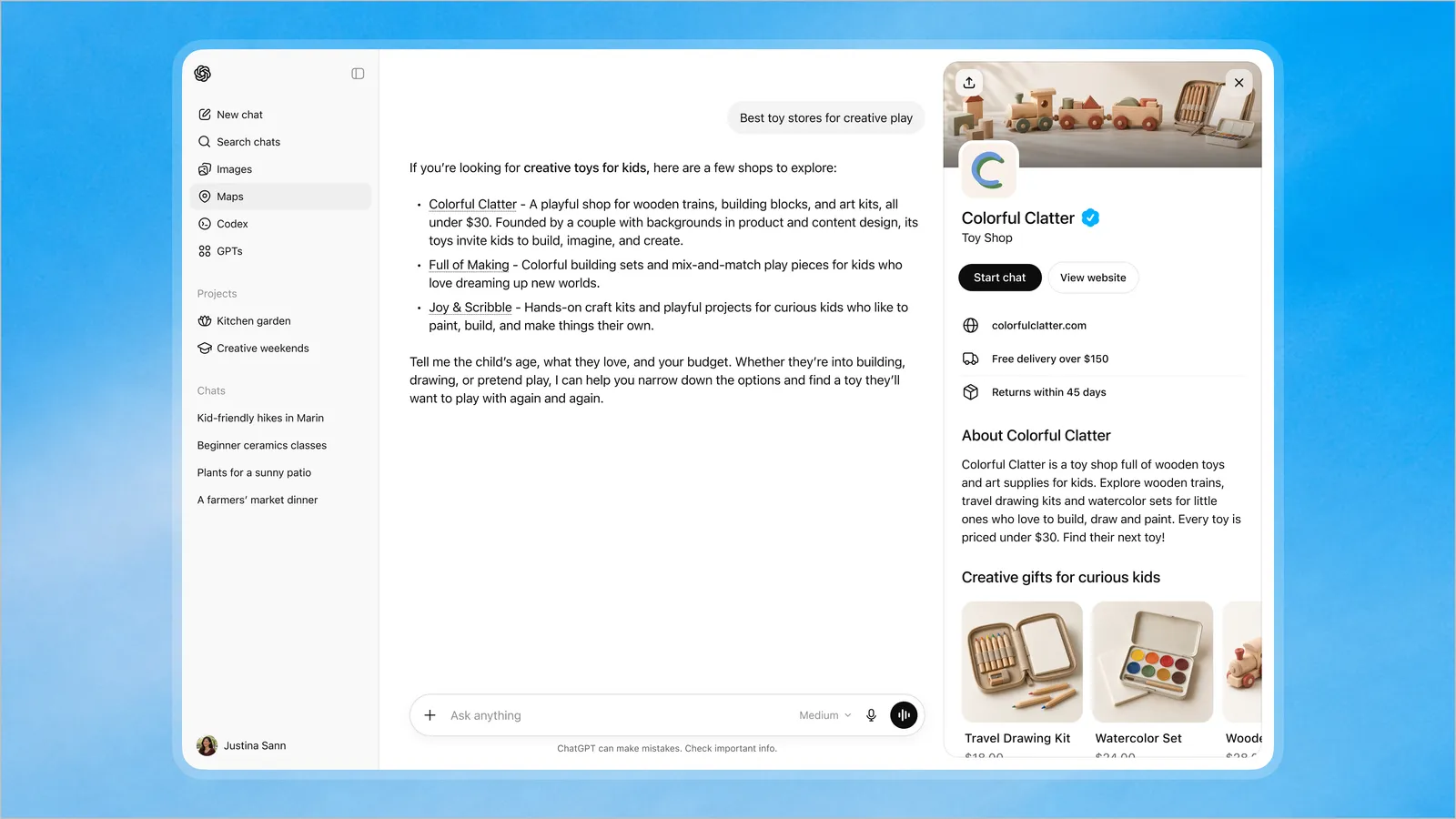
On November 10, OpenAI launched Businesses in ChatGPT in beta. A company registers itself in a management screen called Business Hub and gets verified. After that, it can directly edit the company information ChatGPT uses and upload a product list with prices and stock. OpenAI said 1.2 billion people use ChatGPT every week. Registering a shop on a map app and fixing its opening hours has, in effect, moved into AI answers.
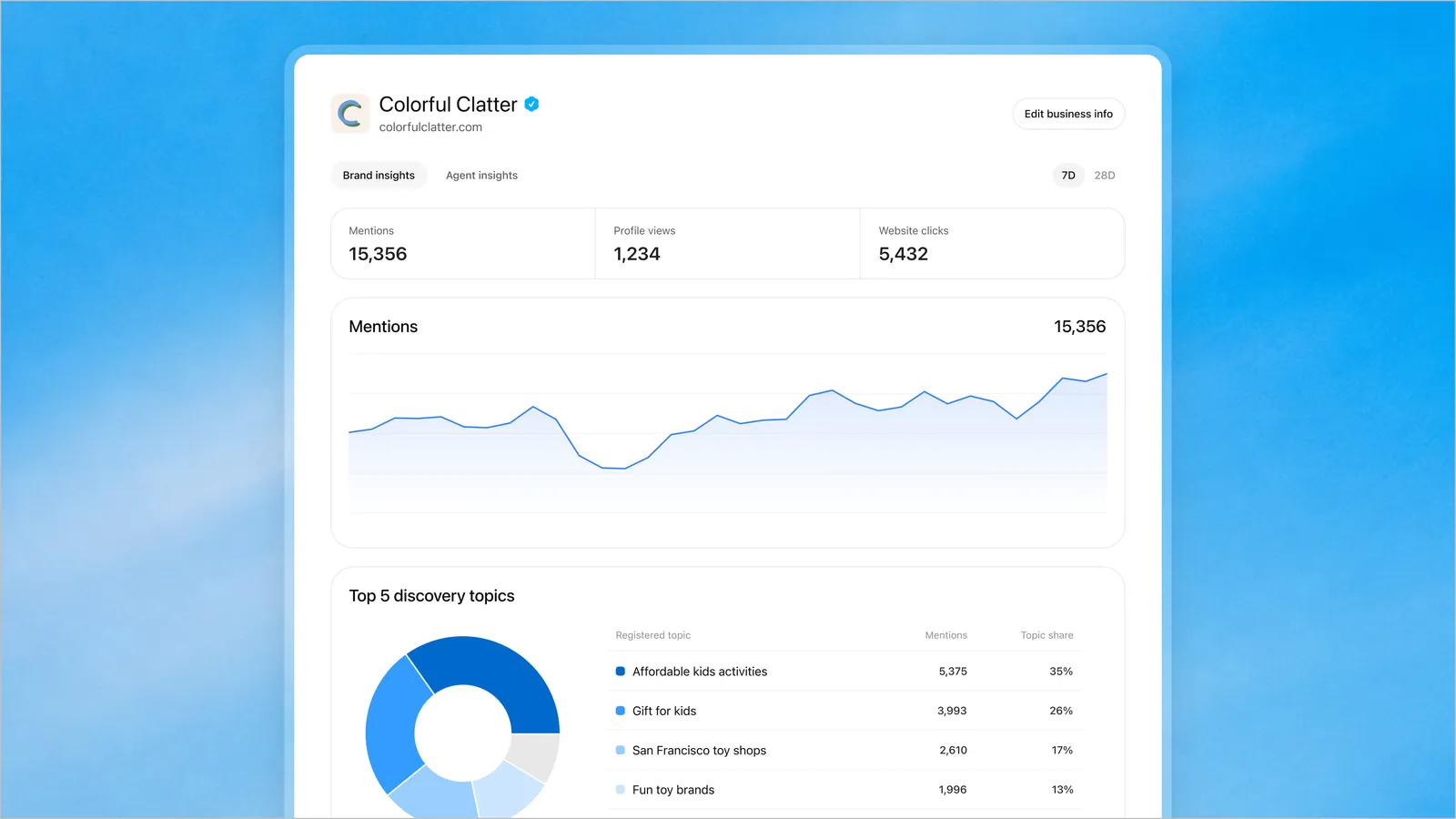
Business Hub also shows numbers: how many times the company was mentioned in ChatGPT answers, how many website clicks it got, and the common themes of conversations that cited the company's website (discovery topics). OpenAI said it does not hand the original user conversations to the company, and shows only grouped figures once conversations reach a certain count. What you used to check in a search engine, the search terms that show your site, you can now check for AI answers too.
OpenAI said any qualified business in a region where ChatGPT is available can apply to register. However, Business Agent, in which a company puts up its own conversation partner, opened first to online shopping and online service businesses in the US, and a Business Agent can also be shown through ads (ads are labeled). If you run a company in Korea, first ask ChatGPT about your company and products to see whether the answers are right, and then check in Business Hub whether you qualify to register.
Gemini 4 Hydrogen — A Fast, Cheap Model Anyone Can Use
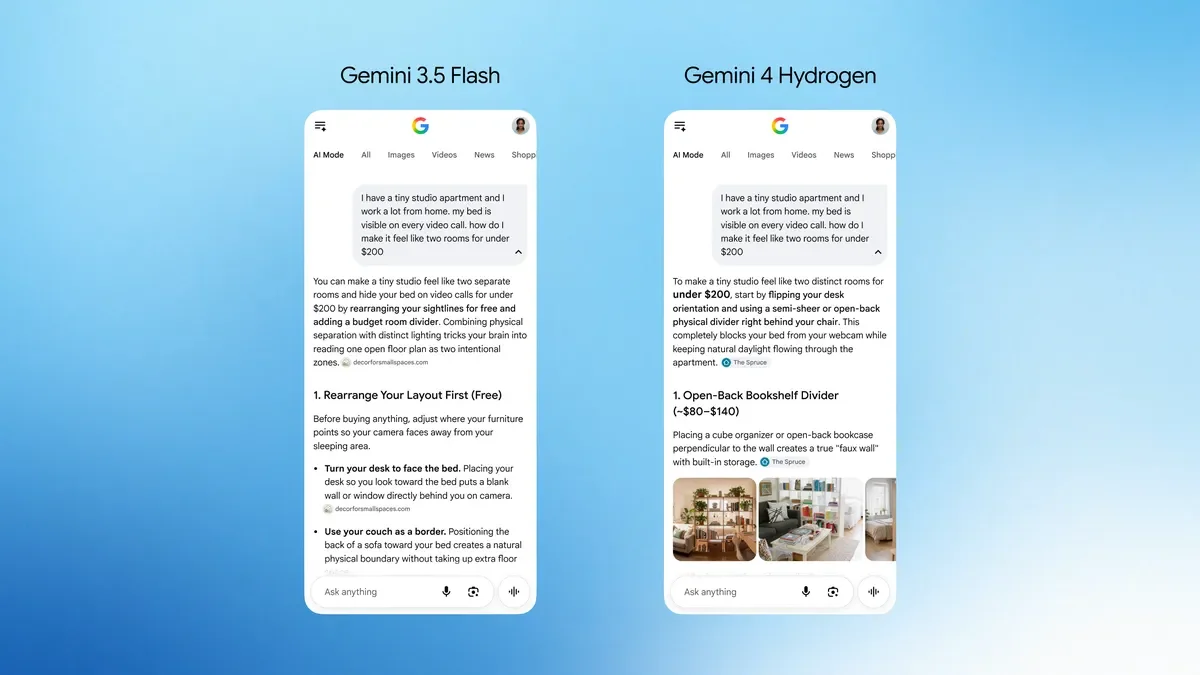
Google released Gemini 4 Hydrogen on November 12. If the top models Carbon and Argon are the ones that think for a long time about hard problems, Hydrogen is the one that handles everyday work quickly. It is open to all users in the Gemini app and Google Search.
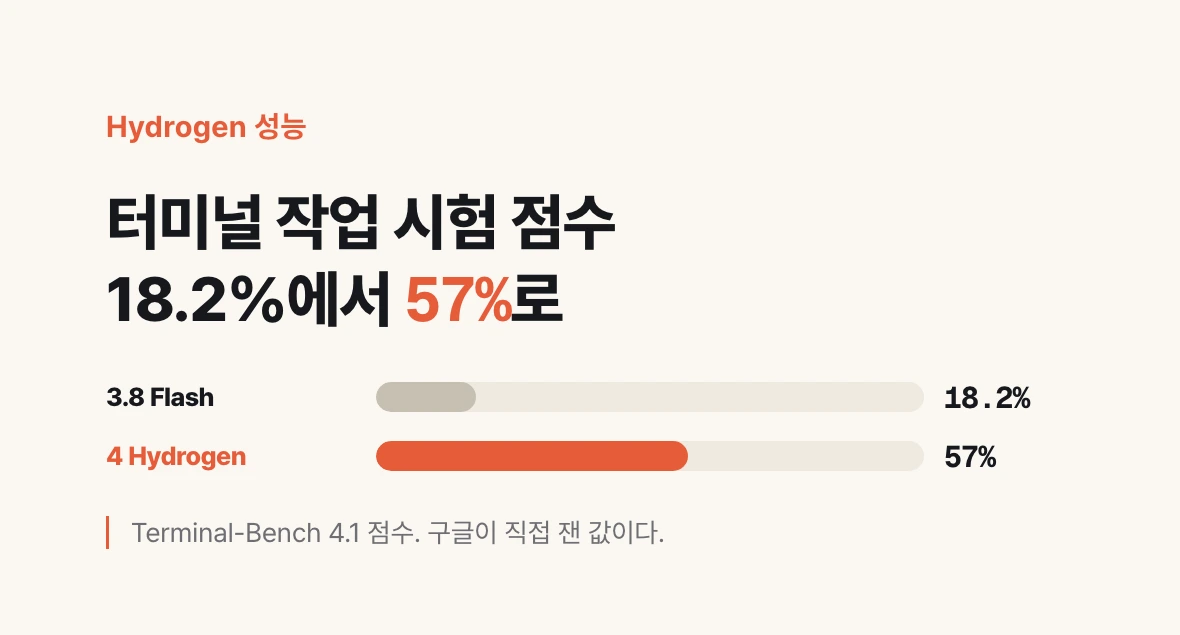
The developer price is $1.5 per 1 million input tokens and $7.5 per 1 million output tokens. A token is the unit AI uses to split text into small pieces and count it. The amount it can read at once (the context window) is 1 million tokens, and the price stays the same even when you feed in a long document. Google said it finishes tasks 2.5 times faster than the previous 3.8 Flash, and that its score on a terminal-work test (Terminal-Bench 4.1) rose from 18.2% to 57%. These are figures the company measured itself.
At work, a good split is to give Hydrogen the jobs you repeat often, such as email drafts, document summaries, and organizing tables, and pass only the hard-to-judge work to a higher model. Google also released a feature in its development tool Antigravity that lets you switch between Carbon and Hydrogen within a single task.
Gemini 4 Carbon — The API Introductory Price Lasts Until November 30
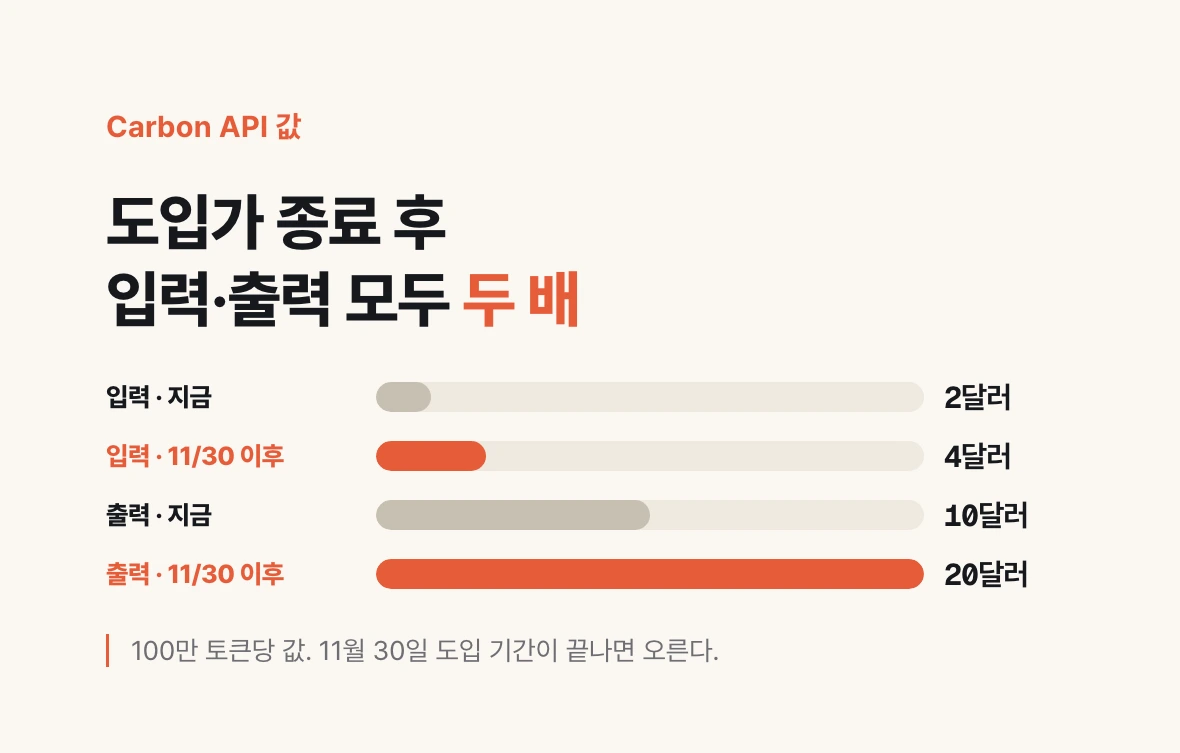
Gemini 4 Carbon, which had been open only to security researchers two weeks ago, was released publicly on November 10. The API is available to all paying developers and companies, while in the Gemini app, Search AI Mode, and Antigravity only subscribers to the top plan, Google AI Ultra, can use it.
The price is now $2 per 1 million input tokens and $10 per 1 million output tokens. But this is an introductory price. According to a footnote in Google's announcement, when the introductory period ends on November 30, it doubles to $4 for input and $20 for output. If you are testing Carbon through the API, assume the same work costs twice as much from December and redo your budget.
Claude Fable 5.2 — Faster, but Everyday Work Starts with Opus 5.5
On November 9, Anthropic released its top models Claude Fable 5.2 and Mythos 5.2. They are the same model, and Fable is the version opened to all users with safeguards added to block cybersecurity and biology misuse. It produces answers up to 30% faster than 5.1, and costs $8 per 1 million input tokens and $40 per 1 million output tokens.
Anthropic itself recommends starting most coding and document work with Claude Opus 5.5 and moving up to Fable only when the job is big and hard. Don't make the expensive top model your default; the way to manage cost is to bring it out only for stuck designs and analysis.
A Judgment-Only API and a Small Model — Give Classification to the Cheap Model
On November 11, Google released the Gemini Decisions API. Instead of writing long text, it is a channel that returns probabilities and confidence levels for questions with fixed answers, such as 'yes/no', 'pick one of the options', and 'assign a grade'. You can ask up to 1,000 questions in one request, and it costs $0.1 per 1 million input tokens with no output charge. It is used for sorting inquiry emails, checking document photos, and choosing which model to hand a job to.
Meta released its smallest model, Muse Ember. Up to 200,000 tokens, it costs $0.1 per 1 million input tokens and $0.5 per 1 million output tokens, and is tuned for repetitive coding assistance, tool calls, and document summaries. Both pieces of news point the same way: hand judgments with fixed answers and repetitive work to small, cheap models instead of big ones to cut costs.
Anthropic's IPO — Offering Price of $70 to $78 per Share
On November 10, Anthropic began its IPO presentations (roadshow). A roadshow is the step before listing where a company meets investors and explains itself. The offering is 825 million shares, and the offering price was put at $70 to $78 per share. It applied to list on Nasdaq under the ticker symbol 'ANT'.
Among the items we wrote as 'listing date and offering price not yet set' in the November 2 roundup, the offering price range has now come out. The company has not officially announced a listing date, though reports citing people familiar with the matter say trading is planned to start on November 19. As of the November 10 announcement, the registration filing with the US Securities and Exchange Commission had not yet taken effect. These numbers are only the range the company proposed, not the final offering price.
Also This Week — Adobe's Agent and Deploying Vibe Coding Apps
At Adobe MAX on November 10, Adobe expanded Adobe Creative Agent, which carries on work on your behalf, to Premiere, Illustrator, InDesign, After Effects, and Frame.io (beta). It also opened Firefly Design, which creates multiple media formats on one screen, in beta. A connection feature (MCP) that lets outside AI agents directly edit Photoshop and Premiere files on a user's computer is due in a private beta in early 2027.
Automattic, the company behind WordPress.com, released Spacefast on November 9. It is a service that takes websites and apps made with vibe coding, meaning describing what you want in words and having AI build it, adds a database, login, file upload, email, and visitor analytics, and puts them live. You start by connecting an AI such as ChatGPT or Claude, or a Git repository. If your company has landing pages the marketing team made with AI scattered across several services, it is a candidate for bringing them into one place.
This Week's Checklist — Listings, Model Prices, and Splitting the Work
First, check your company in AI answers. Ask ChatGPT using your company and product names to see whether the answers are right, and check whether you qualify to register in Business Hub.
Second, put the change in model prices on your calendar. The Gemini 4 Carbon API introductory price ends on November 30, and from December it doubles.
Third, split work by size. Give repetitive work to small models such as Hydrogen and Muse Ember, fixed judgments to the Decisions API, and only stuck designs and analysis to top models such as Fable and Carbon.
| Check Item | This Week's Basis | First Step |
|---|---|---|
| Company info in AI answers | Businesses in ChatGPT beta (11-10) — register, edit information, see mention and click counts | Ask ChatGPT by your company name and check Business Hub eligibility |
| Top model cost | Gemini 4 Carbon API input $2 to $4, output $10 to $20 (after 11-30), Fable 5.2 input $8, output $40 | Recalculate your API testing budget at December prices |
| Everyday work model | Gemini 4 Hydrogen input $1.5, output $7.5; Muse Ember input $0.1, output $0.5 (per 1 million tokens) | Run one repetitive task on a small model and compare the results |
| Fixed judgments | Gemini Decisions API input $0.1, no output charge, up to 1,000 questions per request | Pick one job with a fixed answer, such as inquiry sorting, and test it |