You have probably had that moment
Writing thank you at the end of a conversation with an AI. Typing nice work when the answer was good. Adding sorry to bother you before an unreasonable request.
And then feeling slightly odd about it. It's a program. You know that.
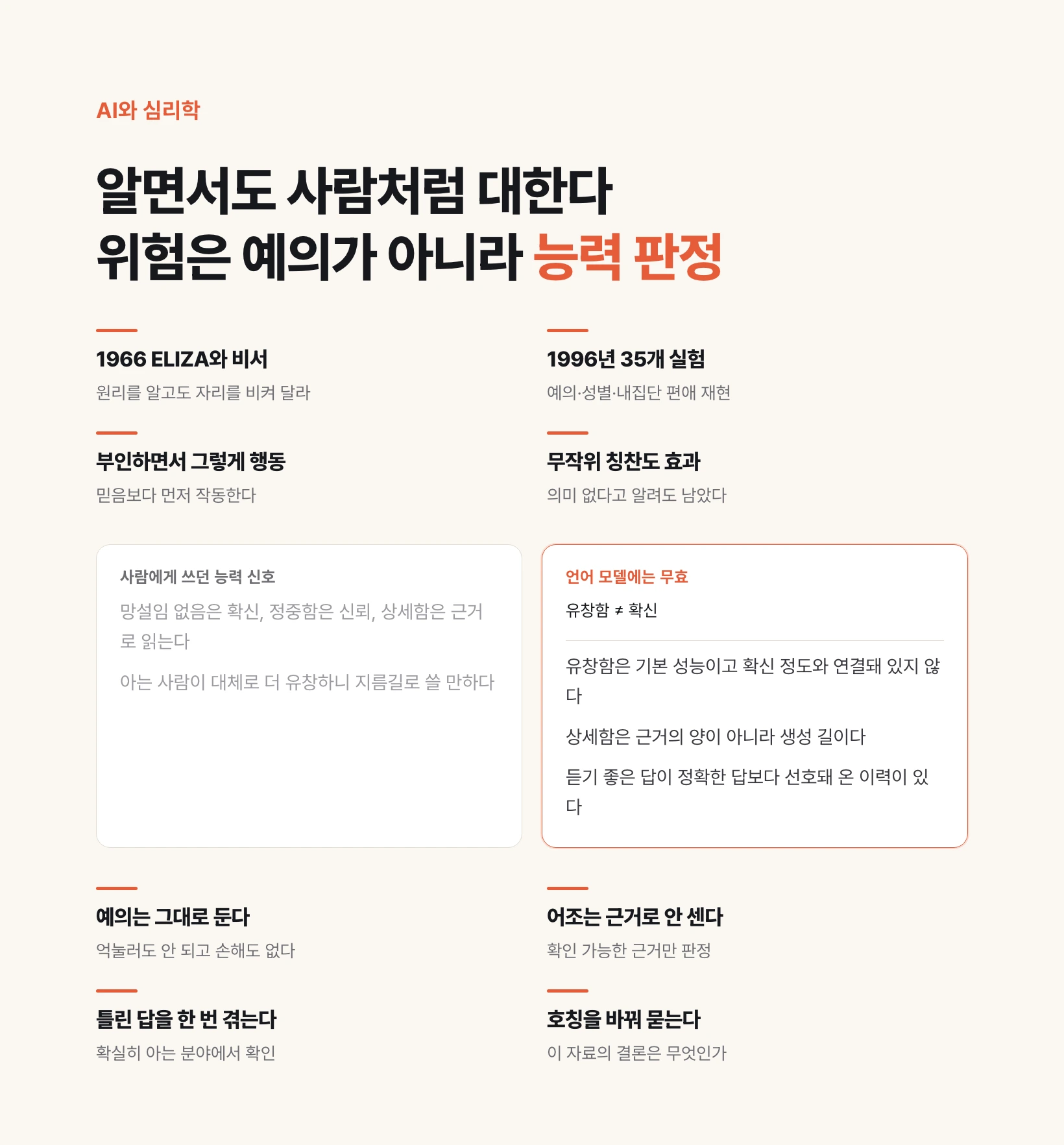
That reaction is not an exception but a rule that has held for sixty years, and it carries the name of the place where it was first observed. The point of this episode is not to tell you to drop the habit. What the data says is that you cannot, and that therefore a different response is needed.
1966: a program of a few rules
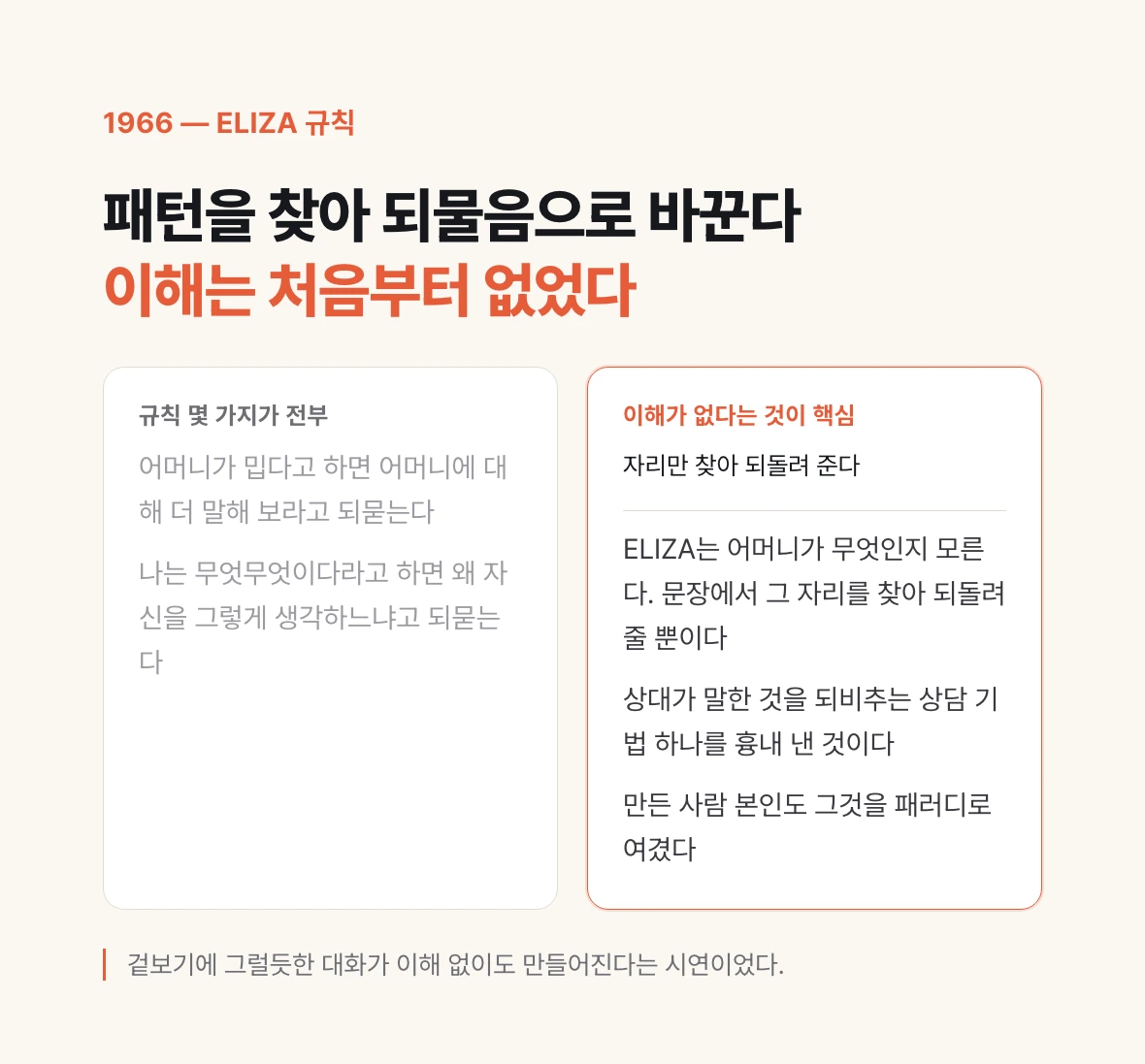
ELIZA, built by Joseph Weizenbaum at MIT, is modest by present standards. It is a handful of rules that find certain patterns in what you say and turn them into a question back. Say you hate your mother and it asks you to say more about your mother; say I am something and it asks why you think of yourself that way.
The key is that there is no understanding. ELIZA does not know what a mother is. It finds the slot in the sentence and hands it back. It imitated one counseling technique, reflecting back what the other person said, and Weizenbaum himself regarded it as a parody.
What he meant to show with the program was how thin conversation between a person and a machine is. It was a demonstration that plausible looking dialogue can be produced with no understanding behind it.
The opposite happened.
The person most surprised was its author
People began confiding in ELIZA in earnest. After a few exchanges, personal matters came out.
The most famous scene is this. His secretary, while using ELIZA, asked him to leave the room. She had watched this program being built. Knowing the mechanism and how one feels in front of it turned out to be separate things.
It was not only laypeople. Several psychiatric researchers seriously proposed that the approach could be used for real counseling at scale. To Weizenbaum this was the greater shock. It meant experts thought the work of dealing with human problems could be handed to pattern substitution without understanding.
He changed direction after this and spent the rest of his life writing warnings about technology. The line from his 1976 book is the point: I had not realized that extremely short exposures to a relatively simple computer program could induce powerful delusional thinking in quite normal people.
Note the phrase quite normal people. This is not a story about the gullible.
1996: thirty five experiments

Thirty years later Byron Reeves and Clifford Nass turned this from anecdote into data. Their method was clever. They took classic social psychology experiments about person to person relations and reran them with one of the people replaced by a computer.
The results pointed one way. People return a computer's politeness with politeness. Asked by a computer to evaluate its own performance, they rate it more generously than they rate the same thing on a different computer. Just as with people, they are reluctant to be harsh to its face.
Give a voice a gender cue and gender stereotypes follow. Saying identical things, a male voice was rated more competent on certain topics.
Tell people a computer is on their team and in group favoritism appears. The same advice is accepted more readily and rated more highly when it comes from the team's computer.
Thirty five studies pointed at the same place from different angles. People treat media like real people and real places.
They denied it and behaved that way anyway
The most important part of this work is not the results but the participants' self reports.
Asked afterward, participants explicitly denied that a computer was the sort of thing that deserved such treatment. They said there was no reason to be polite to a computer, and did not accept that they had behaved that way. The data says they did.
That mismatch carries weight. It means the response is automatic processing rather than judgment. Social cues come in, a social response goes out, and it operates before any belief about what the other party is.
Why does that matter practically? Because it means you cannot remove it by correcting a belief. Repeating to yourself that this is just a program does not stop the response. So the response should not be to suppress the reaction but to block where it leaks.
Praise works even when it is random
One experiment from the same line of work shows this automaticity especially clearly.
Participants work on a task with a computer that praises them along the way. In one condition they are told in advance that the praise comes at random and has nothing to do with performance. It is stated plainly to be meaningless.
Even so, the participants who received praise felt better, rated their own performance higher, and viewed the computer more favorably. Knowing it was meaningless did not remove the effect.
This meets the sycophancy from episode five. That was about AI being trained to match people; this is about people being wired to respond to that matching. The two properties face each other. One side learned to produce pleasant answers, and the other side is genuinely persuaded by pleasant words.
So the danger is not politeness
A common misreading has to be cleared up here. The conclusion of this research is not that saying thank you to an AI is foolish.
The real danger is elsewhere. Treat it like a person and the judgment habits you use on people come along with it.
Dealing with people, we use three things as signals of competence. Speaking without hesitation reads as confidence, speaking politely and coherently reads as trustworthy, and speaking in detail reads as well grounded.
With people those three are usually workable cues. People who know their subject generally speak more fluently, and people who prepared generally give more detail. There is enough correlation to use them as shortcuts.
With a language model all three are void. Fluency is simply baseline capability and is not tied to how confident it should be. Detail is generation length, not quantity of evidence. And as episode five showed, well written pleasant answers have a history of being preferred over accurate ones. So these cues are not merely useless; they can mislead in the opposite direction.
One term only: anthropomorphism
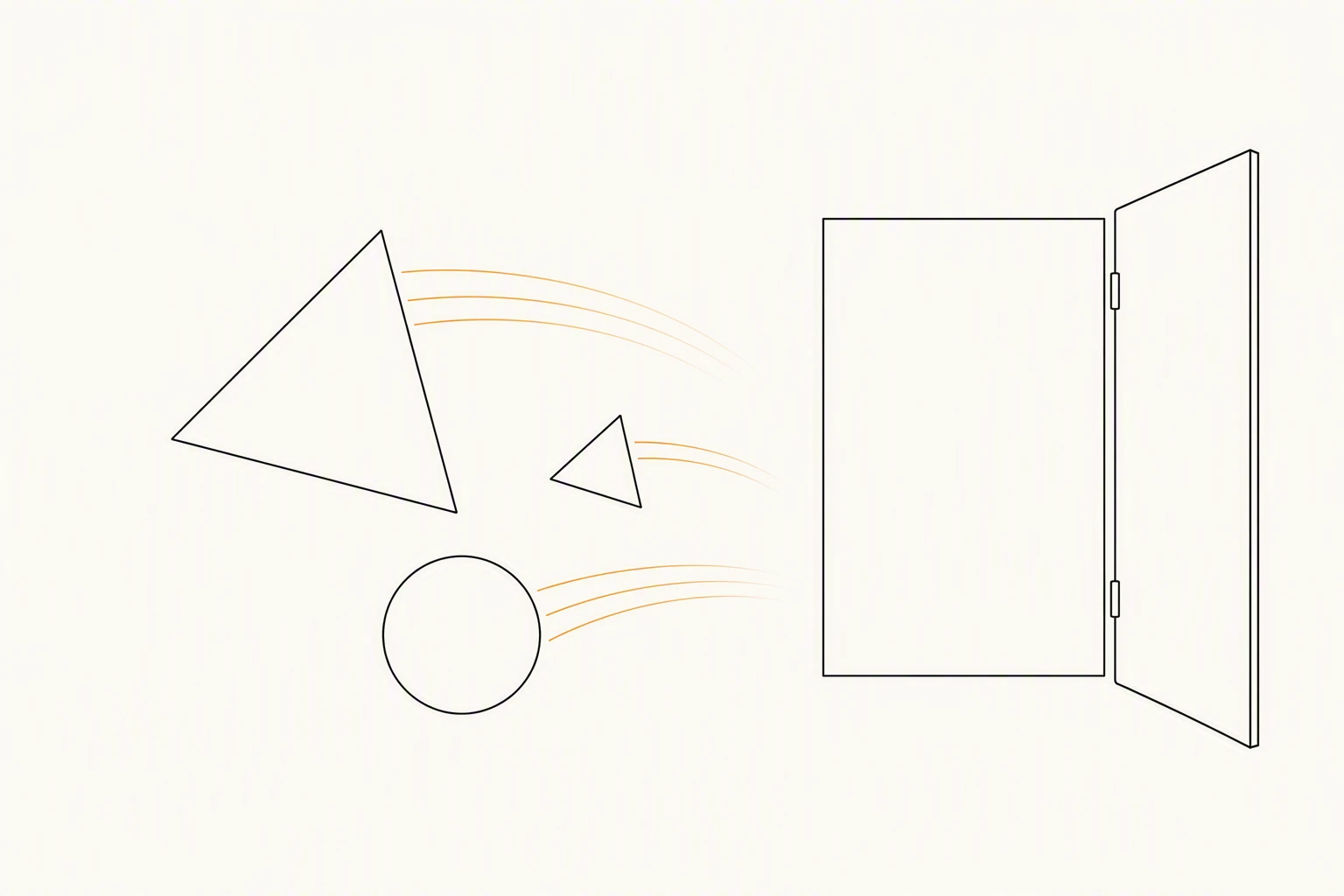
Anthropomorphism is attributing inner states such as beliefs, intentions and emotions to something that is not a person.
The thing to note is that it is not an error but a default. People read intention into moving shapes. In an old experiment, showing a short animation of a triangle and a circle in motion, people describe it as chasing, fleeing and bullying. They see it that way knowing they are shapes.
So not anthropomorphizing cannot be the goal. The goal is separating how far it is safe to anthropomorphize from where it stops being safe. Politeness is the safe zone; judging competence is the dangerous one.
The direction in which this effect is growing
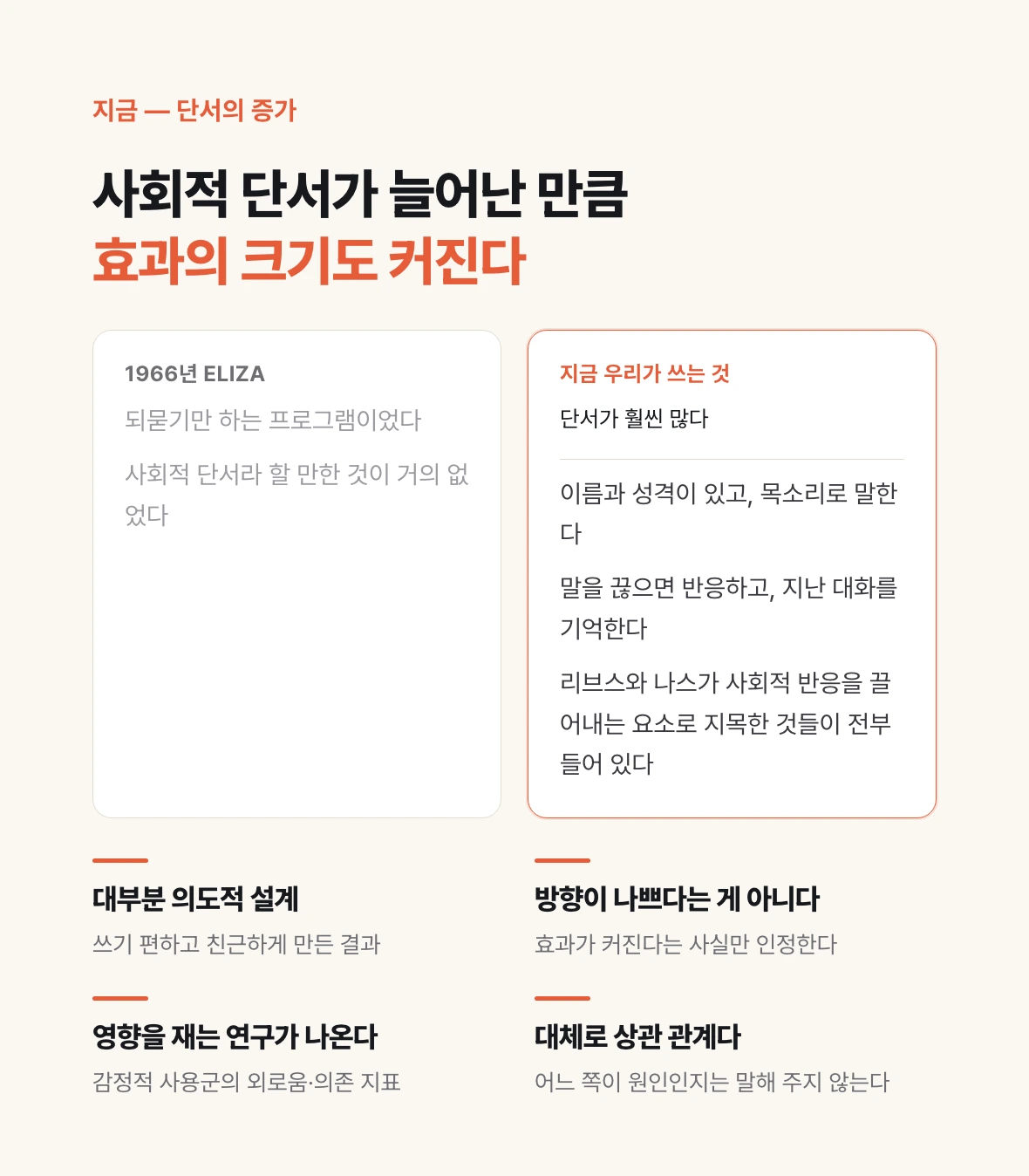
The ELIZA of 1966 was a program that only asked questions back. What we use now carries far more social cues than that.
It has a name and a personality, it speaks in a voice, it responds when you interrupt, it remembers previous conversations. Everything Reeves and Nass identified as eliciting social response is in there. And most of it is deliberately designed, the outcome of decisions to make the thing easy and pleasant to use.
That direction is not being called bad. But the fact that the size of the effect grows has to be acknowledged.
Recently research has appeared measuring what this use pattern does to people. Observations have been reported that among users who make heavy emotional use of conversational AI, indicators of loneliness and dependence run higher, though such results are largely correlational and do not tell you which way the causation runs. What is telling is simply that the question is now something people measure.
This is why the badge on this episode is design principle. Here psychology does not explain the AI's algorithm. It explains the person using the AI, and so it governs how it should be used.
So what changes tomorrow
Keep the politeness. There is no reason to fight it. It is automatic, so effort spent suppressing it is wasted, and a polite prompt costs nothing in output quality. If that way of writing feels natural and comfortable, leaving it alone is better.
Instead, stop reading tone as a signal of competence. There is exactly one place to judge: does this claim come with verifiable grounds? Absence of hesitation, level of detail and politeness are not grounds. Hold that one line and the practical value of this episode is fully recovered.
Deliberately meet one confidently wrong answer. Ask a verifiable question in a field you know well until you get a wrong answer, and how unruffled the tone is will stay with you physically. This is the cheapest inoculation in this episode, and the same place as episode six's rule that the more perfect the formatting, the more you should doubt.
For important judgments, change how you address it. Not what do you think, but what conclusion follows from this material. A sentence that addresses the other party as a person also summons the judgment habits you use on people. Change the form of the sentence and your own reading posture shifts a little.
And one question to ask yourself. Am I believing this answer because of its grounds, or because it is well written?