A chat window you used alone has become a team workspace
On September 29 (local time), OpenAI made more than 20 announcements at its developer event DevDay, and the biggest shift is on the team side. ChatGPT Space is a shared home where teammates, ChatGPT and OpenAI's always-on agent dot build on the same material. An agent is an AI program that takes a goal and works through several steps on its own. Leave instructions and ChatGPT keeps the space organized. It runs in the desktop app and on the web for Pro, Business and Enterprise plans; on mobile, finding, reading and sharing come first.
Pages is a new kind of document that people and agents edit together. Create a page from a conversation, invite teammates for feedback, and write, research, build charts or generate images right inside it. Slides that several people can edit at once arrive in the coming weeks. On Business and Enterprise, recurring work such as weekly updates can be handed to team tasks that run on a schedule or when a new email or Slack message arrives. A plugin is a part that adds outside capabilities to ChatGPT; the Meetings plugin (beta) in the macOS desktop app saves meeting notes and action items to Space and deletes the audio once the notes are ready.
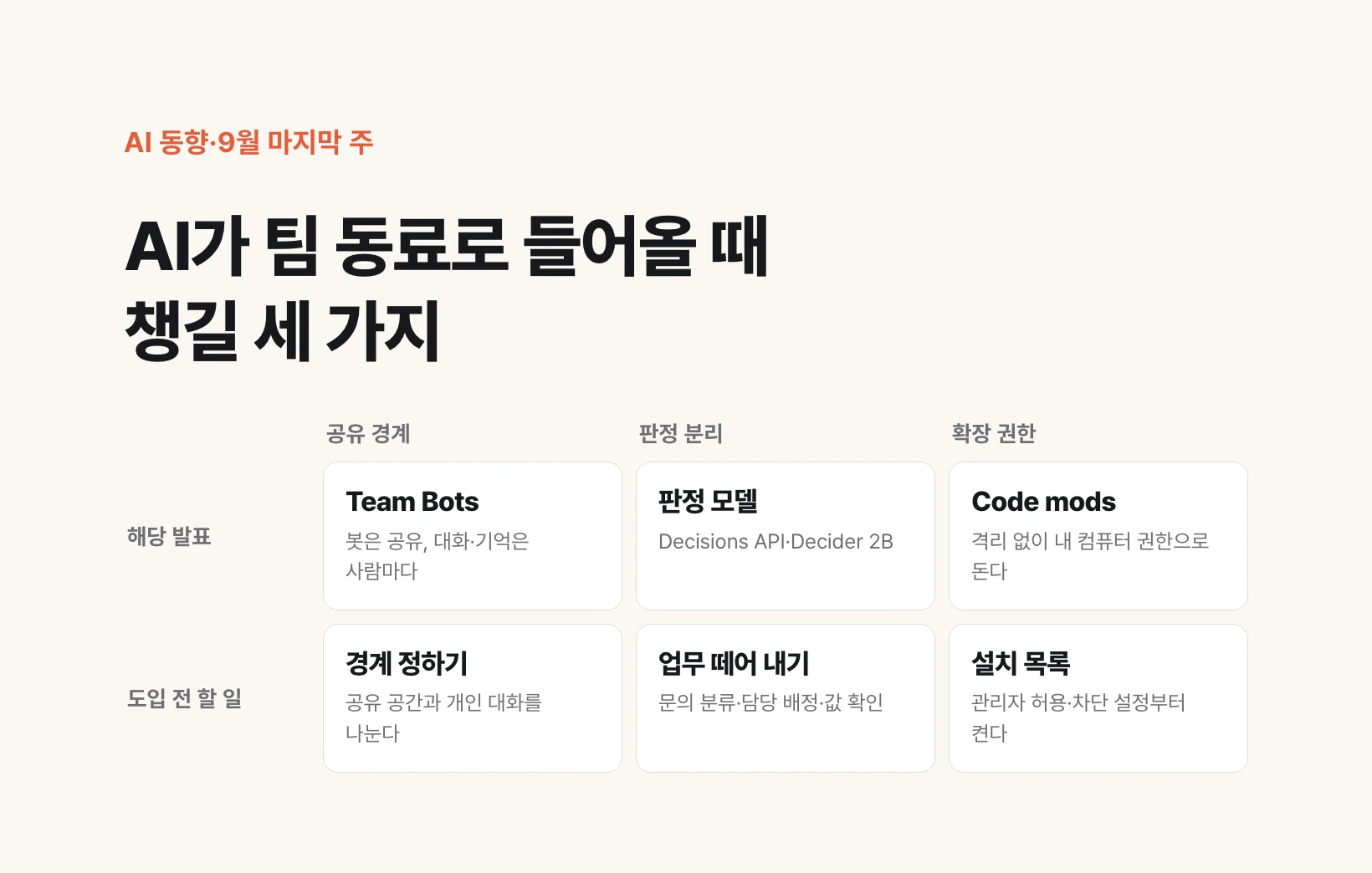
A day earlier, on September 28, xAI launched Grok Team Bots in public beta on Teams and Enterprise plans. You build a bot around a single role, give it files and instructions, connections to work apps, keys for outside services and memories of what it learns on the job, then share it with the team. The team uses the bot together, but each person's conversations and memories stay separate. In Slack it joins under its own handle and takes questions in channels. xAI said that internally each major sales account has its own bot, which reviews call records, documents and Slack threads overnight and posts each person's next steps every morning.
Reshaping an AI tool to fit team rules — Claude Code mods
On October 1, Anthropic added mods to Claude Code, its AI tool that does coding work through conversation. A mod is a short TypeScript function (TypeScript is a programming language widely used in web development) that hooks into the signals Claude Code emits whenever it calls a tool, asks for permission or draws the screen. It can run before or after that event, or instead of it. You can write one yourself or ask Claude Code to write it.
Mods can do what the existing hooks (a mechanism that runs a command at a set point) could not. They can strip secrets from tool output before Claude reads it, add buttons and inputs to the screen, and replace built-in features. The built-in /diff feature is now a mod, so you can turn it off or swap in your own. For teams, Anthropic gave examples such as a mod that shows the status of automated checks in a pane beside the conversation, one that requires confirmation before any command touches production settings, and one that records every call other mods make.
The caveat is clear. Mods are not sandboxed; they run on your machine with the same access as Claude Code, and Anthropic says to install them only from sources you trust. Because mods ship inside plugins, existing controls that let admins allow or block plugin marketplaces still apply. On Team and Enterprise plans and on machines with managed settings, a built-in mod called sec-default loads first and stops user-installed mods from risky actions such as overriding permission deny rules.
Hand pick-one work to small decision models — Decisions API and Strands Decider 2B
A decision model picks one answer from a fixed set of options and returns a score for how far you can trust that answer. It cannot write text, but in exchange it is fast and cheap. It fits work where the answer sits among the options, such as deciding whether an inquiry goes to billing, sales or a store.
At DevDay, OpenAI released the Decisions API in limited preview. An API is the doorway through which programs exchange functions. Developers supply a question, a fixed list of answers and context as text or images, and the Luna model picks from that list. OpenAI says it is meant for classifying content, routing requests and choosing an agent's next action, and plans a broad release within days.
On October 1, the team behind Strands Agents, an open-source toolkit for building agents, released the decision model Strands Decider 2B. Open source means the code is published for anyone to take and modify. It is a small model with 2 billion parameters (the internal numbers a model tunes during training): the team took the language model Qwen3.5-2B, removed the part that generates text and attached a component that scores each option. It published even the training data and scripts on GitHub and Hugging Face. The team reported a median decision time of about 115 milliseconds on an RTX 3090 graphics card and about 153 milliseconds on an M3 MacBook for small tasks.
The Strands team wrote that this class of model has drawn attention since TypeSafe AI launched Jev in September, and listed uses such as choosing a model, choosing a tool and safety checks. In its public example, when an agent invents a city the user never mentioned to call a weather tool, the decision model first asks whether that value came from the user, so the agent asks the user instead. Splitting hard judgments to large models and repetitive easy ones to decision models cuts cost and waiting time, the team explains.
On the model side: writing longer, speaking faster
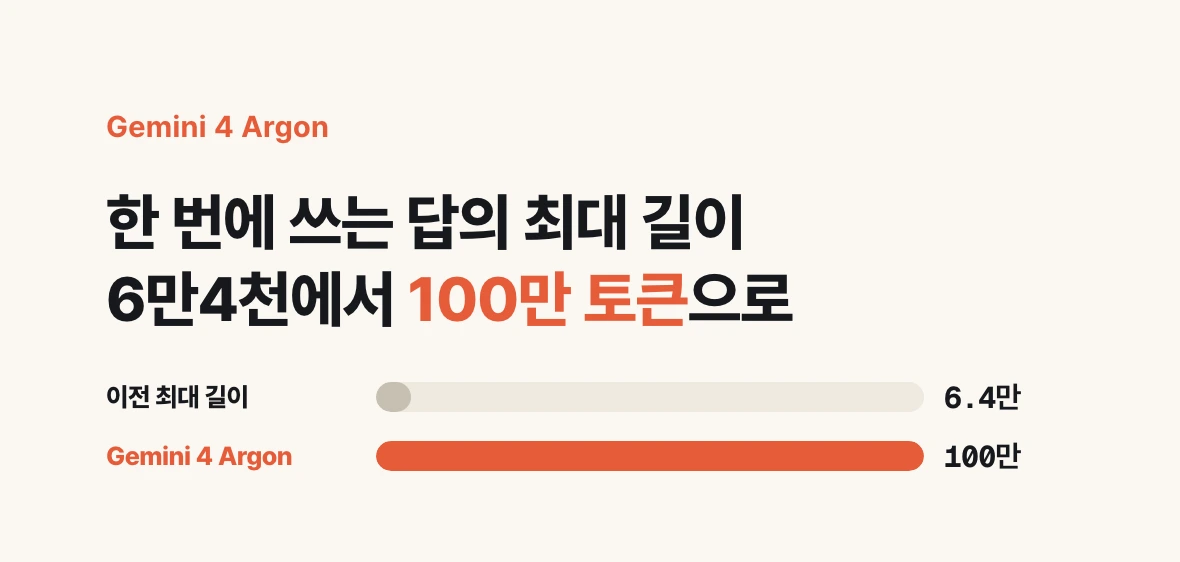
On September 30, Google announced Gemini 4 Argon. It raises the maximum length of a single answer from 64,000 tokens to 1 million. A token is the small piece AI cuts text into when it reads and writes. The design aims to finish long code migrations or multi-step research in one go. Google said it already uses the model internally to move C/C++ code to Rust (a programming language strong at preventing memory mistakes), and that it reworked the Rust version of libgav1, its video-decoding software, to run 2.7 times faster.
The rollout is staged. It goes first to trusted cyber defenders through the Fairwind Program, who receive it without cyber guardrails, and then to paid API customers and Google AI Ultra subscribers. The introductory price is $2 per million input tokens and $10 per million output tokens, rising to $4 and $20 after the introductory period.
On the voice side, response times have shrunk to the length of a pause in human conversation. On September 28, ElevenLabs released the speech model Eleven v4 and its fast-response variant v4 Turbo. Turbo has a median of about 150 milliseconds from request to first sound; both models speak more than 90 languages and clone a voice from a 10-second recording. On October 1, Microsoft released MAI-Transcribe-2-Streaming, a real-time transcription model. It produces its first draft transcript just over 100 milliseconds after receiving audio, before the speaker finishes, revises it as it goes and handles 60 languages, at $0.54 per hour of audio through the end of the year. MAI-Voice-2.1-Flash, a speech model released the same day, costs $15 per million characters.
On the image side, Ideogram 4.5 promotes editing that holds up across many rounds. The company says it reduces the pixel shifts and color changes each edit introduces, and edits part of a high-resolution photo without shrinking it.
Three things to check before bringing an AI coworker onto a team
First, what the team sees and what stays with you. Team Bots are shared but keep each person's conversations and memories separate, and the Meetings plugin lets you choose whether notes stay private or go to the team. Before adopting, decide which material goes into shared spaces and which stays in personal conversations.
Second, whether you are handing pick-one work to a large model. Classifying inquiries, assigning owners and checks like 'did the user actually say this value' all have answers within fixed options. Splitting that work off to a decision model is faster and cheaper, and every answer comes with a number for how far to trust it.
Third, what permissions your add-ons run with. Claude Code mods run with your machine's access and no sandbox, and Team Bots receive keys to outside services. Keep a list of who installed what, and turn on admin-level allow and block settings first.
| Check | Evidence from this week's announcements | First step |
|---|---|---|
| Shared vs. personal | ChatGPT Space and Pages, per-user conversations and memories in Team Bots, the sharing choice for Meetings notes | Separate material for shared spaces from material that stays in personal conversations |
| Decision vs. generation | OpenAI Decisions API, Strands Decider 2B | List tasks whose answers sit within fixed options, such as classifying, assigning and checking |
| Add-on permissions | Claude Code mods (no sandbox, sec-default), outside-service keys for Team Bots | Keep an install list and set marketplace allow and block rules |